

Leaving behind the hustle and bustle of the coastal region, our journey took us to Tlemcen – a city in the northwest, more than 500 km from the capital Algiers.
From the cool interiors of caves to the sun-drenched courtyards of palaces, everything seems to entice visitors to slow down and listen to the stories of bygone dynasties.
Our journey began with a rather unexpected experience: venturing deep into the mountains to the Béni Add caves. Located about 30km from the city center, more than 50m underground, Béni Add, millions of years old, is one of North Africa's greatest geological wonders.
As soon as you step through the cave entrance, the dry heat of the highlands immediately disappears, giving way to a cool atmosphere. Under cleverly placed lights, giant stalactites and stalagmites appear in all sorts of strange shapes.
Here are soft, silken curtains of stone, there are towering stone columns supporting a deep vaulted ceiling.
The space is so quiet that you can clearly hear the steady dripping of water from the cave ceiling. But Béni Add is more than just a geological wonder.
During the arduous years of war, this cave served as a strong natural fortress, sheltering Algerian revolutionary fighters struggling for independence.
"This is truly a masterpiece of nature," exclaimed a tourist from China, his eyes wide with amazement at the grandeur of the stone sculptures sculpted over millennia.
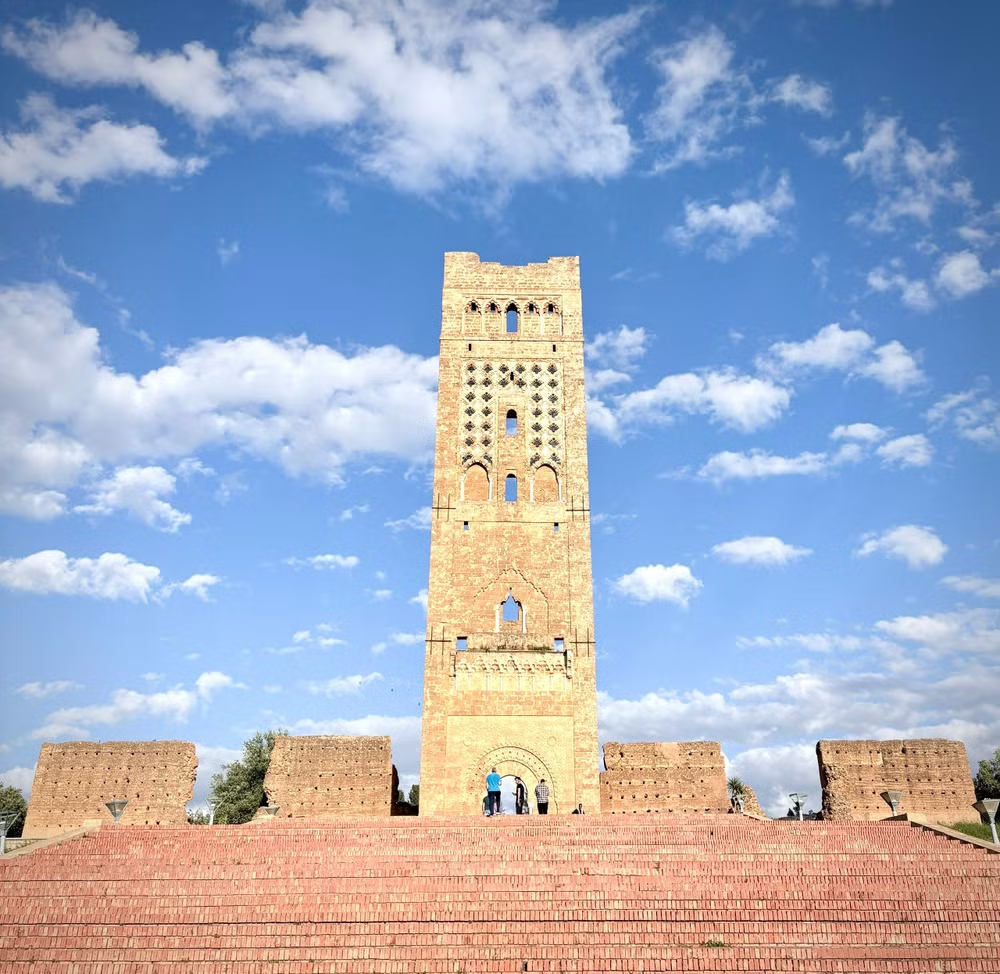
Back on solid ground, we journeyed back in time to the 13th century, stopping before the ruins of the Mansourah, the proud minaret of an ancient mosque.
In the vast expanse, the stone tower, clad in a time-worn orange-yellow hue, stands tall as the last remaining testament to a fortified stronghold, erected by the Marinid dynasty during the historic siege of Tlemcen.
Although much of the church has been ravaged by wars and the ravages of time, this nearly 40-meter-tall tower still retains its solemn, proud appearance. The cracked walls and gaping arches looking straight up at the deep blue sky resemble the scars of history.
"People call this the city of victory (Mansourah), but for us, it's a lesson in resilience," a local guide said, pointing to the cracks of time on the tower.
Memories in the heart of the city
To understand the cultural roots of Tlemcen, the National Museum of Art and History is a must-visit. Located right in the city center, the museum houses a vast collection of antiquities, spanning from prehistoric times and Roman periods to the great Islamic dynasties of Almoravid, Almohad, and Zayanid.
Here, I was captivated by the collection of ancient gold and silver coins, the handwritten maps in saffron ink, and especially the traditional Chedda wedding dress of the Tlemcen bride – a masterpiece of textiles that has been recognized by UNESCO as an Intangible Cultural Heritage of Humanity.
A few steps away is the Tlemcen Grand Mosque, one of the oldest structures in North Africa, dating back to the 12th century.
As soon as you step through the heavy wooden door, the hustle and bustle of the city outside suddenly disappears, giving way to a tranquil, spiritual space.
Brilliant sunlight streamed down the spacious courtyard, where a marble purification basin stood. Inside the main hall, the horseshoe-shaped arches characteristic of Moorish art were supported by dozens of stone columns.
The most exquisite detail is the enormous bronze chandelier hanging from the vaulted ceiling, illuminating the intricate plaster reliefs inscribed with flowing Arabic calligraphy.
A warm dance, the flavor of the highlands.
After a morning engrossed in history, we stopped at a traditional restaurant. And there, the warm hospitality typical of the Algerians left us with an unforgettable memory.
As soon as we stepped through the door, the space was filled with music. A group of musicians in traditional costumes surrounded us. The high-pitched, resonant sound of the ghita blended with the rapid, powerful rhythm of the derbouka and bendir drums, making the listeners' chests vibrate with each beat. The musicians played and danced to ancient folk dance steps.
Their radiant smiles and enthusiasm immediately dispelled any language barriers or the fatigue of the long journey. Soon, our entire group, even the most reserved, was swept up in the dance to resounding applause.
That lunch was truly a sensory experience. Huge, steaming platters of couscous were brought out. The couscous was light and fluffy, paired with tender braised chicken and sweet, flavorful vegetables.
The meal concludes with steaming cups of mint tea, poured from above to create a frothy texture, served with sweet and salty roasted peanuts. For the locals, a meal is not simply about satisfying hunger, but a warm and welcoming ritual.
Royal Palace Colors
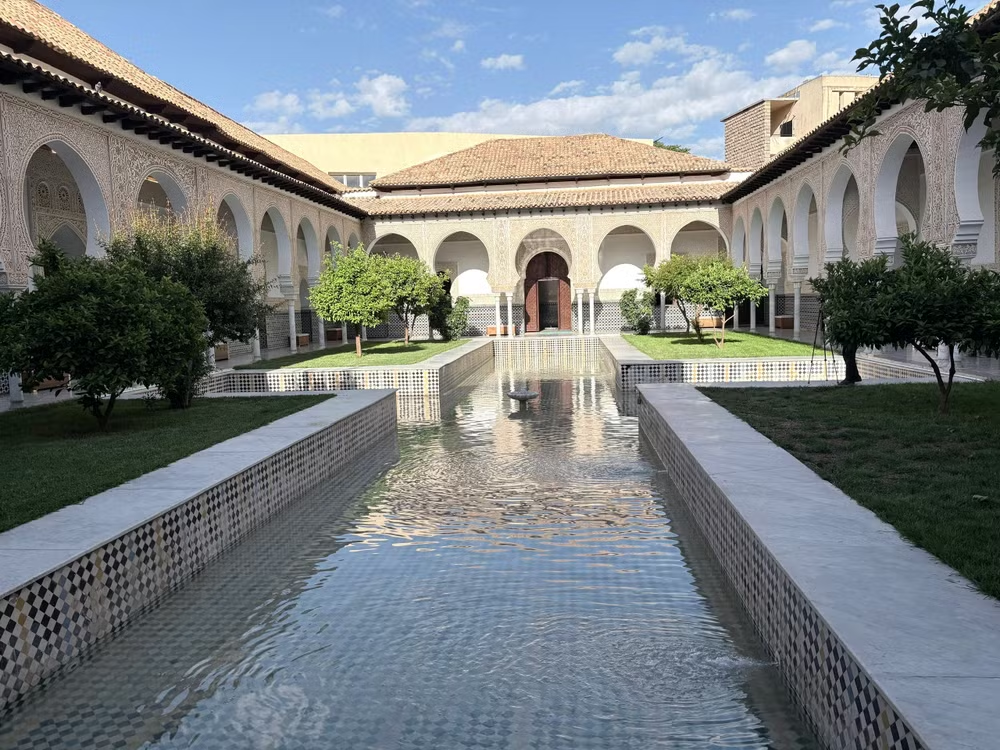
In the afternoon, our journey continued to El Mechouar Palace, once the center of power of the Zayanid dynasty from the 14th century. Although much of the original architecture has been lost through the vicissitudes of history, the main area of the palace, recently restored, recreates some of the opulence of the former royal family.
Strolling through the breezy corridors, admiring the pristine white plaster walls meticulously carved like lace, or standing by the crystal-clear lake reflecting the sky, I felt as if time had stopped.
The late afternoon sunlight filtered through the ancient archways, casting warm streaks of color onto the blue and green ceramic tiles, creating a serene, regal atmosphere.
Tlemcen is not bustling or noisy. The city captivates travelers with the serenity of its centuries-old heritage, the grandeur of its nature, and above all, the warmth of its people.
Source: https://www.vietnamplus.vn/tlemcen-mien-di-san-nam-giua-long-da-co-post1113174.vnp



















![[Video] Sunset at Lap An Lagoon – Where the sun sets over the fishing nets](https://vphoto.vietnam.vn/thumb/340x192/vietnam/resource/IMAGE/2026/05/31/1780192137701_beach-landscape-sea-water-nature-grass-745871-pxhere-com.jpeg)





![[Photo] The General Secretary, President and his wife lay flowers at the Ho Chi Minh Monument in Manila.](https://vphoto.vietnam.vn/thumb/1200x675/vietnam/resource/IMAGE/2026/05/31/1780219759477_anh-man-hinh-2026-05-31-luc-16-29-07.png)































































Comment (0)