

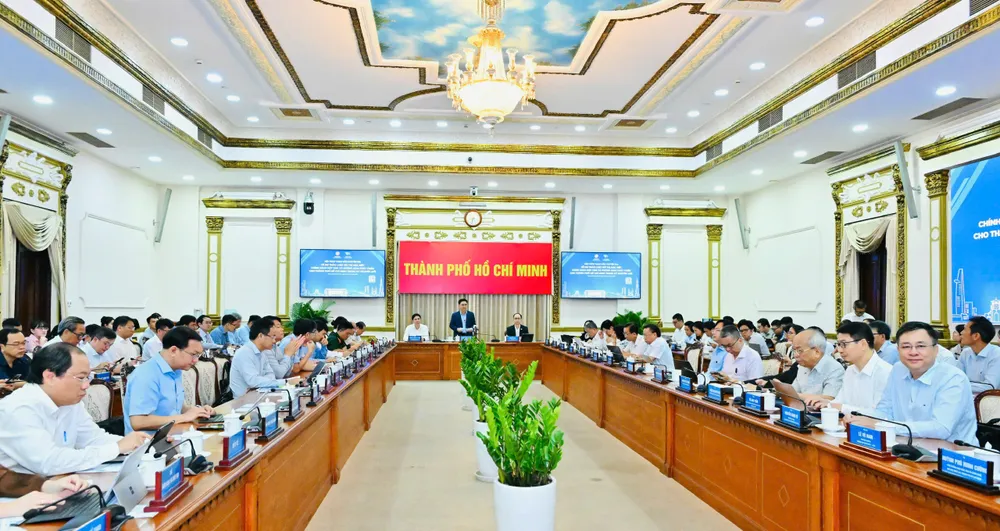
Carefully assess the obstacles faced by departments and agencies.
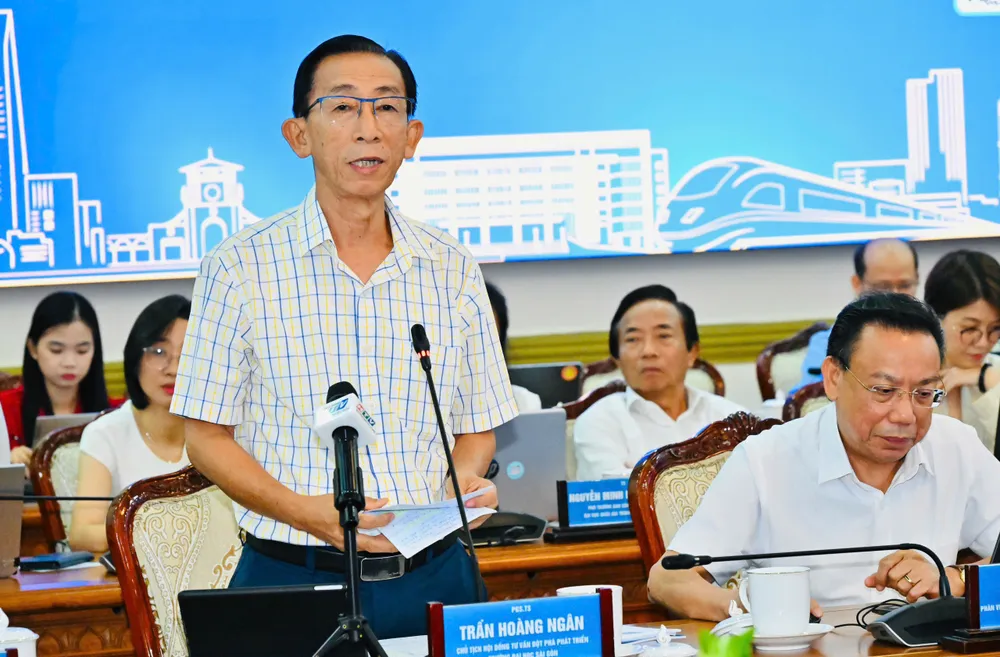
During the workshop discussion, Associate Professor Tran Hoang Ngan, Chairman of the Advisory Council for Breakthrough Development at Saigon University, analyzed Ho Chi Minh City's growth results in the first quarter. He stated that these results stemmed from the city's efforts as well as resolutions of the National Assembly and specific mechanisms.
Associate Professor Tran Hoang Ngan analyzed that, over the years, the Politburo has issued many resolutions for the city. From Resolution 01 (1982), Resolution 20 (2012), Resolution 16 (2012) to Resolution 31 (2022). However, when summarizing these resolutions, the Central Committee always commented: The city has strived to develop its potential and maintain its leading role, but has not yet fully exploited its potential and advantages. According to Associate Professor Tran Hoang Ngan, one of the reasons for this assessment by the Central Committee is the institutional framework; therefore, the city needs a compatible institutional framework.
Recently, the city has issued specific resolutions such as Resolution 54, Resolution 98, and Resolution 260 of the National Assembly. Subsequently, wherever obstacles remain, the National Assembly continues to issue resolutions to resolve them, such as Resolution 188 (on urban railways) and Resolution 170 (Special mechanisms and policies to address difficulties and obstacles related to projects and land in inspection, audit, and court rulings).
Associate Professor Tran Hoang Ngan commented that although there are many resolutions, they are short-term in nature. The city needs a stable, long-term institutional framework, and that is why a law for the city is necessary.
The law's content needs to focus on addressing existing problems; therefore, it is necessary to summarize the implementation of Resolutions 54, 98, and 260 to thoroughly assess the obstacles encountered by departments and agencies. The law's content must also leverage the diverse drivers of the city's development, such as marine economic development, logistics centers, free trade zones, high-tech clusters, eco-industrial parks, international financial centers, high-quality services, and cultural industries… Along with this, new resolutions of the Politburo should be incorporated into the law for faster implementation.
"The law must address existing bottlenecks, shortcomings, and obstacles before it can even dream of anything new," said Associate Professor Tran Hoang Ngan.
A completely different development space is needed.
Associate Professor Dr. Do Phu Tran Tinh, Director of the Institute for Policy Development, Vietnam National University Ho Chi Minh City, analyzed that in practice, the special mechanisms applied to Ho Chi Minh City in the past have mainly been issued and adjusted in stages to address immediate problems. Although they have yielded certain results, these mechanisms are still localized, focusing on individual issues, lacking a stable legal framework to meet the increasingly large development demands of Ho Chi Minh City.
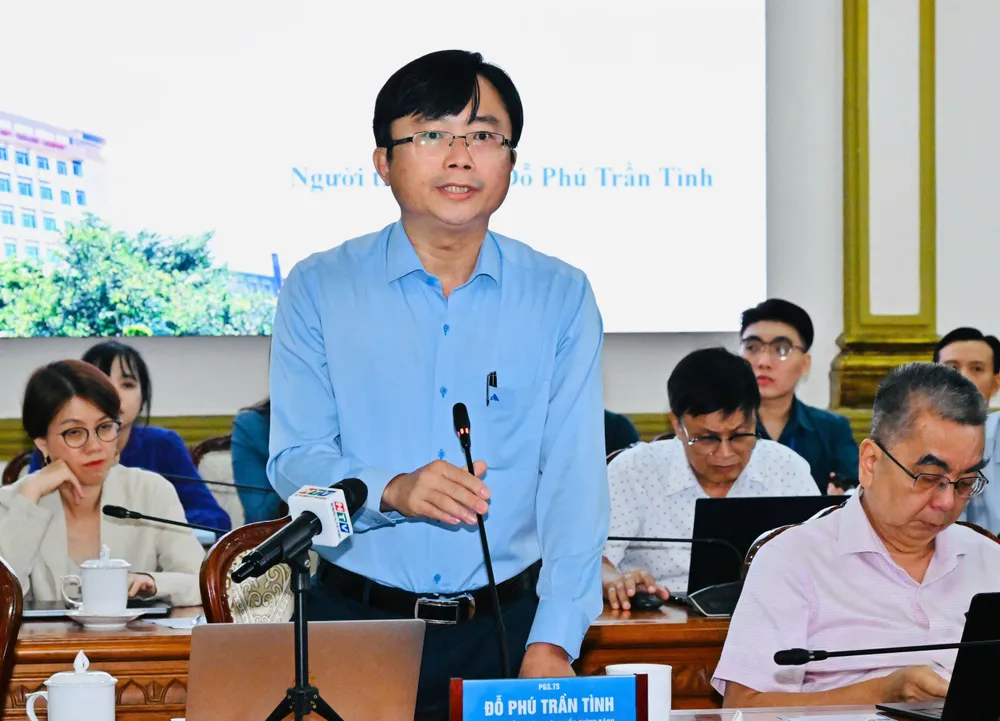
Experts proposed three fundamental pillars for the draft law. These are: granting Ho Chi Minh City genuine autonomy in governance, from organizational structure to decision-making on planning, investment, and finance; establishing an institutional testing mechanism (sandbox) to allow Ho Chi Minh City to pioneer new economic and technological models not yet covered by current legislation; and building an internationally competitive legal framework, particularly in the financial sector, to realize the goal of establishing an International Financial Center in Ho Chi Minh City.
Associate Professor Dr. Do Phu Tran Tinh believes that if the three pillars mentioned above are successfully addressed, Ho Chi Minh City will have a completely new and different development space. This will also help the city overcome core bottlenecks in institutions, infrastructure, resources, and regional connectivity. Beyond the local level, successful reforms in Ho Chi Minh City can also become practical experience for improving the national institutional framework, contributing to enhancing national competitiveness.
Comprehensive decentralization and delegation of power – “ the heart of institutional design ”
Associate Professor To Van Hoa, Rector of Hanoi Law University, believes that the law must be designed specifically for Ho Chi Minh City to meet the city's development, which in turn meets the development needs of the region and the entire country. Therefore, the expert suggests that Ho Chi Minh City should not be considered a single megacity but should play a crucial role for the region and the nation. The scope of the law should encompass a comprehensive policy ecosystem, in which the major components are linked by a unified development logic.
Specifically, the law needs to clearly define and establish Ho Chi Minh City's development goals in the context of the new era, for example, as a financial, innovation, and internationally connected center with regional competitiveness. Simultaneously, it needs to address the overall master plan and its legal status. The law should regulate the development of the city's master plan and ensure that the plan has sufficient legal standing to truly lead development, not just function as a spatial management system.
Furthermore, comprehensive decentralization and delegation of power are considered the "heart of institutional design." Without genuine decentralization and delegation of power, there cannot be a mechanism for breakthrough development. The scope of decentralization needs to be broad enough to cover all sectors. The structure of the urban government apparatus is unique, and the design of the government organization model is flexible and suitable to the specific nature and spatial structure of a megacity.
Source: https://www.sggp.org.vn/tphcm-can-the-che-on-dinh-dai-han-post846260.html
































































































Comment (0)