

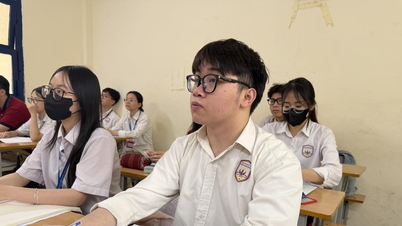
The news that tuition fees from preschool to high school (public schools) will no longer be a concern for all students and parents nationwide, starting from the 2025-2026 school year, is great news for all students and parents across the country. However, the question of whether students at private and non-public schools will also be exempt from tuition fees like public school students?
Accordingly, in addition to the students currently exempt from tuition fees, the Ministry of Education and Training (MOET) proposed, and the Politburo agreed, to exempt all public kindergarten, primary, lower secondary, and upper secondary school students from tuition fees starting from the 2025-2026 school year. Students in private and semi-private schools will receive tuition fee subsidies equivalent to the tuition fees of public schools as stipulated by law; the difference in tuition fees between public and private/semi-private schools will be paid by the students' families. Tuition fee support will be based on the actual time the child attends school and will not exceed 9 months per school year.
In parallel with the implementation of current regulations, the Government has also stipulated a policy to reduce tuition fees by 50-70% and provide financial support for many groups of poor students, students from disadvantaged backgrounds, students from social policy groups, and students from ethnic minorities (studying at public and private schools).
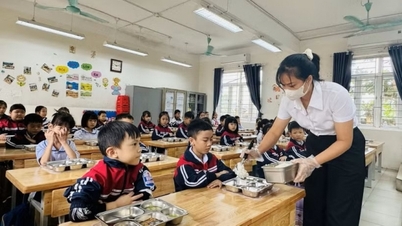
Although delighted by the news that their children will be exempt from tuition fees, many parents wonder why, even in localities where tuition is free, elementary and middle school parents still have to pay millions of dong each month for their children. In reality, when students attend school, depending on the registration and choices made at the beginning of the school year, parents pay for boarding and meals; enhanced English classes; extracurricular classes; drinking water; school newspapers; photocopying of review materials; health insurance; and voluntary personal accident insurance… Even so, according to many parents, the current contribution levels at public schools are reasonable compared to the income of the vast majority of families. This is precisely why the competition for admission to public schools in Hanoi is always intense.
According to education experts, waiving tuition fees means eliminating mandatory charges, restoring the true value of public schools. This sends a strong message about the direction of teaching and learning in schools towards a fee-free system, a decision that resonates with the public. However, one issue that needs careful consideration is the impact of this policy on the private school system. When tuition fees at public schools are completely waived, some parents may opt for public schools instead of private ones. This could lead to a decline in the number of students at private schools, forcing them to adjust tuition policies or improve the quality of education to remain competitive.
Many parents surveyed expressed their desire that tuition waivers should go hand in hand with improving the quality of education, so that students can study in the best possible environment. Ensuring teaching quality amidst a sudden increase in student numbers and tightening the management of extracurricular tutoring are issues that need to be addressed and considered adequately and thoroughly. "Tuition waiver" and "free education" are two different concepts. The school is only waiving the tuition fees it previously collected, while numerous other fees remain, as mentioned above. And these fees are not always agreed upon by all parents.
Dr. Nguyen Tung Lam, Vice President of the Vietnam Association of Educational Psychology, believes that waiving tuition fees for students is a humane policy that contributes to educational development and brings happiness to all citizens. This policy is also in line with the country's development in this era of progress. However, more attention needs to be paid to the mechanism for investing in educational development to align with a market economy and international integration, creating conditions for schools to be more autonomous. Along with that, the State needs to have a reasonable policy for recruiting, training, and rewarding teachers to attract talent and maintain educational quality.
Source: https://daidoanket.vn/tra-lai-gia-tri-that-cho-truong-cong-10300860.html
![[Photo] General Secretary and President To Lam meets with National Assembly delegates from ethnic minorities.](https://vphoto.vietnam.vn/thumb/1200x675/vietnam/resource/IMAGE/2026/04/20/1776696701056_a1-bnd-8331-3342-jpg.webp)



![[Image] National Assembly discusses the implementation of the socio-economic development plan.](https://vphoto.vietnam.vn/thumb/1200x675/vietnam/resource/IMAGE/2026/04/20/1776696707422_ndo_br_img-20260420-185419-jpg.webp)

























































Comment (0)