


FIFA underestimated the level of interest in the 2026 World Cup from China - Photo: XINHUA
A time of "making money" in China
FIFA once believed that China would be the new "gold mine" of world football, especially in competitions related to the "World Cup" - the dream and also the obsession of the country with the world's largest population.
But just weeks before the opening of the 2026 World Cup, the most powerful organization in global football found itself being pressured into accepting lower prices in its own "gold mine" market.
After months of negotiations, FIFA finally agreed to sell the television rights for the 2026 World Cup to China Media Group (CMG), for a price that Chinese media revealed was only around $60 million. This figure is far lower than the $300 million FIFA had initially demanded.
This is considered one of FIFA's most notable commercial failures in recent years, and reflects the dramatic shift in the Chinese football market after a period of rapid growth.
Over the past 15 years, the price of World Cup broadcasting rights in China has steadily increased with each tournament. The 2010 World Cup in South Africa was estimated at only around $25-35 million. By the 2014 World Cup in Brazil, this figure had risen to approximately $50-60 million thanks to the boom in internet video, smartphones, and the sports advertising market.
The 2018 World Cup in Russia marked a golden age for China. At that time, China was living the "World Cup dream," with a massive project involving investments of tens of billions of dollars.
Corporations like Wanda, Hisense, and Mengniu were major sponsors of FIFA during this period. At the World Cup, CCTV and digital platforms like Migu and Youku also participated in exploiting broadcasting rights, bringing the total market value to an estimated over $80 million by analysts.

FIFA has always attached great importance to the Chinese football market - Photo: REUTERS
Leading up to the 2022 World Cup in Qatar, commercial value continued to peak. Douyin, Migu, and a host of other streaming platforms jumped into the fray, turning the World Cup into a mobile "content battleground." Many sources in the Chinese media industry estimate that the total revenue generated at this point could exceed $100 million.
This continuous growth has led FIFA to believe that the 2026 World Cup will be even more expensive. This will be the first World Cup with 48 teams and 104 matches, the largest in history. FIFA aims for a revenue of $8.9 billion for the 2026 season, with television rights revenue alone expected to increase by 33% compared to 2022.
According to Reuters Breakingviews, FIFA “has bet too much on growth in emerging markets.” The news agency argues that the World Football Organization has acted as if the value of the World Cup “is always increasing,” despite declining purchasing power and real interest in many Asian markets.
Times change.
FIFA's first mistake lay in its valuation of China. For years, FIFA saw the 1.4 billion population, the enormous viewership, and the influx of sponsorship money from Chinese corporations and assumed that this market would be willing to pay as much as the US or Europe. However, the television structure in China is completely different.
In Europe, broadcasters compete fiercely for broadcasting rights. But in China, CCTV is virtually the only buyer capable of broadcasting the World Cup nationwide. This prevents FIFA from creating the competitive bidding process they desired.
Reuters reported that FIFA had demanded a price of up to $300 million for the 2026 World Cup in China. CCTV refused, and the two sides were at an impasse for months.
China's Global Times reported that as soon as this price was announced, Chinese experts strongly objected, warning that the country should take decisive action against FIFA.
Another factor contributing to FIFA's failure is the decline of the "Chinese football craze." The period from 2015 to 2019 had created the illusion that China would become the new football superpower.
However, following the COVID-19 pandemic, the Chinese Super League faced a financial crisis, many clubs went bankrupt, the national team continued to fail in qualifying campaigns and was unable to participate in the 2026 World Cup. Businesses also began to tighten their advertising spending.
Furthermore, the 2026 World Cup will be held in the US, Canada, and Mexico, creating extremely inconvenient time zones for Asian viewers. Many matches will take place in the early morning hours according to Beijing time. This directly reduces the value of television advertising.
AP believes this is a major reason why FIFA has "lost commercial leverage" in negotiations with China.
The difficulties are compounded by China's failure to qualify for the 2026 World Cup. In the sports broadcasting industry, the national team is always a key factor in selling advertising. Without a host nation or local team, the general audience typically drops significantly.
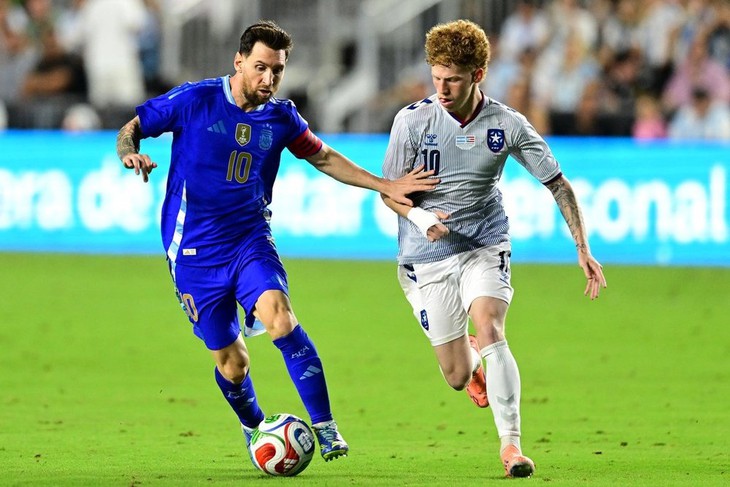
Even superstars like Messi couldn't help FIFA continue raising the price of World Cup broadcasting rights - Photo: REUTERS
By early May 2026, just about a month before the opening day, FIFA had still not finalized the broadcasting rights in China and India, the two most populous markets in the world.
As time ran out, the tables completely turned. FIFA, from being the seller of power, became the party under pressure to finalize the deal at all costs.
Finally, on May 15th, FIFA confirmed reaching an agreement with CMG. The contract package includes the 2026 World Cup, the 2030 World Cup, and two Women's World Cups in 2027 and 2031.
Although the official value has not been released, many Chinese sources indicate that the 2026 World Cup alone will cost around $60 million.
A shocking "price drop" occurred, and even more remarkably, the amount FIFA earned from this year's expanded World Cup ended up being lower than in the two previous World Cups.
A memorable defeat for FIFA – that's how Western media described their financial negotiations with the world's most populous nation.
Source: https://tuoitre.vn/tran-thua-nho-doi-cua-fifa-truc-trung-quoc-20260517112500924.htm
![[Image] Hanoi's urban life under the challenge of a "scorching hot" environment](https://vphoto.vietnam.vn/thumb/1200x675/vietnam/resource/IMAGE/2026/05/25/1779706979265_nang-nong-t5-2026-minh-duy-7-4636-jpg.webp)









































































Comment (0)