

Bamboo is used to make rafts for raising shrimp and oysters in the coastal area of Song Cau town. Photo: MANH LE TRAM |
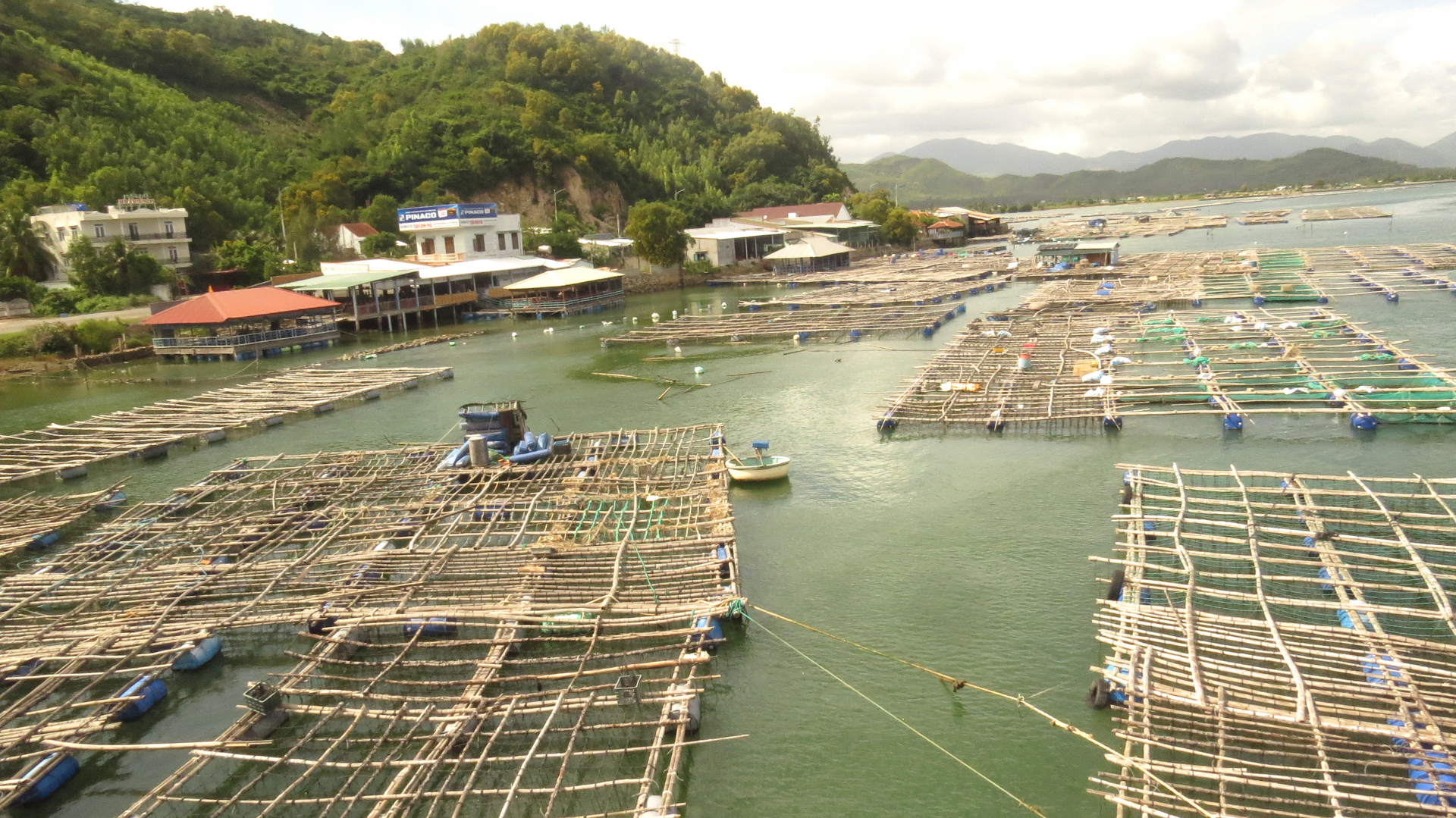
Using bamboo to make rafts for raising seafood.
Mr. Pham Van Lien from Xuan Quang 3 commune (Dong Xuan district) said: "I've been involved with bamboo for nearly 7 years. Initially, I sold bamboo to truck drivers who transported it to various places for consumption, then I earned money by cutting bamboo for hire."
According to Mr. Lien, currently, a single bamboo stalk sold standing in a clump costs 20,000 VND. A clump of bamboo, typically consisting of 20 stalks, fetches 400,000 VND. Near the Tra Buong River, some people who cultivate 20 clumps of bamboo along the riverbank earn 8 million VND. However, mature bamboo isn't available for sale every year; it usually takes two years for the bamboo shoots to mature before they are ready for sale. In rural areas, besides rice, sugarcane, and cassava, many families supplement their income from bamboo to support their lives.
Mr. Phan Van Sau, a bamboo buyer supplying lobster farming areas in Song Cau town, said: "Previously, I bought bamboo to sell to businesses that made beds, woven items, and handicrafts from bamboo, especially living room sets. However, for a time, plastic products dominated the market, and no one bought bamboo. At that time, rural people only planted bamboo for shoots and to build houses. Now, bamboo is scarce again because of its additional use in making rafts for shrimp and oyster farming. Every month, I supply thousands of bamboo poles to farmers in the coastal area of Song Cau town."
Speaking about the durability of bamboo used for "submerging" in the sea, Mr. Thai Van Sau from Xuan Phuoc commune (Dong Xuan district) said: "I have an older brother who raises shrimp in Xuan Dai Bay (Song Cau town). A few years ago, I went down to the sea to help him build shrimp and oyster farms, and I learned that besides the surrounding wooden frames, the rest of the rafts are made of bamboo. Bamboo is light, so it's easy to move the bamboo rafts used for shrimp and oyster farming to avoid storms. Bamboo is very durable when submerged in saltwater; it usually rots after 3 years on land, but can withstand 4-5 years underwater. Thousands of shrimp and oyster farms in Xuan Dai Bay are made of bamboo. Recently, shrimp and oyster farmers who want to build rafts have to place orders and wait a while for mature bamboo."
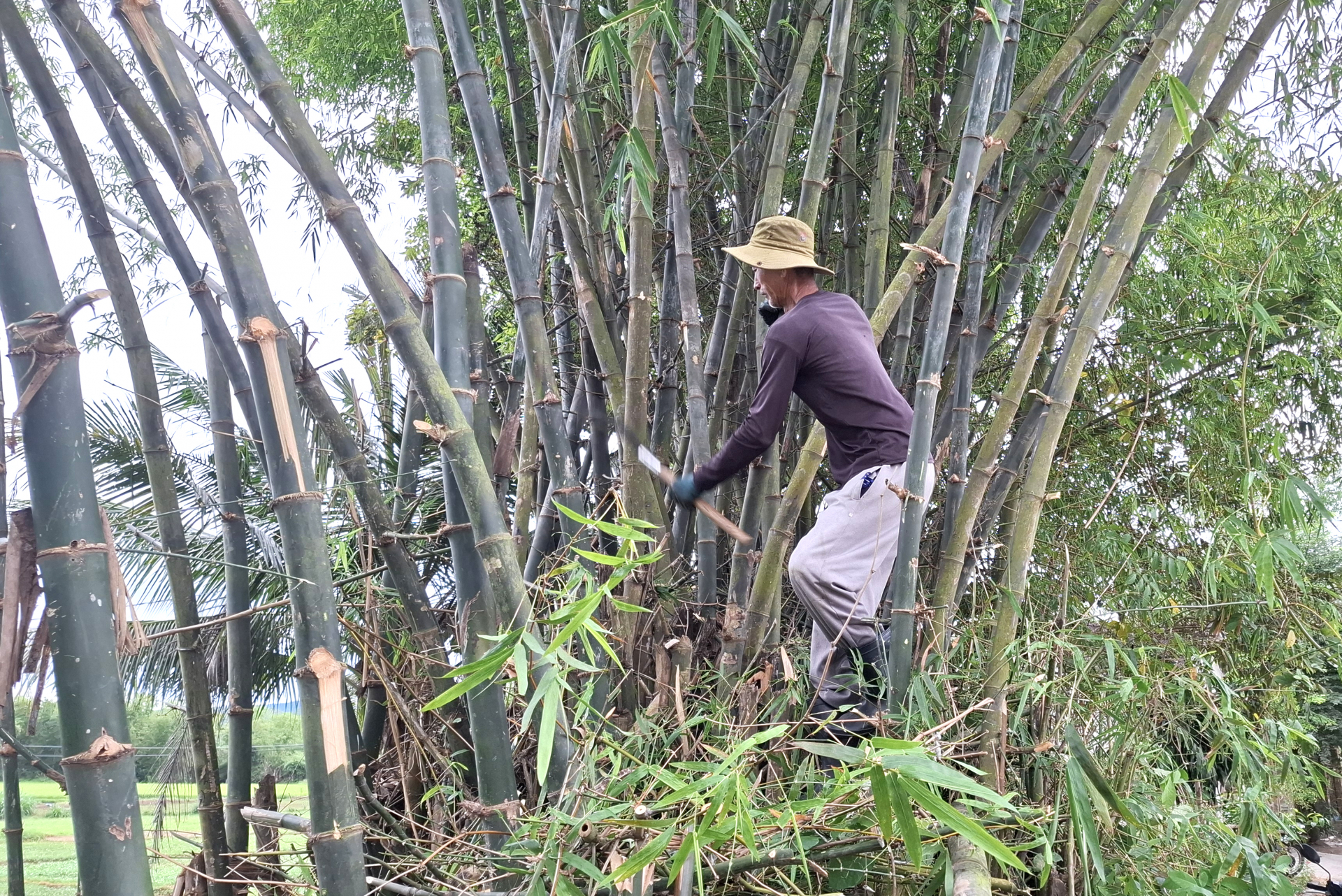
“In recent years, bamboo growers have increased their income from selling bamboo, and I have found work. Every day, I go to cut bamboo for hire, earning 300,000 dong per day. The bamboo cutting process is very important; if you don't know how, you will 'kill' the bamboo clump,” Mr. Sau said.
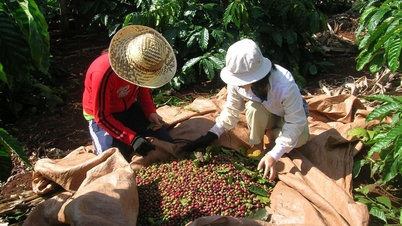
Farmers in Xuan Quang 3 commune (Dong Xuan district) cut bamboo to sell to shrimp and oyster farmers. Photo: MANH LE TRAM |
Techniques for "growing" bamboo
Mr. Manh Van Cuong, from Xuan Quang 2 commune (Dong Xuan district), owns 100 bamboo clumps. His bamboo grove "fence" the Ky Lo riverbank for nearly a kilometer. The bamboo has been passed down through three generations, from his grandfather to his father and himself, who have diligently nurtured it. He explains that during the process of cultivating the bamboo, cutting it requires the right technique, and harvesting the shoots also has its secrets.
According to Mr. Cuong, when cutting bamboo for sale or weaving, it's important to prune and leave some stalks so that when the shoots grow, they can lean on the older bamboo stalks for protection and grow straight. If the old bamboo is completely cut down, the shoots will be blown off by the wind, and the bamboo will be stunted, causing the clump to become short. If the stunted bamboo is left for many years (over 10 years), the stalk will turn a golden yellow, and when used for weaving baskets or trays, it will rot quickly and won't be as durable as bamboo with intact shoots. The secret to harvesting bamboo shoots is to break them off from the ground up to an adult's knee, close to the base. Shoots that reach waist height should not be harvested, because if you break off the tender upper part (about two adult handspans) while leaving the lower part at the base, the bamboo will continue to sprout leaves, making the bamboo "deformed." Furthermore, repeatedly breaking off shoots like that will damage the bamboo clump because it won't have enough strength to produce shoots later. In addition, to keep the shoots growing straight, you must regularly use a machete to clear the thorns around the bamboo clump. Properly cutting bamboo and harvesting shoots helps "nurture" hundreds of lush green bamboo clumps along the Ky Lo River, providing both income and the development of the bamboo grove.
Previously, I bought bamboo to sell to businesses that made beds, woven items, and bamboo handicrafts, especially living room sets. However, for a time, plastic products dominated the market, and no one bought bamboo. Now, bamboo is scarce again because it has an additional use in making rafts for shrimp and oyster farming. Every month, I supply thousands of bamboo poles to farmers in Song Cau town.
Mr. Phan Van Sau, a bamboo buyer who supplies bamboo to lobster farming areas in Song Cau town.
“The bamboo fence prevents riverbank erosion. For many years, not a single inch of my family's agricultural land behind the bamboo fence has been lost along the riverbank. Meanwhile, on the other side of the river, because there is no bamboo, erosion and sand deposition have covered dozens of hectares of agricultural land,” Mr. Cuong said.
Below Mr. Cuong's bamboo grove is a row of nearly 100 bamboo clumps belonging to Mr. Manh Nhon, also in Xuan Quang 2 commune. Speaking about the uses of bamboo, Mr. Nhon shared: "This area is next to the Cai River (Ky Lo River). During the rainy season and storms, water flowing down from the mountains uproots the pigsty foundations, tilting the roof and breaking the rafters. I immediately cut bamboo to replace them. Or, if the cow shed is damaged by a storm, I cut male bamboo to 'support' it. Bamboo helps overcome emergency situations, providing a place for cows and pigs to stand. Or, if a storm knocks down power lines crossing the road, I cut bamboo to prop up the electrical system in the house before replacing the pole. If I didn't have bamboo and had to cut other trees, it would take a whole day to find replacements."
"In the past, those who built houses near rice fields would use bamboo stumps to secure the perimeter and then pour soil on top. This prevented the soil from sagging and firmly held the foundation of the house. For mounds of land near stream mouths, where rainwater would wash soil and rocks into the fields, people would also use bamboo stumps to firmly secure the soil and build bamboo embankments to prevent soil and rocks from the stream from flooding in," Mr. Nhon said.
Source: https://baophuyen.vn/xa-hoi/202504/tre-them-cong-dung-nguoi-trong-tang-thu-nhap-6632007/


![[Photo] Prime Minister Pham Minh Chinh attends the Conference on the Implementation of Tasks for 2026 of the Industry and Trade Sector](/_next/image?url=https%3A%2F%2Fvphoto.vietnam.vn%2Fthumb%2F1200x675%2Fvietnam%2Fresource%2FIMAGE%2F2025%2F12%2F19%2F1766159500458_ndo_br_shared31-jpg.webp&w=3840&q=75)


















































































Comment (0)