

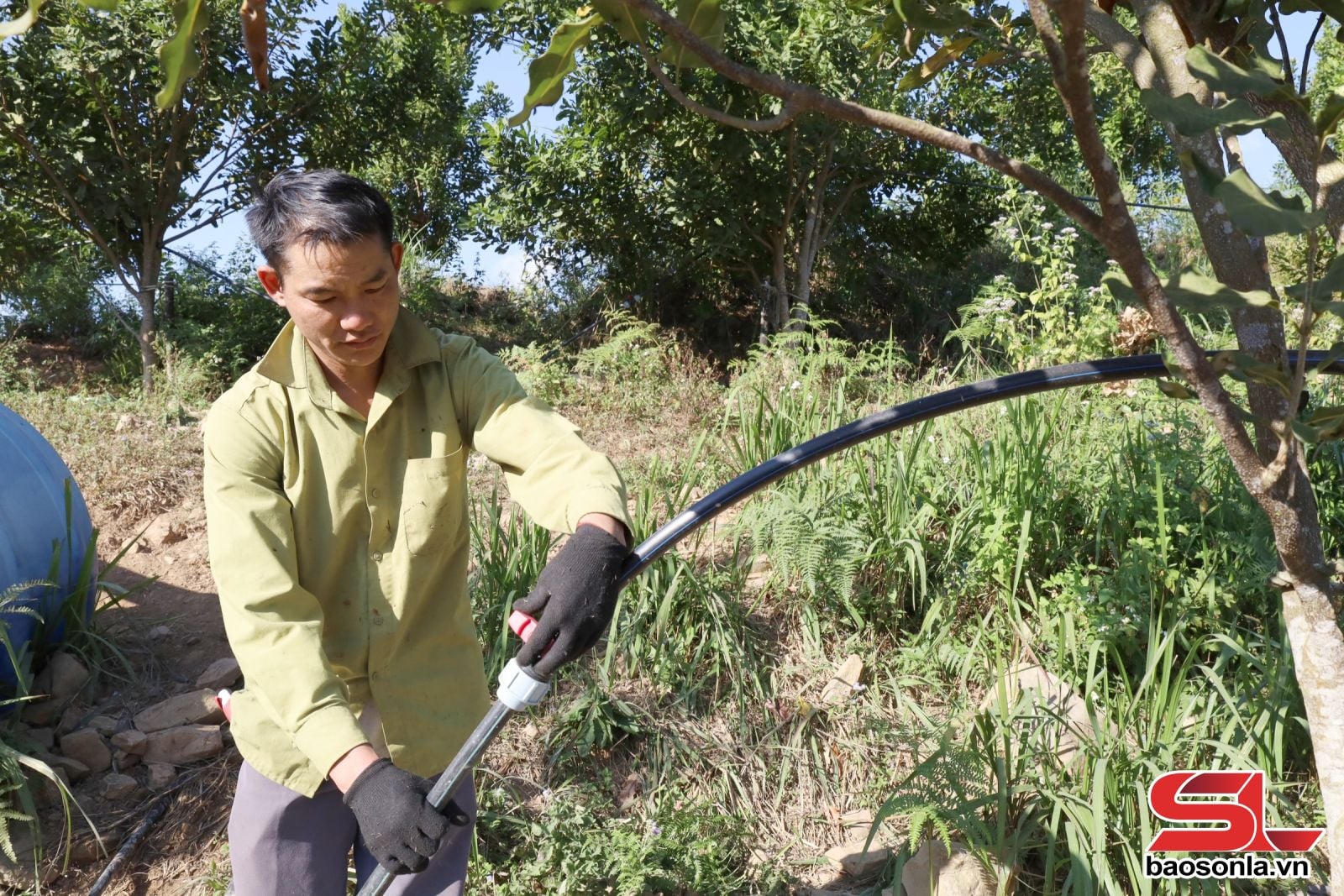
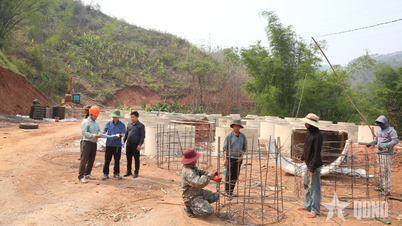
Muong Chien commune currently has nearly 300 hectares of macadamia trees, mainly concentrated in Bon and Phieng Bay villages. To enhance land use value, local people have adopted the practice of intercropping fruit trees and industrial crops under the macadamia trees. A typical example is the family of Mr. Tan Van Pap in Phieng Bay village. After visiting and learning from macadamia tree cultivation models and receiving technical guidance on seedling care from Lien Viet Son La Joint Stock Company, in 2019, he boldly converted his less productive crop land to macadamia cultivation. To date, his macadamia orchard, intercropped with fruit trees, is thriving and beginning to yield harvests.
Leading us on a tour of the lush green hills in Phiêng Bay village, Mr. Tẩn Văn Pặp couldn't hide his radiant smile. Few would imagine that what was once barren land of corn and cassava has now become a circular economy model under the trees. Mr. Pặp shared: "Currently, my family has 3 hectares of macadamia trees intercropped with 1,300 mango trees and 3,000 coffee trees. Macadamia trees are suitable for the sloping land and local climate. In the recent macadamia harvest, some trees bore their first fruits, and my family harvested 4 tons of fresh macadamia nuts. Lien Viet Son La Joint Stock Company supported us by purchasing all the produce at a price of 30-60 thousand VND/kg of fresh nuts, providing my family with an additional income of over 200 million VND."

Lien Viet Son La Joint Stock Company currently has the largest macadamia nut plantation area in the commune, with over 75.64 hectares currently yielding harvests. Sharing about the cultivation process, Mr. Pham Van Dung, Director of the company, said: "For large-scale cultivation, strict adherence to techniques and planting density is key. We arrange the macadamia trees at a reasonable distance, intercropping with 500 mango trees and 500 plum trees. The macadamia trees grow and develop well, with an average yield of 7.5-8 tons of fresh fruit per hectare. This raw material is then processed further, supplying the market with diverse products such as shelled nuts, kernels, macadamia wine, and macadamia oil."
With the goal of developing a concentrated macadamia nut growing area, Muong Chien commune always accompanies and supports people and businesses with seeds and production techniques, prioritizing guiding farmers to choose new varieties suitable for the soil conditions and with good disease resistance such as A38 and QN1; and using organic fertilizers. In the new planting stage, each hole is fertilized with 30-50 kg of well-rotted manure, combined with 500g of NPK and 300g of lime powder. Depending on the growth stage, farmers fertilize 2-3 times/year; the first time with 30-50 kg of manure along with 0.2-0.5 kg of NPK/tree; subsequent times use NPK fertilizer with a formula suitable for each stage of development, flowering and fruiting. Pruning and shaping techniques are continuously implemented by farmers during the first three years, helping to create a balanced and airy canopy, resulting in more fruit production, increased yield, and reduced pest and disease control costs in the long run. Proactively digging drainage ditches 20-30 cm deep around the base of the trees is also carried out to prevent root rot.
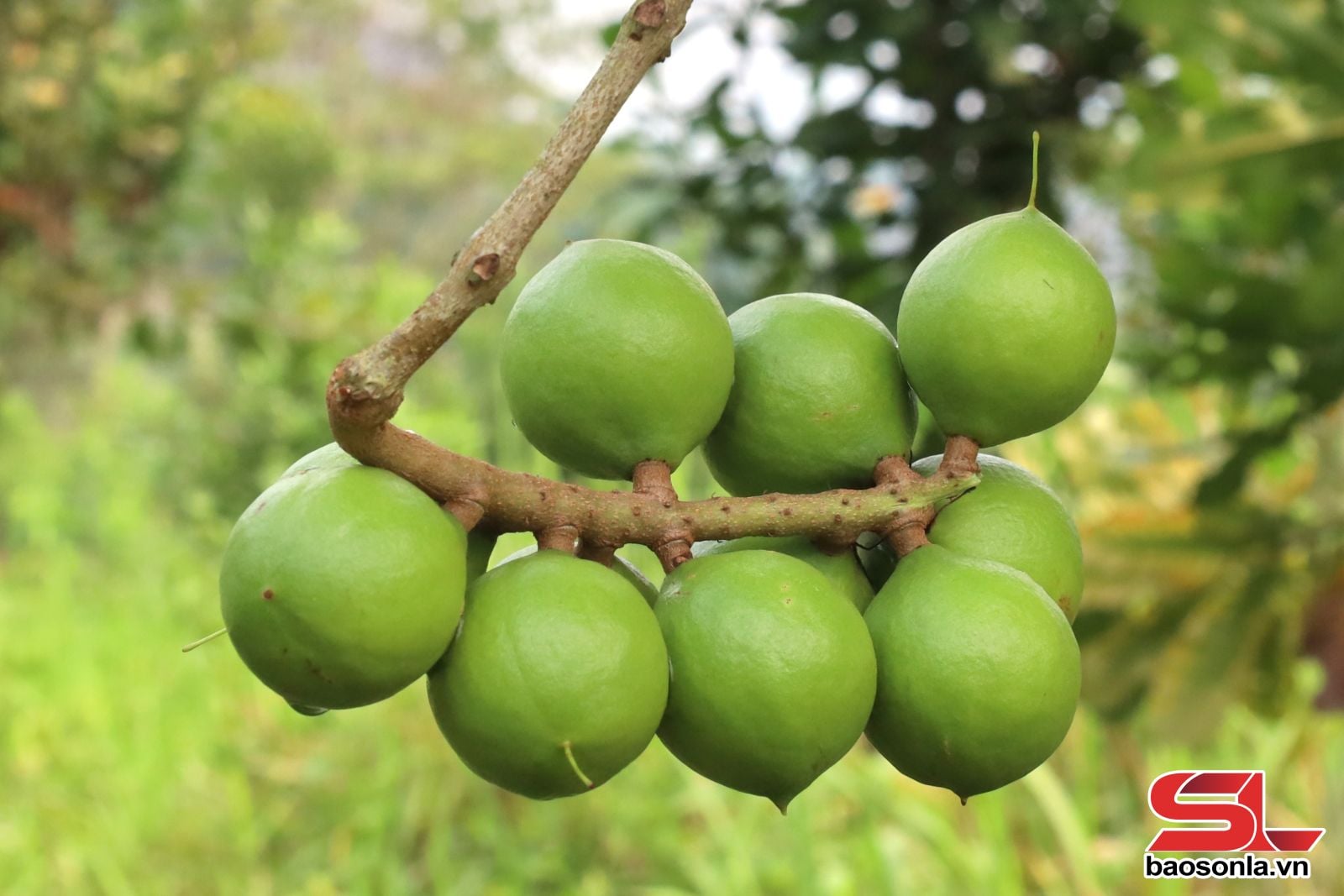
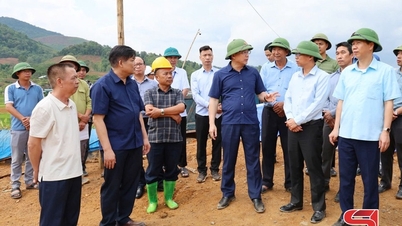
Mr. Dieu Chinh Hai, Vice Chairman of the People's Committee of Muong Chien commune, informed: Recognizing macadamia as a multi-purpose crop with both economic value and contribution to greening barren land, the commune has propagated and mobilized people to convert suitable crop areas, coordinated with businesses to invest, support, and link with households to develop a raw material area associated with consumption and processing of products to develop macadamia cultivation in the area.
With the timely attention and support of the local government, the cooperation of businesses, and the shift in production mindset and application of science and technology by the people, macadamia trees in Muong Chien commune have the potential to become a crop that brings stable income and creates sustainable livelihoods for the people.
Source: https://baosonla.vn/kinh-te/trien-vong-tu-mo-hinh-xen-canh-cay-mac-ca-RRHdYnxvR.html
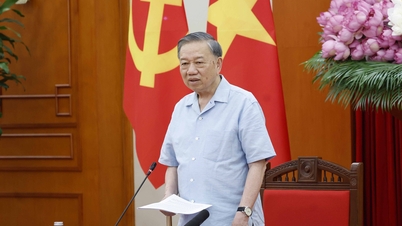
![[Photo] General Secretary and President To Lam presides over a meeting on preparations for the review of one year of operation of the three-tiered government system.](https://vphoto.vietnam.vn/thumb/1200x675/vietnam/resource/IMAGE/2026/06/02/1780391821195_a1-bnd-4595-9717-jpg.webp)

















































Comment (0)