

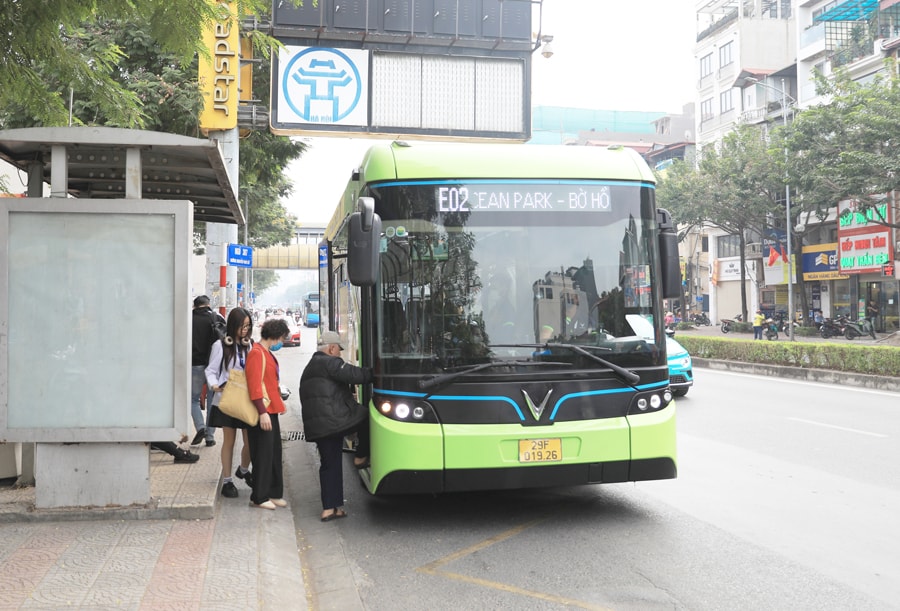
A scientific roadmap is needed.
In the context of Hanoi facing significant pressure from traffic congestion, air pollution, increasing private vehicle use, and the demand for a green transition, this proposal shows the city's desire to use public passenger transport as a tool to regulate commuting behavior. When people have more reasons to leave their motorbikes and private cars and switch to buses and trains, the benefits lie not only in the free fares but also in the ability to reduce congestion on the streets.
In principle, providing free fares for vulnerable groups such as people with disabilities, the elderly, young children, poor households, and war veterans is a social welfare policy that should be maintained. For students, factory workers, and those in industrial zones, the policy's significance is even broader. These groups have frequent and stable travel needs, especially during peak hours, and are sensitive to costs. If these groups can be encouraged to use public transportation, Hanoi could create more substantial changes in its urban transportation structure.
According to Nguyen Hoang Hai, Vice President of the Hanoi Public Passenger Transport Association, waiving bus and train fares for students would be a very good measure to attract this group of passengers to use public transport. However, he also noted that the policy needs to be carefully studied to ensure it is consistent with the city's actual resources; because public policy, no matter how humane, must answer the question: How much of the budget will cover the fare waiver, where will it come from, who will pay, how will the volume be controlled, how will losses be avoided, and will the quality of service keep up with the increasing number of passengers?
Ms. Hoang Thi Thu Phuong, a Master of Economic Management from Hanoi Metropolitan University, also believes that subsidizing all public transportation fares for students is welcome, but it will also put considerable pressure on social costs. Therefore, full subsidies need to be implemented according to a specific, scientific roadmap with objective and detailed evaluation. If buses and trains are free, a large number of students will certainly switch to using public transportation.
Develop a specific action plan.
According to experts, for the policy to be effective, Hanoi needs to consider it a traffic behavior intervention program with clear objectives, measurable data, a pilot phase, and an adjustment mechanism. If it's free but buses lack services, the metro system isn't conveniently connected, stops are far from residential areas, sidewalks are difficult to walk on, and there's a shortage of parking spaces, people will still struggle to change their habits. A good policy doesn't necessarily have to be free all the time, on all routes, and for all needs. For Hanoi, a more reasonable approach is to design it according to time frames, target groups, and trip purposes.
First, priority should be given to waiving fees during school and work hours, especially for students and industrial zone workers. This is when private vehicles put the greatest pressure on the road system; therefore, the effect of reducing congestion will be much clearer than waiving fees throughout the day without linking it to traffic management goals.
Secondly, free fares could differentiate between school days, workdays, and holidays. Experience from several countries shows that public transport fare policies can be designed flexibly. Mr. Dang Trung Kien, a Vietnamese person living in Sweden, said that where he lives, train and bus fares for students are quite detailed. From Monday to Friday, fares are significantly reduced. On weekends, when the main need is not for school, the prices are much higher... This suggestion is worth considering for Hanoi. Free public transport could focus on essential needs such as going to school or work; while trips not for essential purposes, especially on weekends or during off-peak hours, could be offered at discounted fares, reduced fares, or at the original price. This approach makes the policy both humane and avoids putting excessive pressure on the budget.
On the other hand, Hanoi could select several target groups with clearly defined and easily controllable data, such as students along metro lines and workers in certain industrial zones with stable bus connections, to pilot a free public transportation policy. After a period, it is necessary to clarify indicators such as: how much the number of passengers has increased, how much the subsidy costs have increased, whether the use of private vehicles has decreased, which routes are overloaded, which routes are inefficient, and which groups benefit the most... in order to formulate appropriate policies. In particular, the free public transportation policy needs to be linked to an electronic ticketing system and target identification. If free transportation is expanded but still managed manually, the risk of inaccurate figures, difficulties in accounting, and difficulty in evaluating the policy will increase. Each free ride still represents a public budget expenditure that must be recorded. Therefore, the wider the free fare program, the more rigorous the data collection must be. It can be affirmed that this policy is necessary and should be implemented, but it must be for the right people, at the right time, with the right goals, and be measurable.
Source: https://hanoimoi.vn/tro-gia-ve-van-tai-cong-cong-lam-sao-cho-dung-va-trung-815533.html















































































Comment (0)