

In Kien Giang, switching to organic rice production not only increases economic value but also helps farmers repay their environmental debt after a long period of using chemical fertilizers and pesticides.
Find ways to repay our environmental debt.
One afternoon, while visiting the rice fields in their prime with members of the 339 Agricultural Cooperative (Thanh Phuoc commune, Giong Rieng district, Kien Giang province), everyone clearly felt the changes in the environment, from the soil and water to the air. Thanh Phuoc commune was selected by the Department of Agriculture and Rural Development of Giong Rieng district to implement a project on organic rice production.
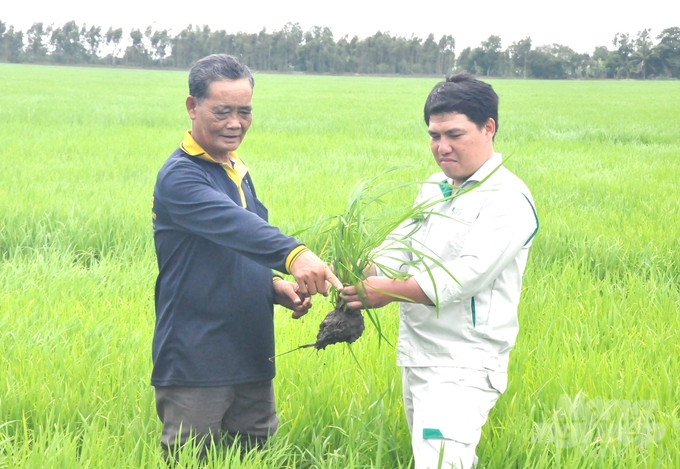
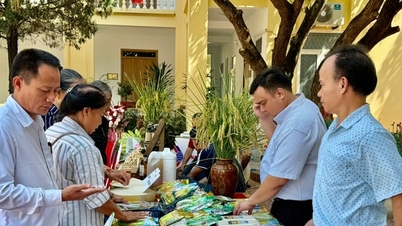
Members of the 339 Agricultural Cooperative are seeking to repay their environmental "debt" caused by the long-term use of chemical fertilizers and pesticides, which have polluted and degraded the soil. Photo: Trung Chánh.
On a vast field spanning over 122 hectares, 29 member households of the 339 Agricultural Cooperative have boldly transitioned to organic rice production with the support of relevant authorities and businesses. Accordingly, before the production season, farmers participate in training courses on technology transfer and exchange of experiences in organic rice production. Simultaneously, policies are implemented to support essential supplies, aiming for farmers to use over 70% organic fertilizers and biological pesticides in the first season, gradually replacing chemical pesticides.
Kien Giang Organic Production and Trading Investment Co., Ltd. was awarded the contract to provide technical support throughout the cultivation process, committing to achieving rice yields equivalent to the average yield in the area where the model is implemented, and purchasing all the rice produced by the farmers.
Farmer Bui Van Chin, a member of the 339 Agricultural Cooperative with 5 hectares participating in organic rice production, said: “Although all farmers here have years of experience in rice cultivation, they mainly follow traditional practices and experience. Farmers invest heavily to achieve high yields but pay little attention to economic efficiency. The overuse of chemical fertilizers and pesticides has created an environmental debt that we are now trying to repay before we have to pay the price.”
Mr. Nguyen Van Kich, Director of the 339 Agricultural Cooperative, happily stated that thanks to the successful application of organic rice cultivation processes, the "1 must, 5 reductions" approach, and timely pest and disease management, farmers in the model have reduced the number of pesticide sprayings compared to those outside the model by only 2 times per season. In addition, the application of alternating wet-dry irrigation techniques and field drying increases oxygen levels, releases toxins in the soil, enhances mineralization, helps rice roots grow deeper, strengthens the plants, reduces lodging, and facilitates mechanization during care and harvesting.
According to assessments, the yield of organically grown rice reached 8.5 tons/ha, equivalent to the yield of conventionally produced rice outside of this model, which is 8.6 tons/ha. The total revenue from rice in the organic rice production model was 68 million VND/ha, 0.8 million VND lower than outside. However, thanks to reduced investment costs (over 3.1 million VND/ha) and the model's output linkage, the selling price was 100 VND/kg higher, achieving a profit of 49 million VND/ha, more than 2.3 million VND/ha higher than outside.
Supporting the development of organic rice.
Mr. Do Van Dong, Vice Chairman of the People's Committee of Thanh Phuoc commune, said that as a remote commune, farmers in Thanh Phuoc mainly grow rice three times a year. The entire commune has an area of over 4,080 hectares of rice land, with over 10,200 hectares sown in 3 seasons in 2023, yielding nearly 69,300 tons of rice. Although the yield and production of rice met the set targets, most farmers still cultivate according to traditional practices, paying little attention to economic efficiency and reducing environmental pollution. They also spend a lot of money on production inefficiently, leading to waste and high costs.
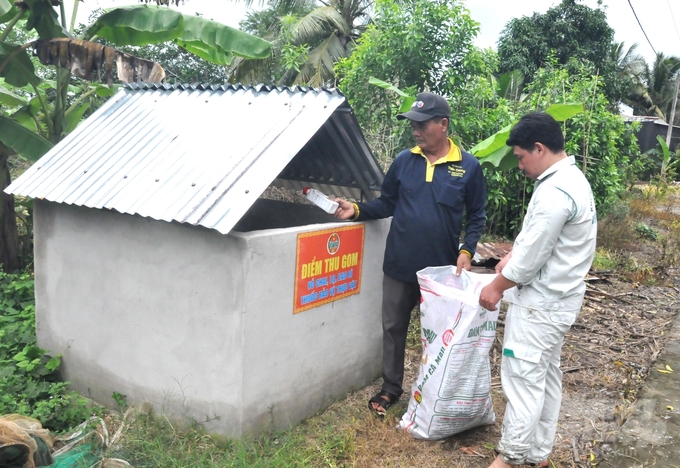
By participating in organic rice production, members of the 339 Agricultural Cooperative have raised their awareness of environmental protection, collecting pesticide packaging for proper disposal. Photo: Trung Chánh.
In implementing the advanced and model new rural development program, especially focusing on production organization and environmental criteria, Thanh Phuoc selected Phuoc Nguyen Cooperative and Agricultural Cooperative 339 to participate in the district-implemented organic rice production project. Producing rice according to standards and applying scientific and technological advancements has helped reduce input costs, decrease environmental pollution emissions, and improve rice quality to meet the high demands of export markets such as Europe and the United States.
According to the Department of Agriculture and Rural Development of Giong Rieng district, the organic rice production project was implemented in the district starting from the 2023 summer-autumn rice crop with an area of 185 hectares. Due to its effectiveness, farmers invested in expanding organic rice production to nearly 500 hectares in the 2023 autumn-winter crop, and this further increased to over 686 hectares in the 2023-2024 winter-spring crop. Along with transferring organic rice production processes, Giong Rieng district is also focusing on establishing planting area codes linked to rice consumption networks within farmer organizations participating in the project.
To promote the shift towards organic rice production, Giồng Riềng district is implementing support policies for farmers' organizations participating in the project, covering 30% of input costs (approximately 3.4 million VND/ha), including organic fertilizers and biological pesticides.
Source: https://nongsanviet.nongnghiep.vn/trong-lua-huu-co-de-tra-mon-no-moi-truong-d396507.html

![[Photo] Secretary of the National Assembly Party Committee, Chairman of the National Assembly presides over the meeting of the Standing Committee and Executive Committee of the National Assembly Party Committee.](https://vphoto.vietnam.vn/thumb/1200x675/vietnam/resource/IMAGE/2026/06/03/1780480353201_ndo_br_bnd-2585-jpg.webp)

![[Photo] First session of the 14th Congress of the Vietnam Trade Union](https://vphoto.vietnam.vn/thumb/1200x675/vietnam/resource/IMAGE/2026/06/03/1780465947883_ndo_br_img-3852-jpg.webp)

![[Photo] General Secretary and President To Lam presides over a meeting with the Central Organizing Committee.](https://vphoto.vietnam.vn/thumb/1200x675/vietnam/resource/IMAGE/2026/06/03/1780482764658_a1-bnd-4741-3342-jpg.webp)














![The Essence of Viet Bac Villages: [Part 3] The Precious Fragrance of Nghinh Tuong](https://vphoto.vietnam.vn/thumb/402x226/vietnam/resource/IMAGE/2026/05/29/1780020600366_5237-tinh-tuy-ban-lang-viet-bac-bai-3-chuyen-o-nghinh-tuong-050626_700.jpeg)
![The Quintessence of Northern Vietnam's Villages: [Part 2] The Famous Cassava Noodles of Kunming](https://vphoto.vietnam.vn/thumb/402x226/vietnam/resource/IMAGE/2026/05/28/1779937455892_3929-3144-mien-dong-15-nongnghiep-023138.jpeg)
![The Essence of the Village: [Part 1] Wine on the mountain, tea in the clouds - Bang Phuc](https://vphoto.vietnam.vn/thumb/402x226/vietnam/resource/IMAGE/2026/05/27/1779841729178_3821-1jpg-nongnghiep-103814.jpeg)






















![[Video] Sunset at Lap An Lagoon – Where the sun sets over the fishing nets](https://vphoto.vietnam.vn/thumb/1200x675/vietnam/resource/IMAGE/2026/05/31/1780192137701_beach-landscape-sea-water-nature-grass-745871-pxhere-com.jpeg)




























Comment (0)