

As countries accelerate their progress toward "net-zero," Chinese businesses are the biggest beneficiaries as they take control of the green energy supply chain.
Seizing the opportunity to transition to green energy also means businesses have to buy more from China. For example, companies like Huawei are dominating the inverter supply segment – used in solar energy systems.
"The 'checkpoint' in the green roadmap"
According to the Taiwan Industrial Technology Research Institute (China), mainland China currently holds more than 90% of the market share in key segments of the supply chain, from polysilicon at the input to solar modules at the end.
A director at Solarest, Malaysia's largest renewable energy provider, said: "China has mastered the solar energy supply chain and technology. They offer the best opportunity to generate green energy at a cost low enough to compete with fossil fuels."
That cost competitiveness has made China a key player in the green energy roadmap of many countries, both in Southeast Asia and beyond.
Beijing has even leveraged its technological expertise in solar energy infrastructure as part of the Belt and Road Initiative, thereby expanding its influence over critical energy infrastructure in countries such as Malaysia, Laos, Thailand, Pakistan, and Saudi Arabia.
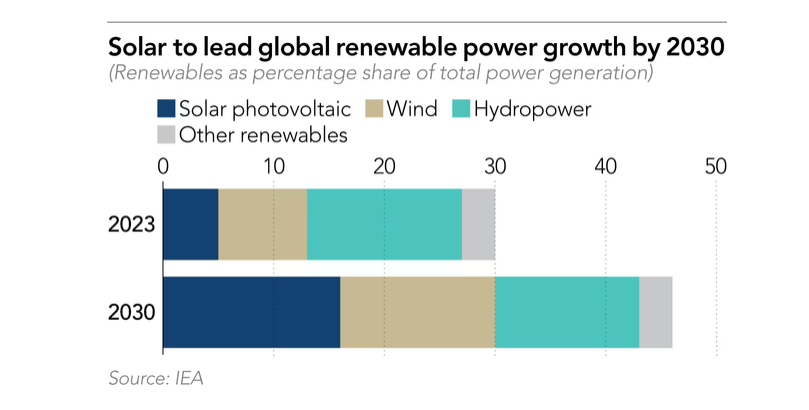
According to the International Energy Agency, solar energy is considered an accessible and easily deployable renewable energy source. In 2024 alone, a total of $500 billion was invested in this energy source, surpassing other alternative energy sources.
Nikkei Asia, citing sources, reported that offshore wind projects can take eight years or more to plan and build, while solar power plants can be deployed in less than two years.
Pressure to adopt renewable energy is increasing, particularly for emerging economies in Asia hoping to attract investment from foreign technology giants.
Companies like Apple, Google, and Microsoft have all joined the RE100 initiative, committing to using 100% renewable energy.
Production doubled globally.
In the 2000s, Japanese and Taiwanese (Chinese) companies such as Sharp, Motech, and New Solar Power led the photovoltaic sector, but they gradually lost their competitive edge to the rapid development of the Chinese economy, coupled with Beijing's subsidies for solar panel manufacturers.
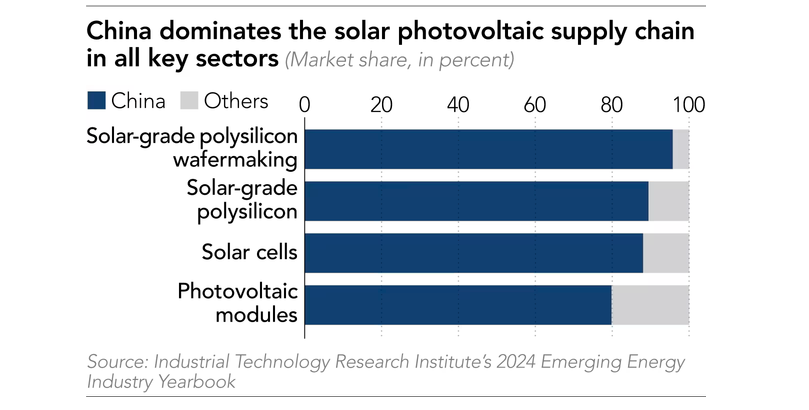
Currently, this country is home to most of the world's leading solar energy companies, such as Longi Green Energy Technology, Tongwei, GCL, Jinko Solar, and TCL Zhonghuan Renewable Energy Technology.
Furthermore, all three of the world's largest inverter manufacturers are also from China, including: Huawei, Sungrow Power, and Ginlong Technologies.
"China's total production capacity in one year could supply the entire world for two years," said Doris Hsu, President of Sino-American Silicon Products, a solar energy equipment manufacturer.
“China’s enormous economic and technological scale gives them a competitive edge in terms of cost. If you ignore trade barriers, then the solutions offered by mainland suppliers are clearly more reasonable,” added Doris Hsu.
According to the IEA, by 2030, China is still expected to maintain more than 80% of global production capacity for all segments of photovoltaic manufacturing, despite efforts by the US and India to shift supply chains locally.
The agency estimates that the cost of manufacturing the modules in the US and India is two to three times higher than in China. "This gap will persist for the foreseeable future."

Source: https://vietnamnet.vn/trung-quoc-nam-90-thi-phan-cung-ung-nang-luong-mat-troi-2343776.html


![[Image] Hanoi Police officially crowned champions of V-League 2025/2026](https://vphoto.vietnam.vn/thumb/1200x675/vietnam/resource/IMAGE/2026/05/31/1780244769054_ndo_br_039d561b692be875b13a-jpg.webp)


























![[Photo] The General Secretary, President and his wife begin their state visit to the Philippines.](https://vphoto.vietnam.vn/thumb/1200x675/vietnam/resource/IMAGE/2026/05/31/1780230559452_anh-man-hinh-2026-05-31-luc-19-28-11.png)




























































Comment (0)