

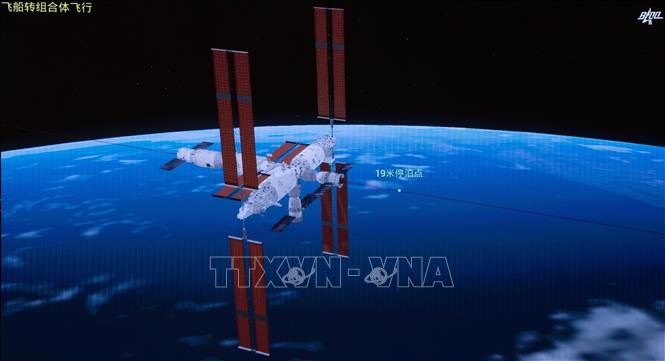
According to the Daily Mail (UK), this camera can operate from space, mounted on satellites, and still clearly identify the faces of people on Earth. Furthermore, the device is capable of capturing high-resolution images of military satellites from other countries orbiting our planet.
This technology has been described by scientists in a new paper and could be deployed to satellites in the near future. However, many people are concerned about the security of this system.
Robert Morton, author and member of the Association of Former Intelligence Officers (AFIO), commented on Twitter: "Millimeter-level resolution from over 100 km? This is surveillance at an extremely sophisticated level."
Meanwhile, Julia Aymonier, Director of Digital Transformation at API, posted on LinkedIn: “The future of space surveillance has arrived, and it’s more powerful than we imagined.”
This new surveillance camera was developed by the Aerospace Information Research Institute of the Chinese Academy of Sciences in Beijing. The camera uses a system called synthetic aperture lidar (SAL), a telemetry technology that works by emitting pulses of light energy and recording the amount of energy reflected back.
SAL technology can operate day and night, creating 2D and 3D models of the Earth's surface under various weather conditions. By utilizing optical waves, this technology enables the creation of images with extremely high resolution and detail, described as a leap forward in the field.
Tests were successfully conducted at Qinghai Lake, a region in northwestern China, where the SAL device was used to observe a target 101.8 km away. The results showed that the images obtained had exceptional sharpness at this distance, close to the boundary of space.
Notably, this device can detect details as small as 1.7 mm and measure distances with an accuracy of only 15.6 mm. However, SAL technology requires the movement of objects, such as satellites, to achieve optimal resolution.
Therefore, this camera may need to be mounted on Chinese satellites, or even on the country's Tiangong Space Station, a rival to the International Space Station (ISS) launched in 2021. Tiangong is currently traveling at 27,000 km/h in low Earth orbit, between 340 and 450 km from the planet's surface.
According to the Center for Strategic and International Studies, China is operating approximately 300 other surveillance satellites in low Earth orbit. Among them, the Yaogan-41 satellite, launched in December 2023, is used to test new technologies in constellations of satellites operating in low Earth orbit.
![[Photo] Solemn bathing ceremony and Buddha procession in Hue](https://vphoto.vietnam.vn/thumb/1200x675/vietnam/resource/IMAGE/2026/05/31/1780228263543_1-jpg.webp)


![[Image] Hanoi Police officially crowned champions of V-League 2025/2026](https://vphoto.vietnam.vn/thumb/1200x675/vietnam/resource/IMAGE/2026/05/31/1780244769054_ndo_br_039d561b692be875b13a-jpg.webp)
![[Photo] The General Secretary, President and his wife begin their state visit to the Philippines.](https://vphoto.vietnam.vn/thumb/1200x675/vietnam/resource/IMAGE/2026/05/31/1780230559452_anh-man-hinh-2026-05-31-luc-19-28-11.png)
![[Photo] Admire the coral "masterpiece" amidst the million-year-old heritage of Dak Lak province.](https://vphoto.vietnam.vn/thumb/1200x675/vietnam/resource/IMAGE/2026/05/31/1780221235105_anh-man-hinh-2026-05-31-luc-16-53-27.png)























![[Video] Sunset at Lap An Lagoon – Where the sun sets over the fishing nets](https://vphoto.vietnam.vn/thumb/340x192/vietnam/resource/IMAGE/2026/05/31/1780192137701_beach-landscape-sea-water-nature-grass-745871-pxhere-com.jpeg)






































![[Photo] Admire the coral "masterpiece" amidst the million-year-old heritage of Dak Lak province.](https://vphoto.vietnam.vn/thumb/402x226/vietnam/resource/IMAGE/2026/05/31/1780221235105_anh-man-hinh-2026-05-31-luc-16-53-27.png)

































Comment (0)