

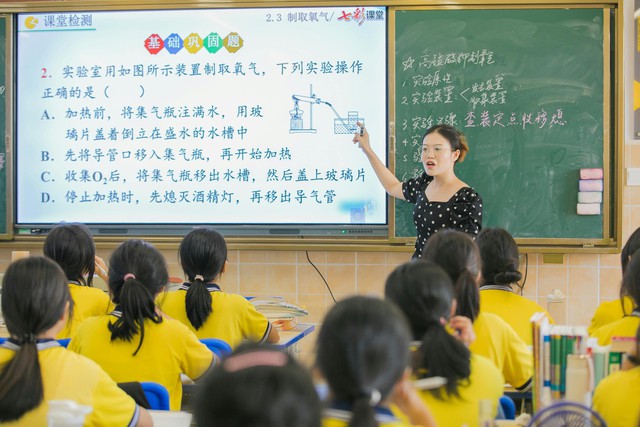
Chinese middle school students are now having more opportunities to be exempt from the 10th grade entrance exam.
ILLUSTRATIVE PHOTO: KIMMI JUN/PEXELS
In China, the 10th-grade entrance exam, also known as zhongkao, is considered one of the most important academic milestones in a student's life, as it determines whether they will attend high school or be channeled into vocational schools. According to Sixth Tone , the national pass rate typically hovers around 60% annually. By 2025, this rate is projected to reach 62.36%, according to the Chinese Ministry of Education .
The model of articulation from primary to high school.
To reduce exam pressure, the southwestern Chinese city of Chengdu launched a pilot program last September to provide a 12-year integrated education system across eight schools, both public and private. Under this program, students can skip directly to high school without taking the 10th-grade entrance exam. However, they are still allowed to leave the program to take the exam if they wish, according to China Daily .
Authorities explain that this reform aims to build a comprehensive educational roadmap from primary to high school, shifting the focus from grades to holistic development for students.
Shanghai also has similar interconnected school plans, stating that the model aims for uniformity in curriculum design and will optimize resource sharing between levels of education, such as laboratories, libraries, and specialized courses, in the context of fluctuating enrollment numbers. The city aims to develop integrated secondary schools – combining existing middle and high schools – to serve this purpose.
However, the authorities of both cities emphasized that implementing the integrated program does not mean abolishing the 10th-grade entrance exam citywide. Officials argued that streaming is necessary to support groups of students with different abilities, while also expanding job opportunities and developing the local economy . Therefore, vocational education is considered an important part of the entire education system.
Initiatives allowing exemptions from the 10th grade entrance exam have also emerged in some other cities, although mostly reserved for high-achieving students. However, some localities are expanding opportunities to include students with average academic performance.
For example, Beijing began experimenting with a more diverse high school admissions model in 2022, allowing students with GPA of "B" or higher to apply to some schools through interviews. Some individual schools also offer a direct pathway from junior high to high school without requiring a 10th-grade entrance exam; however, these programs are limited in scale and are usually implemented by schools with lower competition rates.
Abolishing the high school entrance exam has long been a desire of many Chinese parents, who worry that their children might be forced into vocational schools if they perform poorly on the exam. This is because vocational education is often associated with the stereotype of "lower-level education" or only for students excluded from academic pursuits.
Xiong Bingqi, president of the 21st Century Education Research Institute in China, argues that abolishing the 10th-grade entrance exam would require more far-reaching structural reforms, including eliminating the school hierarchy and narrowing the gap between general education and vocational education.
"As long as the elite high school system exists, concerns about the 10th grade entrance exam will not lessen," Bingqi stated.
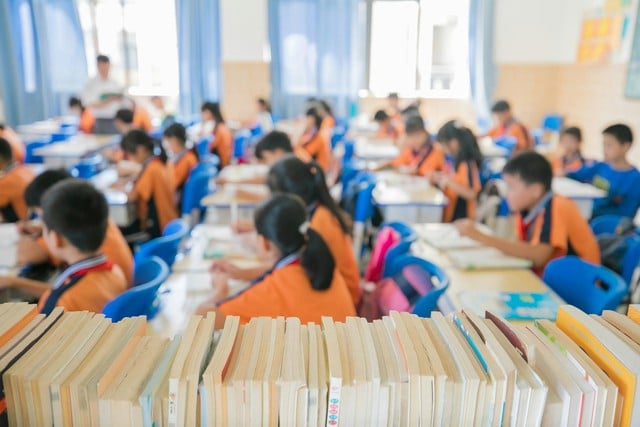
China is stepping up efforts to reduce academic and examination pressure.
ILLUSTRATIVE PHOTO: KIMMI JUN/PEXELS
Reduce the number of subjects in the 10th grade exam.
Another notable move by many Chinese localities to reduce exam pressure is to remove biology and geography from the grading system of the 10th grade entrance exam, starting in 2027. This comes as, in some provinces and cities, elementary school students have to study up to 11 subjects per week, while the number of subjects at the junior high school level has increased to 15.
Jilin Province is the latest locality to announce this reform on March 17th. According to the provincial education department, starting next year, biology and geography will no longer be included in the total grade for the 10th grade entrance exam. Instead, these two subjects will be assessed through open-book exams, with results expressed as letter grades rather than specific scores.
Similar reforms are also being implemented across China.
Huangshan City in Anhui Province will remove biology and geography from the 10th-grade entrance exam, instead requiring students to simply "pass" to be eligible for admission to top-tier high schools. Ji'an City in Jiangxi Province will adopt a computer-based exam format for these two subjects, with results considered only as a reference.
Meanwhile, Xiangtan City in Hunan Province reduced the number of subjects for grading to eight with a maximum total score of 655, removing biology and geography from the grading system, while expanding the open-book exam format and increasing enrollment quotas for disadvantaged schools.
Gao Hang, Vice President of the School of Education at Renmin University of China, said that the model of reducing the number of subjects in exams is becoming increasingly popular, and many other localities are also considering implementing similar reforms. These reforms typically include three main elements: shifting some subjects from "exams" to "assessments," changing from closed-book exams to open-book exams, and replacing numerical scores with a letter grading system.
"These measures help reduce academic and teaching pressure in schools, while also alleviating anxiety about competing for every single point. Previously, a difference of just one point could result in hundreds of students having different rankings," Mr. Hang shared.
Alongside reducing the number of subjects in the entrance exam, many localities in China are also expanding the scale of enrollment and increasing the number of places available in high schools. In January, Shengsi County in Zhoushan City (Zhejiang Province) even took a bolder step, attracting nationwide attention, when it announced the abolition of the streaming function of the 10th grade entrance exam, ensuring that all eligible junior high school students could attend high schools in the area.
Source: https://thanhnien.vn/trung-quoc-thi-diem-bo-thi-lop-10-voi-mo-hinh-moi-18526051911251537.htm

![[Photo] Ba Lang An Lighthouse - the "eye of the sea" amidst the "rock museum" of Quang Ngai province.](https://vphoto.vietnam.vn/thumb/1200x675/vietnam/resource/IMAGE/2026/05/29/1780038698840_anh-man-hinh-2026-05-29-luc-14-10-42.png)
![[Image] Pleasant weather helps students enter the 10th grade entrance exam with confidence.](https://vphoto.vietnam.vn/thumb/1200x675/vietnam/resource/IMAGE/2026/05/29/1780034401612_ngay-1-thi-lop-10-minh-duy-8-5009-jpg.webp)













































































Comment (0)