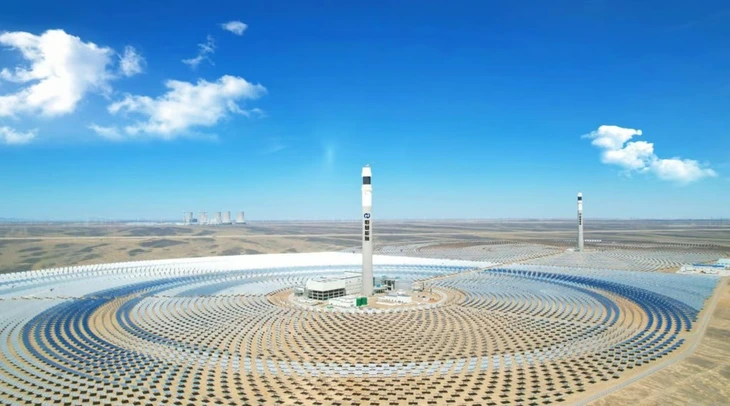
The east tower receives the morning sun and the west tower receives the afternoon sun - Photo: HANDOUT
China has officially commissioned the world's first solar thermal power plant in the Gobi Desert. This project is considered to utilize efficient and cost-effective technology, and has the potential for scalability.
Built by China's Three Gorges Corporation in Guazhou County, Gansu Province (northwest China), the plant utilizes two towers to power a single turbine – marking the world's first application of this model.
Nearly 27,000 mirrors have been installed to focus sunlight onto two 200-meter-tall towers, located about 1 kilometer apart.
The concentrated light generates high heat, melting and storing salt at temperatures up to 570 degrees Celsius. This energy is then used to create steam, operate turbines, and maintain a continuous power supply, even after sunset or on cloudy days.


According to CCTV , the twin-tower design allows the east tower to receive morning sunlight and the west tower to receive afternoon sunlight, increasing efficiency by approximately 25% compared to a single tower. The two overlapping mirror fields also reduce the number of mirrors needed, significantly saving on construction costs.
This design—and potentially future multi-tower systems—has broken the capacity limitations of single-tower plants, opening new avenues for scaling up solar thermal power development in China.
Unlike many previous solar thermal power projects in Europe and the US that operated independently, the Chinese plant is part of a larger clean energy complex. This complex, combined with massive existing wind and solar farms in the region, is expected to supply electricity to around half a million households annually.
Solar thermal power has a significant advantage over photovoltaic (PV) cells, thanks to its ability to continue generating electricity after dark.
Previously, China invested heavily in inexpensive wind and solar power in sunny and windy regions such as Gansu, Xinjiang, and Qinghai, but these sources lacked stability and could not meet demand at night or on cloudy days.
According to Wang Zhifeng of the Chinese Academy of Sciences , solar thermal power is not intended to compete with, but rather complement, PV batteries, helping to fill the gaps left by other renewable energy sources.
CCTV reported that China has built 21 commercial solar thermal power plants with a total capacity of 1.57 million kilowatts. An additional 30 projects are currently under construction, adding another 3.1 million kilowatts.
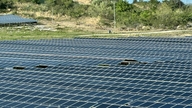


Globally, the largest operational solar-thermal power complex is the 700-megawatt Noor Energy 1 project in the United Arab Emirates.
China has also contributed to large-scale projects such as the Noor complex in Morocco and Cerro Dominador in Chile, where solar power remains a part of the national clean energy strategy.
Source: https://tuoitre.vn/trung-quoc-van-hanh-nha-may-nhiet-dien-mat-troi-giua-sa-mac-20251009164539348.htm




![[Photo] Prime Minister Le Minh Hung presides over the thematic session on promoting science and technology development and innovation.](https://vphoto.vietnam.vn/thumb/1200x675/vietnam/resource/IMAGE/2026/06/23/1782207872934_ndo_br_dsc-1724-jpg.webp)











![[GALLERY] 20-Year-Old Compact Cameras Unexpectedly Make a Comeback Thanks to Gen Z](https://vphoto.vietnam.vn/thumb/402x226/vietnam/resource/IMAGE/2026/06/24/1782275945979_anh-1-png.webp)