

The Ministry of Transport has issued the National Technical Standard on Technical Safety and Environmental Protection for Automobiles QCVN 09:2024, effective from January 1, 2025.
Dark yellow, with identifying markings for school buses.
According to QCVN 09:2024, the exterior of school buses must be painted in a dark yellow color covering the entire body. The school bus identification symbol must be placed on the front at the lower right corner of the windshield, on the rear, and on the front one-third of the vehicle body along both sides.
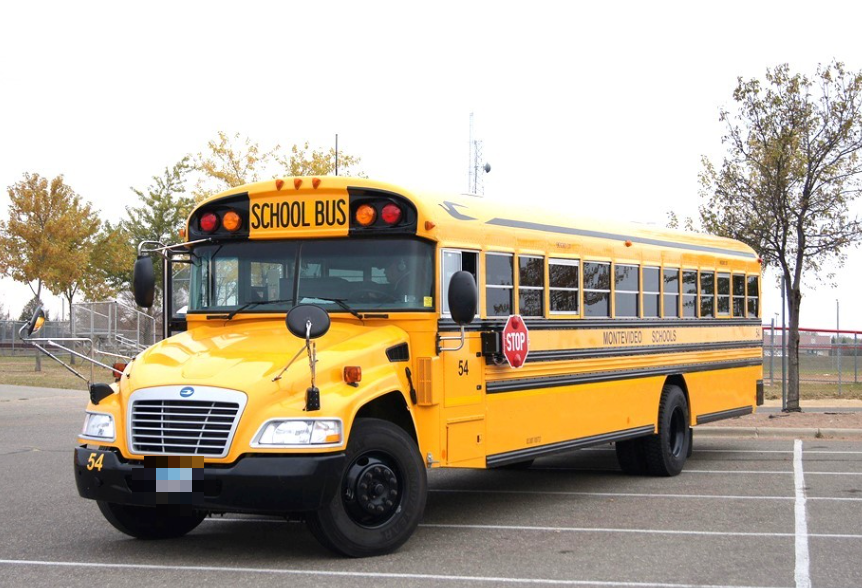
From January 1, 2025, newly manufactured, assembled, or imported school buses must comply with specific requirements in QCVN 09:2024, including being dark yellow in color and having warning signs or devices indicating when the vehicle stops to pick up students (illustrative image).
The identification markings on school buses feature reflective material or electronic LED lights. The overall shape and dimensions can be square (350mm x 350mm) or circular (350mm in diameter) as described in the regulations.
Specifically, double-decker buses and buses with connecting carriages must not be used as school buses. The interior and exterior of the buses must be free of holes, sharp edges, or defects that could cause injury to students.
For vehicles carrying preschool and elementary school children, there must be at least one additional seat for a student supervisor.
For vehicles with 29 seats or more (excluding the driver's seat) carrying 27 or more preschool and primary school children, a minimum of two seats must be provided for student supervisors.
For vehicles transporting preschool or primary school children, the total number of passengers, including the driver, must not exceed 45 people.
For vehicles designed to transport only preschool or elementary school children, the permitted number of passengers, including the driver, must not exceed 56.
Specifically, student seats must not be located in the first row alongside the driver's seat, but must be in the second row or later, and must be equipped with two-point seat belts.
School buses are not permitted to have overhead luggage racks; luggage compartments must be located inside the vehicle along its length. Steps (if any) must have handrails at the passenger doors and must not have any protrusions or ridges on the handrails that could injure students.
The passenger area of a school bus intended for students must have a flat floor structure with no steps or raised sections, except for raised structures such as wheel arches.
Emergency exit doors must be lockable and openable from either the inside or the outside to facilitate evacuation or rescue in emergency situations. Additionally, at least one first-aid kit clearly marked with a red "cross" symbol and an emergency alarm switch that emits an audible and visual alert must be installed to alert the driver, school supervisor, and students on board in special circumstances.
School buses must be equipped with at least two fire extinguishers, each weighing no less than 2 kg. One extinguisher should be placed near the student supervisor's seat in the passenger compartment, and the other near the driver's seat.
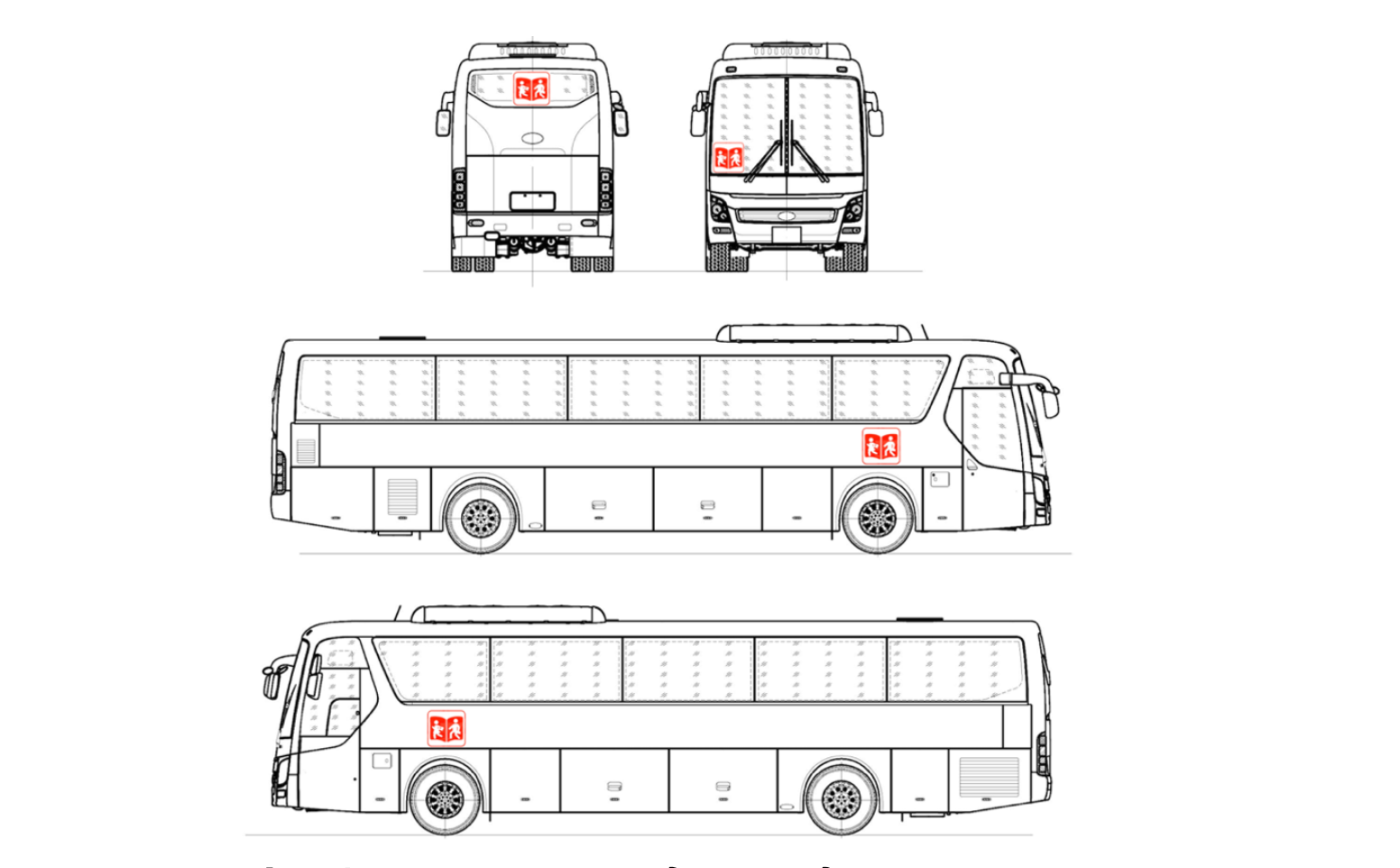
The identification markings for school buses must be placed on the front at the lower right corner of the windshield, on the rear, and on the front 1/3 of the vehicle body along both sides (illustrative image from QCVN 09:2024).
There must be a warning device to alert when stopping to pick up or leaving students behind on the bus.
The regulations also state that school buses must be equipped with a system to monitor the entire passenger area via rearview mirrors and an interior camera system to supervise the behavior of the driver, school supervisor, and students on board.
Outdoor cameras monitor traffic conditions outside the entrance/exit gates, and automatic hazard warning lights are activated when the gates open to drop off or pick up students. The cameras must have a system for recording and processing information.
In addition, the vehicle must be equipped with an electric warning light or a stop warning sign. These devices are intended to warn other vehicles not to overtake when the school bus is parked at a bus stop to pick up or drop off students. The electric warning light is installed at the rear of the vehicle, or the stop warning sign is installed on the front and rear left side of the vehicle.
For warning devices using lights, regulations stipulate that LED lights or light boxes using other types of lights may be used. The device runs horizontally across the rear window of the vehicle. The device emits a red light and displays a white illuminated message with a minimum height of 130mm that reads: "Stop and wait".
For stop warning signs, they must be circular or hexagonal in shape with a minimum size of 150 mm. The sign must be painted or coated with a reflective material. The background color of the sign is red with white lettering: "Stop" at a minimum height of 40 mm. The arm of the warning sign can be automatically opened and closed when the vehicle is moving at a speed exceeding 5 km/h. The stop warning sign can also be operated manually in case of a malfunction of the automatic system.
The regulations also state that when the vehicle's doors open to pick up or drop off students, the above systems must automatically activate, the lights will turn on, or the sign's arm will open. The vehicle may be equipped with a combination of lighting systems using advanced technology, illuminating the road surface to create a no-overtaking zone surrounding the vehicle (behind and to the left) to warn vehicles behind not to overtake or to stop as indicated.
Notably, school buses must be equipped with a system to alert students if they are left behind. This system can operate automatically or manually, independently or in conjunction with other warning systems.
The warning system must meet the following requirements: Three minutes after the engine is switched off, the system will issue a warning using lights or an audible alert inside the vehicle, prompting the driver to check the vehicle to avoid leaving students behind. The warning deactivation switch must always be in the normally open position and can only be activated after the system issues a warning inside the vehicle. It must be located at the rear of the vehicle on the driver's side.
After 3 minutes from the time the alarm is triggered inside the vehicle, if the alarm deactivation switch is not activated, the system will issue a warning via lights or sound outside the vehicle, ensuring that anyone standing outside the vehicle is aware of it.
The warning system must have an independent power source separate from the vehicle's electrical system, ensuring that the warning system continues to function normally even when the vehicle is switched off and while it is parked.
If the vehicle is not equipped with the aforementioned warning systems, it must be equipped with a similar warning system that ensures that when the driver and supervisor have left the vehicle, the warning system can identify any students left behind and immediately transmit an urgent message to the driver, student supervisor, or operations center.
Source: https://www.baogiaothong.vn/tu-2025-xe-cho-hoc-sinh-phai-co-nhan-dien-ra-sao-19224122909584879.htm
![[Image] Hanoi's urban life under the challenge of a "scorching hot" environment](https://vphoto.vietnam.vn/thumb/1200x675/vietnam/resource/IMAGE/2026/05/25/1779706979265_nang-nong-t5-2026-minh-duy-7-4636-jpg.webp)










































































































Comment (0)