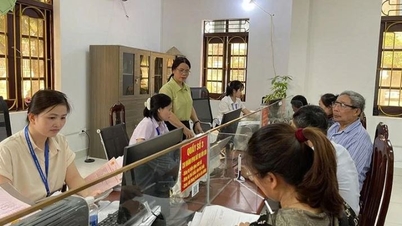
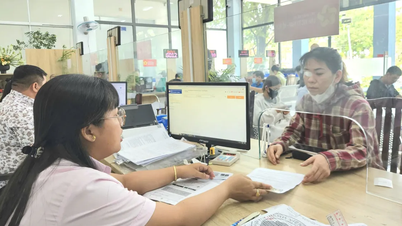
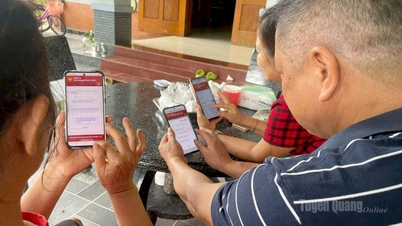
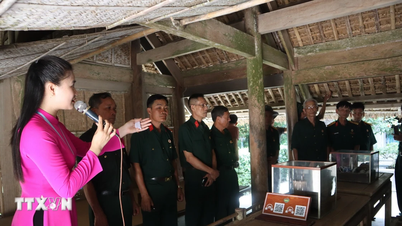
Members of the Digital Technology Team of Thuong Lam commune guide residents on how to use the VNeID application on their mobile phones. |

The torch illuminates the mountains and forests of Tuyen Quang.

 Báo Tuyên Quang•15/08/2025
Members of the Digital Technology Team of Thuong Lam commune guide residents on how to use the VNeID application on their mobile phones. |
The torch illuminates the mountains and forests of Tuyen Quang.
In September 1945, just a few weeks after gaining independence, on October 4th, 1945, President Ho Chi Minh issued an appeal to the entire nation to combat illiteracy. At that time, estimates suggested that in Tuyen Quang province, a region with rugged terrain and a population of over 80% ethnic minorities, the illiteracy rate was over 95%.
The "Popular Education Movement" emerged as a beacon illuminating the mountains and forests of Tuyen Quang, with the slogan "All people learn to read and write, all people teach literacy." In just the first five years (1945-1950), over 10 million people nationwide escaped illiteracy. In Tuyen Quang alone, archival data shows that during the 1945-1955 period, approximately 170,000 people participated in literacy classes. The "Popular Education Movement" continued to grow, from 2.5 million people freed from illiteracy in 1946, to 6 million in 1948, and further to 10 million by 1952. After the liberation of the South and the complete reunification of the country, the lessons learned from the "Popular Education Movement" were flexibly applied in the national education and training reform.
Ms. Ma Thi Lia, 84 years old, from Ham Yen commune, recalled with tears in her eyes: "Back then, we went to school at night, rain or shine, we had to light oil lamps and sit on bamboo platforms to study. But knowing how to read and write was a great joy. Thanks to that, I can still read documents and teach the children."
According to Mr. Hang Mi De, 79 years old, former Director of the Department of Education and Training, he shared: "I still remember the image of people aged 50-60 coming to class for the first time to learn to read and write, holding a pen to practice writing their names, and young children coming to literacy classes with their mothers and grandmothers. By the end of the 1990s, many communes in the province announced the completion of universal literacy, an achievement that not only changed perceptions but also opened a path to sustainable development for future generations."
Alongside the fight against illiteracy, our people also had to battle famine. In 1944-1945, famine caused the deaths of over 2 million people in the North. In Tuyen Quang, the indirect consequences of crop failure and war also plunged thousands into extreme poverty. Therefore, immediately after seizing power, the Provisional Government, headed by President Ho Chi Minh, launched movements to combat famine, such as the "Golden Week" campaign, the "Sharing Food and Clothing" movement, and the "Rice Jar for Famine Relief" initiative. Simultaneously, they launched movements to increase production and improve people's lives. In many localities, including Tuyen Quang, the revolutionary government organized the reclamation and restoration of abandoned farmland after the famine, and tens of thousands of hectares of land were brought into cultivation.
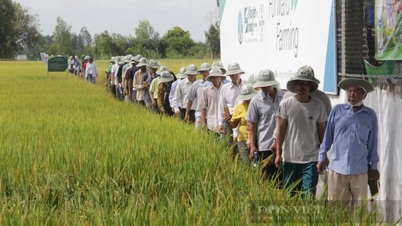
A major milestone in the journey to overcome hunger was the 1986 reform policy, the "contract farming" system in agriculture which "unleashed" farmers. Just a few years later, from a country plagued by chronic food shortages, Vietnam became a rice exporting powerhouse. By the mid-1990s, the country's rice production exceeded 25 million tons per year, placing Vietnam among the top three rice exporters in the world. This was a great victory for the will and aspiration of the Vietnamese people to live and thrive.
Building new rural areas
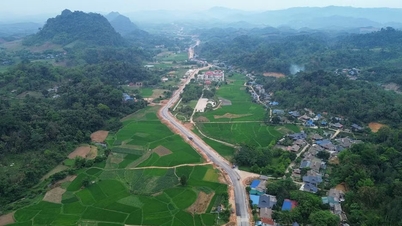
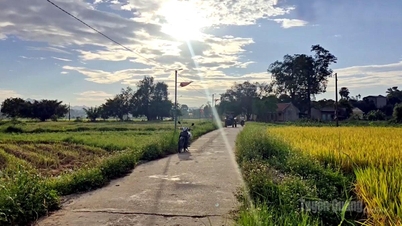
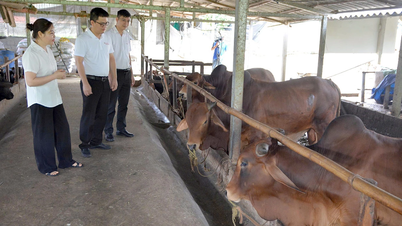
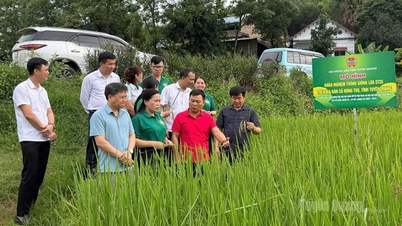
Despite its remarkable achievements, Tuyen Quang province still faces many challenges. At the start of the new rural development program in 2010, most communes lacked electricity, roads, schools, and health stations; the poverty rate exceeded 50%. Faced with these challenges, the Tuyen Quang provincial Party committee and government devised solutions and developed an implementation roadmap, placing the people at the center. This included mobilizing land donations and labor contributions, monitoring construction projects, tackling easier tasks first, and more difficult ones later; and building and replicating model residential areas and model gardens suitable for each locality. Simultaneously, the province issued mechanisms and policies to encourage people to develop production, cultivate economic forests and medicinal plants, and raise livestock along the value chain. New-style cooperatives and cooperative groups were established to connect markets and increase income; vocational training programs, technology transfer, and communication on hygiene and environmental protection were intensified.
According to a report from the Office for Coordinating the National Target Program on Building New Rural Areas, before the merger, the province had 139 communes meeting the new rural area standards, including 88 communes in the former Tuyen Quang province and 51 communes in the former Ha Giang province; 21 communes met the advanced new rural area standards; and 8 communes met the model new rural area standards. After the merger of the two provinces and the reorganization of administrative boundaries, the entire province now has 35 communes meeting the new rural area standards; and 1 commune meeting the advanced new rural area standards.
Promoting digital literacy and building digital citizens.
In accordance with Plan No. 01-KH/BCĐTW dated March 21, 2025, of the Central Steering Committee on the Development of Science, Technology, Innovation, and Digital Transformation of the Nation, the Standing Committee of the Tuyen Quang Provincial Party Committee issued Plan No. 01-KH/TU dated June 5, 2025, to implement the "Digital Literacy Movement" throughout the province. To ensure that every citizen has access to technology, effectively uses digital platforms, and develops the habit of applying digital transformation in their daily lives and work, Tuyen Quang province has established over 3,500 community digital technology groups with 12,000 members. This is the core force in popularizing digital knowledge in the locality.
According to Mr. Do Anh Tuan, Director of the Department of Internal Affairs, the rate of people using online public services has increased significantly. Many farmers have learned to list their products on e-commerce platforms and use e-wallets to pay their electricity and water bills. 100% of officials and civil servants have email accounts; leaders are equipped with specialized digital signatures; and all agencies and communes participate in paperless meetings. Notably, the rate of level 4 online public services is currently at 80-87%, with nearly 90% of results delivered online.
Tuyen Quang is not only a historical "Capital of Resistance," but also a model of revival and sustainable development. The literacy campaigns of the 20th century sowed the seeds for generations to overcome difficulties and learn to change their destiny. It is from this foundation that Tuyen Quang today has become a symbol of overcoming adversity and striving for progress in a learning, humane, and culturally rich society.
Text and photos: Hoang Ngoc
Source: https://baotuyenquang.com.vn/xa-hoi/202508/tu-diet-giac-dot-den-binh-dan-hoc-vu-so-8ed154c/





![[Photo] General Secretary and President To Lam presides over the meeting to approve the draft report on the results of the second inspection by the Politburo of the Standing Committee of the Hanoi City Party Committee.](https://vphoto.vietnam.vn/thumb/1200x675/vietnam/resource/IMAGE/2026/05/26/1779789811432_a2-bnd-4430-9620-jpg.webp)








![[Infographic] Vietnam-Thailand Comprehensive Strategic Partnership](https://vphoto.vietnam.vn/thumb/402x226/vietnam/resource/IMAGE/2026/05/27/1779854632675_infographic-quan-h_65_1779854266.jpeg)









































































Comment (0)