

The rights and dignity of human beings, including victims of human trafficking, especially women and children, must be respected and protected through policies, institutions, and social support. A gender-sensitive, rights-based approach should be implemented in the revised Law on Prevention and Combat of Human Trafficking, currently being drafted by the Ministry of Public Security .
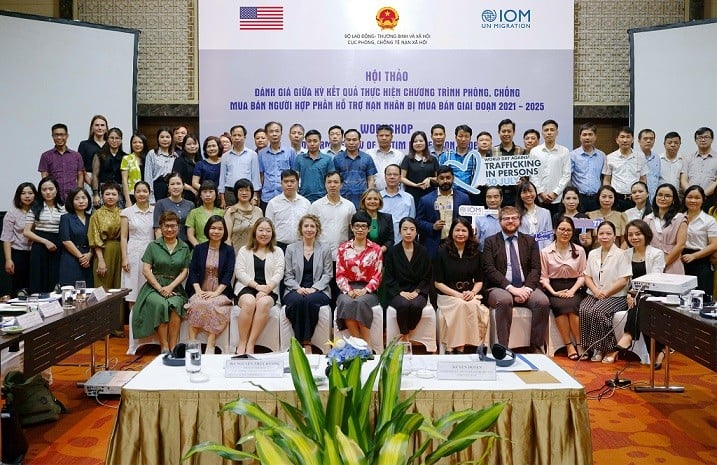 |
| On August 9, 2023, the International Organization for Migration and the Department of Social Evils Prevention under the Ministry of Labour, Invalids and Social Affairs completed a series of workshops on the Mid-Term Review of the Implementation Results of the Program on Prevention and Combatting Human Trafficking for the period 2021-2025 in the field of victim protection in Ho Chi Minh City. (Source: VNA) |
Since the Law on Prevention and Combatting Human Trafficking came into effect, initial results have been achieved in identifying and supporting victims of human trafficking, contributing to the protection of human rights and the protection of victims.
According to the Ministry of Public Security's report summarizing the implementation of the Law on Prevention and Combat of Human Trafficking, from 2012 to February 2023, authorities received and assisted 7,962 victims of human trafficking. Most of the rescued victims, whether through repatriation or their return, received appropriate support from local authorities.
The implementation of the Law on Prevention and Combat of Human Trafficking has helped to curb the increase in human trafficking crimes, contributing to ensuring social order and safety, and protecting human rights. However, after 10 years of implementation, some provisions of the Law are no longer suitable for current practices, requiring amendment and supplementation.
1. Supplementing the principles of ensuring gender equality and victim-centered approach.
The current Law on Prevention and Combat of Human Trafficking reflects several principles of gender and gender equality in its provisions, including: the principle of preventing and combating human trafficking, "Respecting the legitimate rights and interests of victims and not discriminating against them" (Article 4); the prohibited act, "Discrimination against victims" (Article 3); and the content of information, propaganda, and education on preventing and combating human trafficking, "Combating discrimination against victims" (Article 7)...
However, these are still gender-neutral regulations and do not clearly reflect the principle of ensuring gender equality in the prevention and combating of human trafficking.
Research findings indicate that human trafficking is considered a form of gender-based violence; the trafficking of women and girls is an act of gender-based violence, where gender power is abused, causing harm to women and girls. The motivations for human trafficking are highly gender-specific and are exacerbated by pre-existing gender inequalities.
Accordingly, women and girls are more vulnerable to human trafficking for sexual exploitation, while men and boys are targets of traffickers for labor exploitation or criminal activities. The severity of harm also differs relatively between male and female victims.
Therefore, it is necessary to add the principle of ensuring gender equality and a victim-centered approach to the prevention and combat of human trafficking in Article 4 of the current Law. This is an overarching principle that guides all efforts to prevent and combat human trafficking.
2. Supplementing regulations on the rights and obligations of victims.
Clause 2, Article 16 of the 2011 Law on Prevention and Combat of Human Trafficking stipulates: "Mass media participating in the prevention of human trafficking must keep information about victims confidential"; Point b, Clause 1, Article 30 stipulates: "Measures to protect the safety of victims and their relatives include keeping confidential the place of residence, workplace, and study of the victims and their relatives"; Article 31 stipulates: "Protecting the confidentiality of information about victims, in which agencies, organizations, and individuals are responsible for keeping information about victims confidential, except in cases where the law provides otherwise."
The court considers and decides on closed trials for human trafficking cases at the request of the victim or the victim's legal representative. These regulations, to some extent, define the responsibility of individuals and organizations in protecting the confidentiality of information of human trafficking victims.
However, the law's failure to address the issue of information security in the rights of victims of human trafficking is a shortcoming. Currently, with the rapid development of information technology, the participation of streamers, TikTokers, and YouTubers on social media regarding private personal matters has a double-edged nature, with many cases involving seeking likes, making money, and manipulating public opinion.
In addition, according to statistics, at the beginning of 2022, Vietnam had nearly 77 million social media users, accounting for 78.1% of the population, an increase of 5 million compared to 2021; 97.6% of internet users in Vietnam are using Facebook, and the percentage of women using Facebook is 50.9%.
This presents an opportunity for women to access and enhance their knowledge and skills, but it also carries the risk of becoming victims of various types of crime, including human trafficking, if they are not equipped with the knowledge and skills to safely protect their information in cyberspace.
Adding the right to privacy, personal information, and family secrets to the list of victim rights will help victims become more aware of their rights and also provide a basis for law enforcement agencies to protect victims more effectively against public opinion.
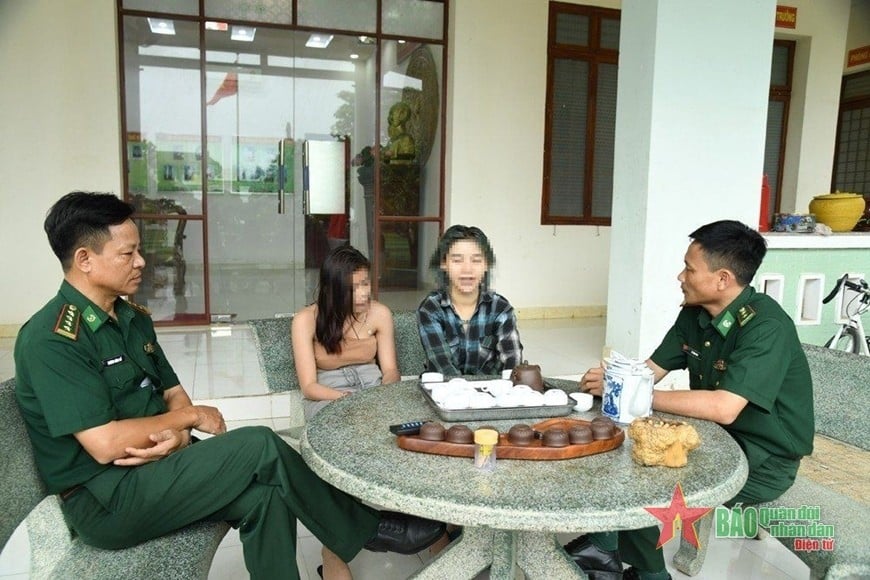 |
| Two female victims recounted their journey of being sold through multiple hands before being rescued by the Border Guard of Tay Ninh province in the TN823p special operation. |
3. Supplementing criteria for verifying and identifying victims of human trafficking.
Current laws lack specific criteria for identifying victims of human trafficking, including documentary and factual criteria for determining whether a person has been trafficked.
The research results have revealed several barriers in verifying and identifying victims, such as: victims losing their identification documents, low education level, being from ethnic minorities, not knowing the Kinh language, being trafficked as children and therefore not remembering their addresses or relatives, etc.; victims refusing support because they do not want to tell their stories for fear of discrimination.
The criteria for identifying a person as a victim are difficult to establish, especially in cases where they acted voluntarily, or when a long time has passed since the trafficking (making it difficult to determine how they were transferred or exploited).
The lack of regulations regarding remuneration for interpreters in cases involving foreign victims, ethnic minorities, or those with intellectual disabilities hinders the process of receiving and assisting victims, including handling reports, rescuing them, and conducting investigations. Furthermore, there are no regulations or standards for special, urgent cases requiring assistance and protection for female victims, girls, or infants during rescue operations.
Therefore, it is essential to supplement regulations on criteria for verifying and identifying victims of human trafficking in a way that does not harm the victims or exacerbate the trauma they have already experienced during the trafficking process.
In particular, these regulations need to be categorized in order to provide adequate and timely support policies and schemes based on the specific characteristics of each victim, ensuring the human rights of each target group, taking into account gender specificities, for example, vulnerable groups, pregnant women, women raising young children, etc.
| “Development visions and practices must ensure fundamental human rights—social, economic, and political—to expand opportunities for choice, respect human dignity, empower women, and promote equality for both men and women.” (Ms. Jean D'Cunha, Global Migration Advisor, UN Women Agency for Gender Equality and Women’s Empowerment). |
4. Supplementing regulations on the rights of children born as a result of their mothers being trafficked abroad.
Current laws contain some provisions on protecting children, but they are often approached from the perspective of children who are victims of human trafficking (Articles 11, 24, 26, and 44). However, there are no clear regulations for children whose mothers are victims of human trafficking for the purpose of sexual exploitation. Many cases involve women who are victims of human trafficking giving birth abroad, but upon being rescued and returning home, they are unable to bring their children with them.
The Vietnam Women's Union, in its operation of the House of Peace and the One-Stop Service Office for the Repatriation of Migrant Women (OSSO Office), has received and supported several typical cases. The OSSO Hai Duong Office once received the case of Ms. H., who was trafficked to China in 1991 and forced to live with a Chinese man. During their time together, she gave birth to three children. Her life was marked by frequent beatings and hard labor. In 2017, she returned to Vietnam but was unable to bring her children with her.
The House of Peace, under the Vietnam Women's Union, also provided counseling and support to Ms. C., a schizophrenic patient who was tricked into marrying a Chinese man. Since arriving in China, she lost contact with her family. After about a year in China, following the birth of her child, her husband abducted her and abandoned her at the hospital. She lived with a group of people and was forced to work as an unpaid kitchen helper, facing verbal abuse and physical assault if she disobeyed. When Chinese police discovered she had no identification documents, she was deported back to Vietnam. After receiving support from the House of Peace, Ms. C. has now returned to live with her mother, but has no information about her child.
Therefore, it is suggested that further research be conducted to include regulations on the rights of children born as a result of their mothers being trafficked abroad.
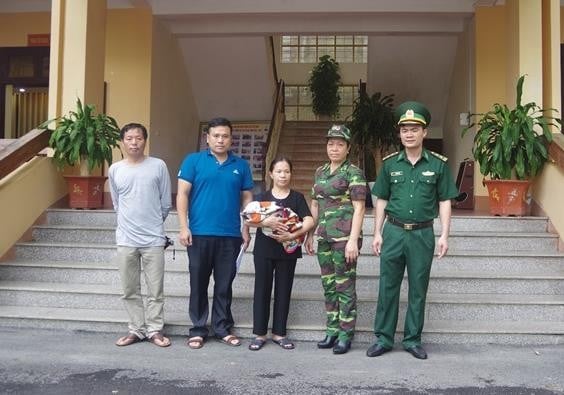 |
| The Huu Nghi border gate border guard station handed over the rescued newborn baby to the social welfare facility in Lang Son province. (Source: Border Guard Newspaper) |
5. There are specific regulations regarding specialized facilities to support victims of human trafficking, specifically for men and women.
Over the past period, returning victims of human trafficking have been received and supported at social protection centers or social work centers (49 facilities nationwide), while others have been received at other social facilities; in addition, they have also been received and supported at facilities/locations/models supported by international organizations or through the proactive efforts of agencies and units such as the House of Compassion in Lao Cai and An Giang; and the House of Peace of the Center for Women and Development.
Social welfare facilities that receive victims of human trafficking do not have dedicated areas for assisting victims, but instead integrate them into the living quarters of other groups. This leads to difficulties in implementing support programs due to the lack of appropriate and friendly procedures for receiving victims, the absence of regulations on case management and specific victim support procedures; and, in particular, the complete lack of regulations for receiving victims in emergency situations or those suspected of being trafficked while awaiting verification and identification.
In reality, there remains a significant gap in ensuring access to support services for both male and female victims. Support services have primarily focused on female victims trafficked across borders for marriage or prostitution, while other vulnerable groups such as male construction workers, service workers, fishermen, or those trafficked domestically often receive less attention.
We focus more on providing support services for female victims than for male victims, leading to a situation where there are only specialized support facilities for female and girl victims, but not for male victims. As a result, the legitimate needs and rights of male victims seem to be neglected.
Therefore, to fully ensure the rights of victims of human trafficking, the amended Law on Prevention and Combat of Human Trafficking needs specific provisions on the establishment, management, and operation of facilities for receiving and supporting victims, based on meeting their gender needs and legitimate rights and interests.
----------------------
(*) Deputy Head of the Propaganda Department, Vietnam Women's Union
References
1. ASEAN. 2016. Guidance document on gender sensitivity in contacting and working with women who are victims of human trafficking.
2. ASEAN-ACT. 2021. Summary of difficulties and obstacles in the Law on Prevention and Control of Human Trafficking 2011 and its implementing guidelines.
3. Blue Dragon Children's Foundation. 2021. What makes people vulnerable to human trafficking. Profile of victims of human trafficking in Vietnam
4. Politburo. 2007. Resolution No. 11/NQ-TW dated April 27, 2007 of the Politburo on Women's Work during the Period of Accelerated Industrialization and Modernization of the Country
5. Ministry of Public Security. 2021. Summary Report on 9 years of implementing the Law on Prevention and Control of Human Trafficking in 2011. Report No. 520/BC-BCA dated June 3, 2021.
Source
























































































Comment (0)