

The worship of the God of Agriculture, along with seasonal festivals such as prayers for a good harvest, prayers for rain, ceremonies for planting and harvesting crops, and offerings of new rice, clearly reflects the religious life of the San Diu community in Bac Ninh. Agricultural beliefs not only play an important role in the spiritual life of the San Diu people but also contribute to shaping the cultural identity of this ethnic group in the midland and mountainous region of Bac Ninh province. The place of worship for the God of Agriculture among the San Diu people may be a small shrine, or sometimes just an altar next to a religious or spiritual building.
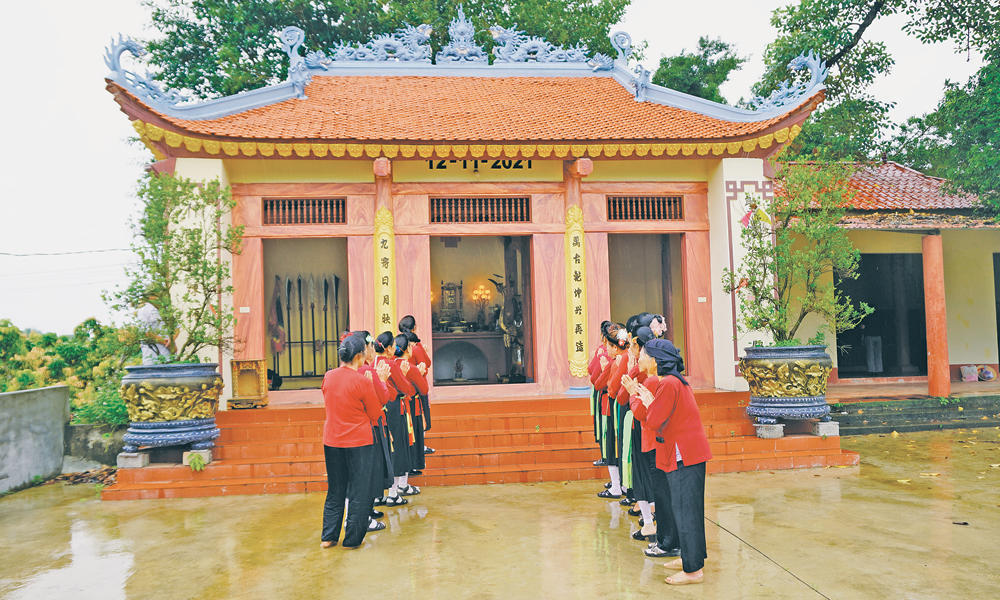 |
The San Diu people hold a ceremony offering incense and new rice at the Say To communal house (Chu ward). |
The altar dedicated to the God of Agriculture of the San Diu people in Ben Huyen village, Nam Duong commune, is built right at the village temple gate next to a tree. It has a pedestal with an incense burner on top. Similarly, the shrine dedicated to the God of Agriculture of the San Diu people in Ho Sen residential area, Chu ward, is built next to the village temple; it is a small, simple structure containing an altar to the God of Agriculture. In some places, the worship of the God of Agriculture is also combined with the worship of the God of Agriculture within the village temple. Besides these shrines and altars dedicated to the God of Agriculture, the agricultural beliefs of the San Diu people are also expressed in the following rituals and customs:
The ceremony of going to the fields.
Typically, the San Diu people's field-opening ceremony is held on the 4th day of the first lunar month each year, also known as the spring opening ceremony.
| Agricultural beliefs not only play an important role in the spiritual life of the San Diu people but also contribute to shaping the cultural identity of this ethnic group in the midland and mountainous region of Bac Ninh province. The San Diu people's place of worship for the God of Agriculture is often a small shrine, or sometimes just an altar next to a religious or spiritual building. |
The ceremony is meticulously prepared with the hope of a smooth start to the upcoming harvest season. The offerings include a pig's head, sticky rice, boiled pork, boiled chicken, a plate of salt, fruits, wine, glutinous rice cakes, and other traditional cakes. Mr. Mô (the caretaker of the communal house) will represent the villagers in lighting incense, inviting the village guardian deity, the God of Agriculture, and other mountain and land spirits to attend the meal and pray for blessings for prosperity, happiness, and favorable weather for the villagers.
After the ceremony, the villagers partake in the offerings and immerse themselves in the melodies of traditional folk songs. All agricultural work is only carried out after the ceremony is over; the villagers then go down to the fields to make the first plowing, witnessed by the deities, hoping for a bountiful harvest.
The ceremony of going down to the fields (to the rice paddies)
The rice planting ceremony is usually held on the 16th day of the fourth lunar month every year, also known as the "going down to the fields" ceremony. This is also an important ritual in the production cycle, performed at the village communal house or shrine dedicated to the God of Agriculture to ask the village guardian deity and the God of Agriculture to bless the villagers with favorable weather, bountiful harvests, and healthy livestock for the new season.
The offerings for the ritual include sticky rice, chicken, pork, wine, banh chung (traditional Vietnamese rice cake), fruits, etc., all products made by the San Diu people. After the shaman completes the ritual of invoking the spirits and expressing the villagers' wishes, the people go down to the fields to plow and prepare for a new planting season.
The ritual of offering rice to the spirits (spirit possession)
The San Diu people also call it the plowing and harrowing ceremony. The plowing ceremony is usually held on the 13th day of the seventh lunar month every year. Villagers contribute food and wine to prepare offerings for the ceremony at the shrine of the God of Agriculture. The ceremony is performed at the village communal house and the shrine of the God of Agriculture first, after which the villagers return to prepare a meal to offer to their ancestors.
After plowing, the villagers perform the shamanic ritual to thank the village guardian deity, the God of Agriculture, and their ancestors, marking the end of a period of hard labor. The shamanic ritual signifies gratitude to the deities and the God of Agriculture, and a prayer for favorable weather and a higher harvest in the following year. After the shaman performs the ritual to the God of Agriculture, the villagers partake in the offerings at the village temple.
New Year's Rice Festival
The New Rice Festival is celebrated on the 10th day of the 10th lunar month. This is an occasion for villagers to express gratitude to the deities, especially the God of Agriculture, for blessing them with a bountiful harvest and protecting them, ensuring peace and prosperity throughout the year. It is also a ritual to invite the God of Agriculture back to heaven to rest after a year of overseeing the fields, before the start of a new planting season.
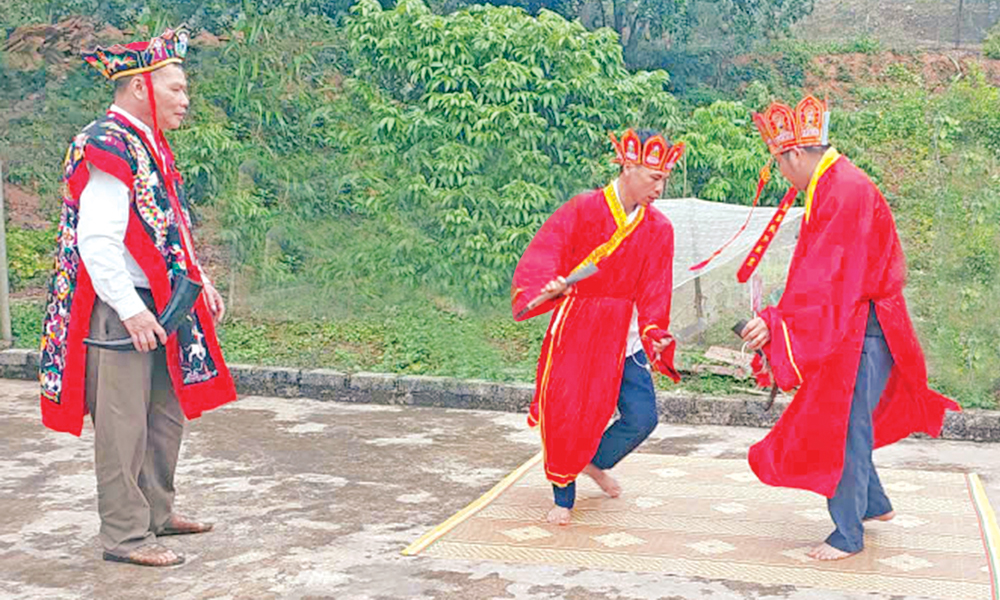 |
The folk religious practices of the San Diu people in Luc Ngan commune during the new rice offering ceremony. |
The offerings at the temple or shrine of the God of Agriculture must include freshly cooked rice and sticky rice made from newly harvested rice – products obtained thanks to the blessings of the deities, expressing both reverence and a hope for a bountiful harvest in the coming season. The offerings to the God of Agriculture are placed inside the temple or shrine. After the ceremony, the God of Agriculture is sent back to heaven, marking the end of a year's farming cycle.
The temple closing ceremony
The San Diu people's temple closing ceremony usually takes place on the 26th day of the 12th lunar month. This ritual marks the end of the year's planting and harvesting cycle. The ceremony includes the usual rituals such as the going-to-the-field ceremony and the planting ceremony, but the prayers will vary in content: announcing the end of the year's harvest season, allowing people to rest, and praying for good fortune and a bountiful harvest in the new year.
In particular, on this day, people will erect a ceremonial pole in front of the communal house, signifying the end of a year of hard work and a time for everyone to rest and celebrate the Lunar New Year. The pole will be removed on the 4th day of the first lunar month of the following year, and a ceremony will be held to begin the new farming season.
The worship of the God of Agriculture is one of the many forms of belief that the San Diu people still maintain in their daily lives today. This is a beautiful cultural aspect that the people still preserve in their lives and needs to be protected and promoted.
Source: https://baobacninhtv.vn/bg2/dulichbg/tuc-tho-than-nong-cua-nguoi-san-diu-postid438786.bbg
![[Image] Close-up view of the interchange connecting the two expressways and Long Thanh Airport.](https://vphoto.vietnam.vn/thumb/1200x675/vietnam/resource/IMAGE/2026/05/25/1779703378210_ndo_br_z7863716673926-224453a31600126cce10622af6290afd-4549-jpg.webp)

![[Image] Hanoi's urban life under the challenge of a "scorching hot" environment](https://vphoto.vietnam.vn/thumb/1200x675/vietnam/resource/IMAGE/2026/05/25/1779706979265_nang-nong-t5-2026-minh-duy-7-4636-jpg.webp)













































































Comment (0)