

Expanding branch locations in various localities.
In recent years, many universities have continuously expanded their branch campuses by merging with local colleges. For example, in 2019, the University of Economics Ho Chi Minh City opened a branch campus in Vinh Long based on the Vinh Long College of Economics and Finance. The University of Education Ho Chi Minh City has a branch campus in Gia Lai province based on the Gia Lai College of Education and a branch campus in Long An (now part of Tay Ninh province) based on the Long An College of Education. This year, the University of Technical Education Ho Chi Minh City officially enrolled students for a branch campus in Binh Phuoc (now part of Dong Nai province) based on the Binh Phuoc College. Can Tho University also established a branch campus in Soc Trang based on the facilities of Soc Trang Community College.

Model of the Ho Chi Minh City University of Economics branch in Khanh Hoa province.
PHOTO: TK
In addition, many universities have at least two campuses outside their main campus, such as: Ho Chi Minh City University of Agriculture and Forestry with two campuses located in Gia Lai and Ninh Thuan provinces (now part of Khanh Hoa province), Ho Chi Minh City University of Industry with two campuses in Quang Ngai and Thanh Hoa, Ton Duc Thang University with campuses in Khanh Hoa and Lam Dong; Ho Chi Minh City University of Economics with two campuses in Vinh Long and Khanh Hoa, Ho Chi Minh City University of Education with two campuses in Gia Lai and Long An (Tay Ninh province)...
Notably, some localities have become destination centers for postgraduate studies at many universities, such as Khanh Hoa. Currently, this province has postgraduate centers for many universities, including: Ho Chi Minh City University of Economics, Ton Duc Thang University, Ho Chi Minh City University of Technology, and Ho Chi Minh City University of Law.
Not only universities in Ho Chi Minh City, but also many educational institutions headquartered in Hanoi are tending to build additional training facilities in other localities. For example, the National Economics University and the Banking Academy opened branches in Ha Nam (now Ninh Binh); Hanoi University of Science and Technology plans to build a second campus in Hung Yen… Among them, some universities have plans to build new campuses in Bac Ninh such as: Hanoi Law University, Hanoi University of Pharmacy, Foreign Trade University, Hanoi Medical University…
THE DIFFERENCE BETWEEN A BRANCH AND A HEAD OFFICE
Given this trend, a key concern for many students is the difference between studying at PH and the school's main campus.

Ho Chi Minh City University of Technology and Education officially opens enrollment for its branch campus in Binh Phuoc (Dong Nai province).
PHOTO: TL

Universities have different orientations when developing postgraduate programs, but basically, the programs and degrees offered at postgraduate and main campuses will not differ. Differences, if any, will be reflected in the number of majors offered, tuition fees, admission scores, etc.
In particular, the branch campuses often do not offer the same full range of training programs as the main campus. For example, in 2025, the University of Economics Ho Chi Minh City (UEH) will enroll students in 59 training programs in the fields of management, business, economics, languages, technology, and applied design, while the Vinh Long branch campus will only enroll students in 15 programs, with 9 programs open nationwide and 6 programs only open in the Mekong Delta region. Similarly, the University of Education Ho Chi Minh City will enroll students in 45 majors at its main campus, while only 8 majors will be offered at the Long An branch campus (Tay Ninh province) and 4 majors at the Gia Lai branch campus. The University of Technical Education Ho Chi Minh City has 74 majors across various training programs at its main campus and only 11 majors at the Binh Phuoc branch campus (Dong Nai province). Ton Duc Thang University also offers admission to 43 standard programs, 21 advanced programs, and 11 undergraduate programs taught in English, including 13 programs with campuses in Khanh Hoa province...
Tuition fees also differ significantly when comparing the Vinh Long branch campus with the main campus of many universities. For example, the University of Economics Ho Chi Minh City charges 1.1 - 1.3 million VND/credit for the Vietnamese-language program at its main campus, while the English-language program is approximately 1.4 times the Vietnamese-language program... Meanwhile, the Vinh Long branch campus tuition is 60% of the tuition in Ho Chi Minh City. Similarly, Ton Duc Thang University has announced projected tuition fees for the 2025 enrollment cohort, which vary depending on the program and campus. Specifically, the average tuition fee for the standard program in the 2025-2026 academic year ranges from 29.7-34.8 million VND/year (with the Pharmacy program projected to cost nearly 66.8 million VND/year); the average tuition fee for the advanced program is 53-64 million VND/year; and the English-language undergraduate program is projected to cost 78-84 million VND/year. Meanwhile, the average tuition fee for programs at PH in Khanh Hoa province is expected to be 20.5 - 24 million VND/year, depending on the field of study…
Furthermore, a key difference lies in the admission scores. While the admission process is essentially the same, the cut-off scores for majors at the branch campuses are generally lower than at the main campus. For example, in 2024, the cut-off scores for majors at the University of Economics Ho Chi Minh City (UEF) in Vinh Long province ranged from 17-22 points, while at the main campus they ranged from 23.8-27.2 points. Similarly, the University of Agriculture and Forestry Ho Chi Minh City set cut-off scores from 15-25 points for majors at the main campus, while those at the Gia Lai branch campus were only 15-16 points; and at the Ninh Thuan branch campus (Khanh Hoa province), the cut-off scores ranged from 15-21.25 points based on the three subjects of the 2024 high school graduation exam…
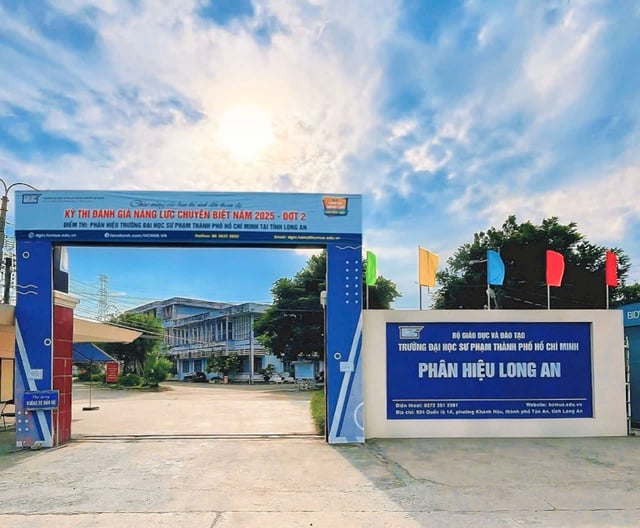
The Long An branch (now part of Tay Ninh province) of Ho Chi Minh City University of Education.
Photo: SP
ADVICE FOR CANDIDATES
Given the similarities and differences mentioned above, representatives from universities offered advice to different groups of candidates on choosing their study location.
Dr. Huynh Trung Phong, Director of the Student Support and Entrepreneurship Development Center at Ho Chi Minh City University of Education, believes that admission to training programs at the branch campus offers certain advantages in terms of entrance competition because the cutoff scores for programs at the branch campus are usually 1-1.5 points lower than at the main campus. In addition, studying at the branch campus is suitable for those who want to study near home, saving costs. Furthermore, if one wishes to work locally, studying at the branch campus is even more appropriate. For example, at the Long An branch campus of Ho Chi Minh City University of Education, teacher training programs are commissioned by the local government according to Decree 116/2020/ND-CP. Therefore, students from the locality studying at the branch campus, benefiting from the policies of Decree 116, will have better opportunities for education and employment upon graduation.

However, Dr. Phong also noted that PH's limitation lies in the number of training programs offered. Therefore, studying at PH will offer more limited opportunities to choose majors and study programs compared to the main campus. "Candidates wishing to study at PH should pay attention to the admission code when submitting their applications. The same major may have different codes at the main campus and PH. For example, the same early childhood education major at the university level might have different admission codes at the main campus (7140201), PH Long An (7140201_LA), and PH Gia Lai (7140201_GL)," Dr. Phong added.
Associate Professor Bui Quang Hung, Deputy Director of the University of Economics Ho Chi Minh City, also believes that depending on individual needs and aspirations, students will find it more suitable to study at the Phu Long campus or the main campus. If they want to study near home, save money, have career prospects near home after graduation, and face lower entrance competition, students from localities close to Phu Long can choose to study at Phu Long. However, according to Associate Professor Hung, although the university initially allows students to choose between Ho Chi Minh City or Vinh Long, all Phu Long Vinh Long students must transfer to study in Ho Chi Minh City in their final year. This aims to help students adapt to diverse learning environments and access the job market in a major city. Conversely, students from the Ho Chi Minh City campus can also return to Phu Long to study if they wish.
There are currently 30 PHs (Public Administration Programs) of higher education institutions nationwide.
According to the Ministry of Education and Training's summary report on the planning of the network of higher education and teacher training institutions for the period 2021-2030, with a vision to 2050, the country has 244 higher education institutions, with 30 new teacher training colleges currently in operation. Of the 20 newly formed colleges, 6 are private higher education institutions, 4 are established on the basis of teacher training colleges, and 9 are established on the basis of universities.
Source: https://thanhnien.vn/tuyen-sinh-dh-2025-chon-hoc-co-so-chinh-hay-phan-hieu-185250714184623768.htm


























































![[Video] Sunset at Lap An Lagoon – Where the sun sets over the fishing nets](https://vphoto.vietnam.vn/thumb/1200x675/vietnam/resource/IMAGE/2026/05/31/1780192137701_beach-landscape-sea-water-nature-grass-745871-pxhere-com.jpeg)







































Comment (0)