

(NLĐO) - Data collected by NASA's InSight spacecraft from a neighboring planet may have led to some major misunderstandings.
In an effort to learn about Mars – a planet being carefully studied by numerous NASA spacecraft – scientists have identified 123 new impact craters that formed between December 2018 and December 2022.
Forty-nine of those may have "led" scientists as they analyzed data from the InSight lander.
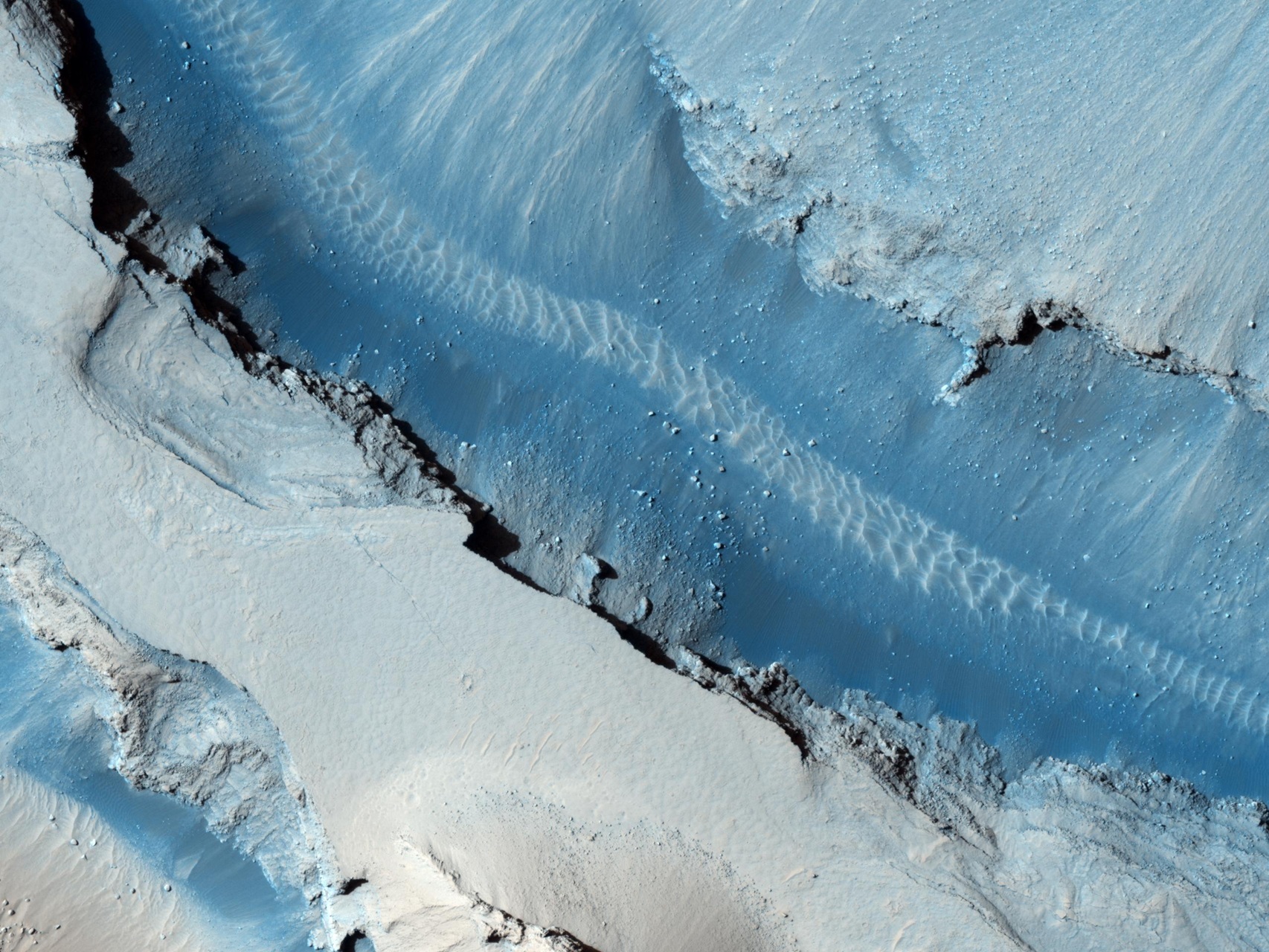
The surreal landscape of the Cerberus Fossae region - Photo: NASA
NASA's InSight lander was a stationary spacecraft used to measure seismology on the red planet. After its last contact on December 25, 2022, InSight "died" due to Martian dust burying its solar panels.
However, in just over two years of operation, InSight has managed to detect more than 1,300 earthquakes on our neighboring planet.
This data has provided the foundation for many groundbreaking studies on Mars, including understanding the planet's internal structure, as well as gaining a better understanding of how all rocky worlds , including Earth and the Moon, formed.
But two studies recently published in the scientific journal Geophysical Research Letters , led by NASA, suggest that the interior of the red planet still holds unexplained mysteries.
Most notably, the data includes information about an impact crater with a diameter of 21.5 m at Cerberus Fossae, a particularly earthquake-prone area on Mars, located 1,640 km from InSight.
This impact crater is much further away than InSight had predicted based on the earthquake's seismic energy.
The Martian crust possesses unique properties that are thought to reduce seismic waves generated by impacts. New analysis of impacts at Cerberus Fossae suggests that the waves they generate travel more directly through the planet's mantle.
Dr. Constantinos Charalambous from Imperial College London (UK), a member of NASA's InSight team, said they previously thought that the energy detected from most seismic events was trapped within the Martian crust.
But new analysis of the impact crater at Cerberus Fossae reveals a deeper, faster path they call a "seismic highway" through the mantle, allowing seismic waves to travel to more distant regions of the planet.
Researchers are also searching for impact craters within a radius of approximately 3,000 km from InSight's location, hoping to find some that formed while the spacecraft was operating.
By comparing images from NASA's Mars Reconnaissance Orbiter (MRO) Context Camera, they found 123 new craters, 49 of which likely coincided with earthquakes detected by the lander's seismometer.
"We thought that Cerberus Fossae generated a lot of high-frequency seismic signals associated with internal earthquakes, but this suggests that some of the activity doesn't originate there but could actually come from impacts," said Dr. Charalambous.
Although this has forced scientists to readjust some models related to the internal structure of Mars, it also opens new doors in the geological study of rocky planets.
Source: https://nld.com.vn/va-cham-vu-tru-khien-nasa-lac-loi-o-hanh-tinh-khac-196250206104058717.htm

![[Image] Pleasant weather helps students enter the 10th grade entrance exam with confidence.](https://vphoto.vietnam.vn/thumb/1200x675/vietnam/resource/IMAGE/2026/05/29/1780034401612_ngay-1-thi-lop-10-minh-duy-8-5009-jpg.webp)
![[Photo] Ba Lang An Lighthouse - the "eye of the sea" amidst the "rock museum" of Quang Ngai province.](https://vphoto.vietnam.vn/thumb/1200x675/vietnam/resource/IMAGE/2026/05/29/1780038698840_anh-man-hinh-2026-05-29-luc-14-10-42.png)













![[GALLERY] The million-dollar 007 blockbuster is causing a sensation on Steam, is it worth buying?](https://vphoto.vietnam.vn/thumb/402x226/vietnam/resource/IMAGE/2026/05/29/1780064112088_ta-2-png.webp)

















































































Comment (0)