

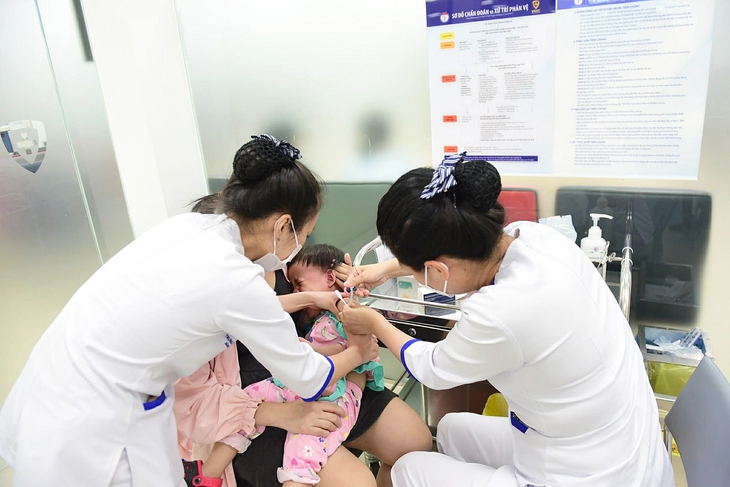
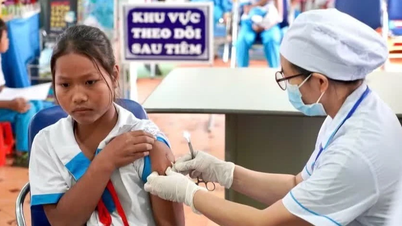
Vaccination - Photo: DUYEN PHAN
In Vietnam, children are encouraged to be vaccinated as part of the national expanded immunization program implemented by the Vietnamese Ministry of Health .
This program aims to help protect children from many dangerous infectious diseases early in life.
According to the current vaccination schedule, young children are usually vaccinated against diseases such as: tuberculosis (BCG), hepatitis B, diphtheria-pertussis-tetanus, polio, Hib (a bacterium that can cause pneumonia and meningitis), measles, rubella, and Japanese encephalitis.
Many of these diseases are prevented by combination vaccines, meaning one injection can protect a child against several different diseases. These injections are given at different age milestones, starting from birth and continuing through the first few years of life. In addition to the vaccines in the national immunization program, there are now several privately available vaccines such as pneumococcal, rotavirus, chickenpox, and seasonal influenza vaccines.
Why do children need so many injections?
Many parents are concerned when they see their children receiving so many injections in the early years of life. In reality, children are more susceptible to illness during this period because their immune systems are still immature and they haven't been exposed to many pathogens.
Vaccination schedules are based on extensive research into child development. Each vaccine has a specific timing and dosage determined to best support an effective and safe immune response.
Possible reactions after injection
After vaccination, some children may experience mild reactions such as fussiness, fatigue, pain or redness at the injection site, mild fever, muscle or joint pain, and headache. These reactions are usually short-lived and resolve on their own.
In rare cases, if a child shows signs such as difficulty breathing, facial swelling, a full-body rash, seizures, or a prolonged high fever, parents should take the child to the nearest medical facility for examination.
What happens if I don't get vaccinated?
Vaccines help prevent many dangerous and potentially life-threatening diseases such as meningitis, tetanus, and polio. When children are not vaccinated, their risk of contracting these diseases is higher. Furthermore, children can unknowingly spread these illnesses to others, especially infants or people with weakened immune systems.
In the early years of life, vaccination is one of the simplest yet most effective ways to protect a child's health. When administered on schedule and carefully monitored, vaccines help a child's body build an early "shield" against many dangerous infectious diseases.
Source: https://tuoitre.vn/vac-xin-cho-tre-nhung-dieu-cha-me-quan-tam-20260317074757274.htm
![[Photo] Admire the coral "masterpiece" amidst the million-year-old heritage of Dak Lak province.](https://vphoto.vietnam.vn/thumb/1200x675/vietnam/resource/IMAGE/2026/05/31/1780221235105_anh-man-hinh-2026-05-31-luc-16-53-27.png)
![[Photo] Solemn bathing ceremony and Buddha procession in Hue](https://vphoto.vietnam.vn/thumb/1200x675/vietnam/resource/IMAGE/2026/05/31/1780228263543_1-jpg.webp)

![[Image] Hanoi Police officially crowned champions of V-League 2025/2026](https://vphoto.vietnam.vn/thumb/1200x675/vietnam/resource/IMAGE/2026/05/31/1780244769054_ndo_br_039d561b692be875b13a-jpg.webp)
![[Photo] The General Secretary, President and his wife begin their state visit to the Philippines.](https://vphoto.vietnam.vn/thumb/1200x675/vietnam/resource/IMAGE/2026/05/31/1780230559452_anh-man-hinh-2026-05-31-luc-19-28-11.png)












![[Video] Sunset at Lap An Lagoon – Where the sun sets over the fishing nets](https://vphoto.vietnam.vn/thumb/340x192/vietnam/resource/IMAGE/2026/05/31/1780192137701_beach-landscape-sea-water-nature-grass-745871-pxhere-com.jpeg)


























































Comment (0)