


Nguyen Canh Luan and Nguyen Thi Xuan Quynh are both teachers with many years of experience in teaching English - Photo: Ho Lam
On the morning of April 5th, a discussion titled "English for Tourism : The Key to Expanding Global Opportunities" was held at 23-9 Park with the authors of the book, Nguyen Canh Luan and Nguyen Thi Xuan Quynh.
The event is being held within the framework of the Ho Chi Minh City Tourism Festival 2025. Speakers will share perspectives and practical experiences on using English in the journey of exploring the world .
The fear of making mistakes when speaking English.
Nguyen Canh Luan, author of the book IELTS Speaking Journey , is an English teacher with an 8.0 IELTS score and a 990 TOEIC score, as well as a popular content creator on social media.
Looking back on his 10 years of experience learning and teaching English, Luân believes that speaking remains the most difficult skill. The challenge lies in overcoming the fear of making mistakes and shyness.
“Back then, when we met foreigners on the street, my father would often tell me to go and strike up a conversation with them. My reaction at the time was shyness. I thought, 'What will I say to them? What if I say the wrong thing and they judge me?'" - Luân recounted.
And the more he learned English, the more he realized that making mistakes was inevitable. Making mistakes, recognizing where you're wrong, and trying to correct them gradually is the only way to improve and progress.
When practicing speaking, Luân often uses the Shadowing method. This is also how he learned to speak English from a young age, and even how he learned Vietnamese.
"For example, when watching movies or videos in English, we imitate the tone of voice and pronunciation of the characters in the clip. Or when we hear our parents or teachers talking, we repeat what they say. That's called shadowing. In my opinion, this is also the most effective way to learn to speak because it aligns with the natural language learning method."
"From the moment we first come into contact with our mother tongue, we also tend to imitate it in order to acquire and use it," said Mr. Luan.
However, according to Mr. Luan, the key point to remember when using this method is that learners need to be persistent and find English-speaking resources they enjoy and that suit them.

Speakers shared practical experiences in learning and teaching English at the event - Photo: HO LAM
Progress comes gradually.
For Xuan Quynh, author of the books "The English Journey" and "English Question 101 ," the most discouraging thing she experienced during her 10 years of learning and teaching English was the feeling of studying constantly but not making progress.
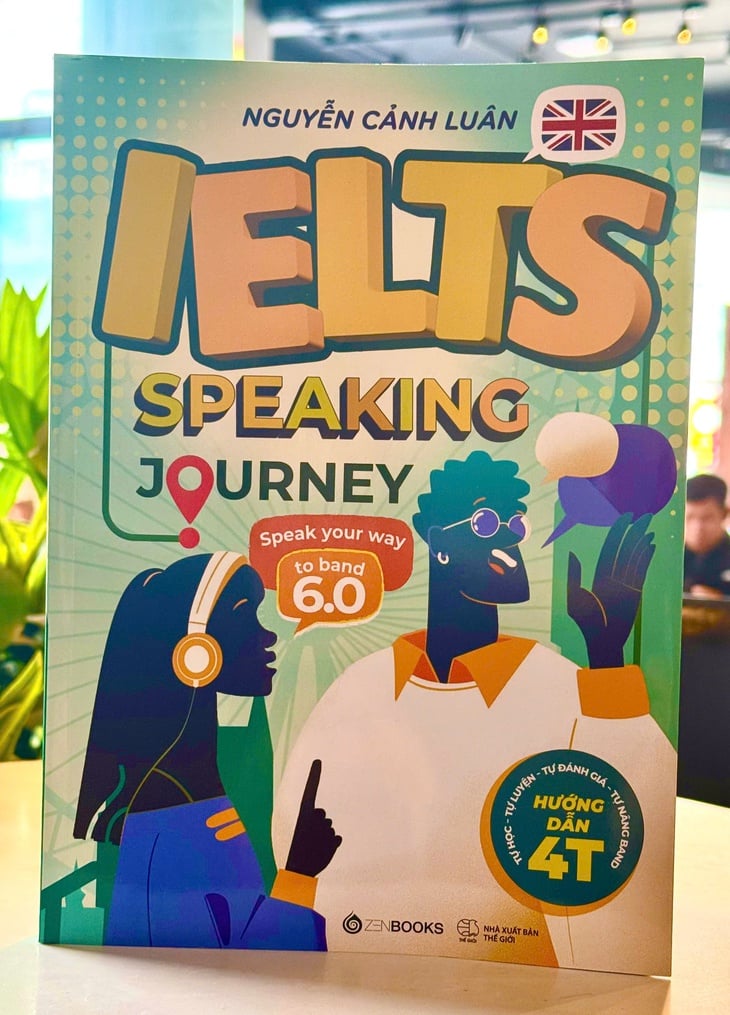
The book IELTS Speaking Journey (published by The World Publishing House) - Photo: HO LAM
This is probably true for many people who enter the "game" of conquering English with high determination, but become discouraged after a short time.
These include gaps in basic knowledge affecting the learning process, vocabulary learned but quickly forgotten, confusing grammar, and listening skills that don't improve despite repeated attempts.
And then many people give up because they think they don't have the talent, or that English is too difficult to master.
"In the beginning, everything seemed fine, but after studying for a while, I started to question why I was still stagnating and not making progress."
But achieving fluency in communication isn't something that happens overnight.
Learning English is a challenging journey that requires perseverance and the right approach. Progress will come gradually.
"When you have the determination to sit down at a table to study every day, it means you are already making progress," said Xuan Quynh.
She advises English learners to find a like-minded friend to practice with, or if they don't have a friend, they can practice on their own by talking about topics they are interested in or passionate about, such as describing a typical workday; what they would say to someone they like, etc.
Afterward, you can use a voice recorder to record your voice and adjust your tone, pronunciation, etc.
At the event, many questions were raised about the opportunities and challenges when English can be seen as a golden ticket to integration in the context of technological development and people's increasing passion for travel and exploration beyond Vietnam's borders.
Many participants believe that opportunities will open up even more if one knows more languages such as Japanese, Chinese, Korean, French, etc., not just English, in the current context.
Source: https://tuoitre.vn/van-su-khoi-dau-nan-hoc-tieng-anh-doi-luc-cung-de-nan-2025040513195861.htm





![[Image] Nearly 125,000 Hanoi students completed the Literature exam for the 10th grade entrance exam.](https://vphoto.vietnam.vn/thumb/1200x675/vietnam/resource/IMAGE/2026/05/30/1780117233041_ndo_br_thiet-ke-chua-co-ten-2-png.webp)





























































































Comment (0)