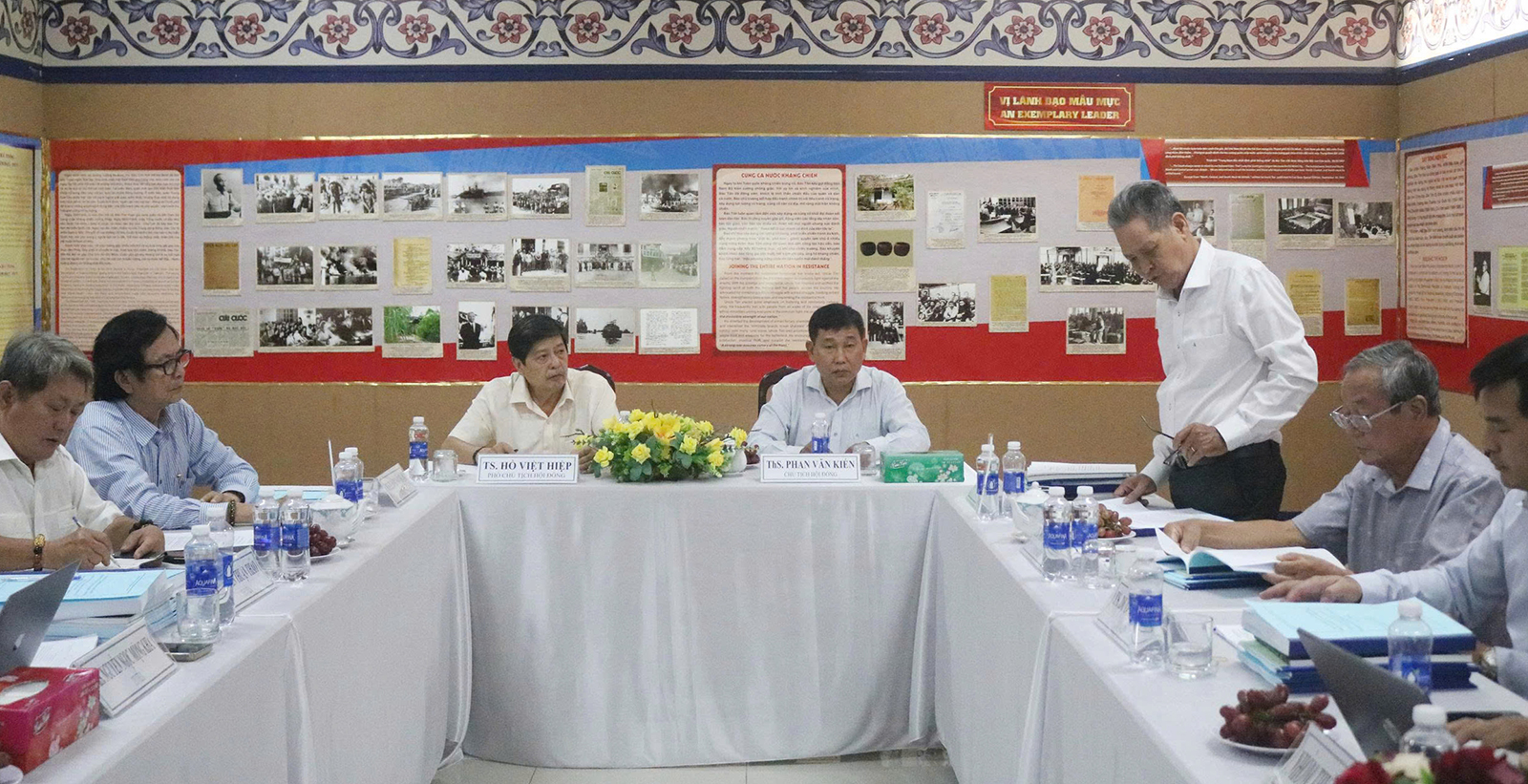
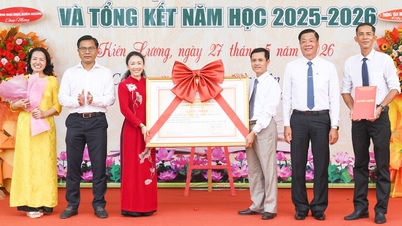
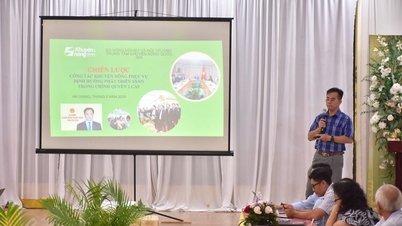
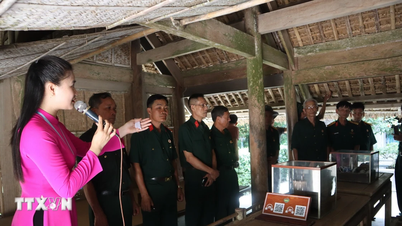
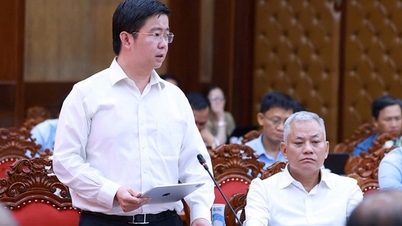
Scenes from the project acceptance ceremony: “Research on promoting the value of the Oc Eo cultural artifact collection in An Giang (including Buddhist and Hindu art)”.
Recognizing its importance, the Provincial People's Committee encourages scientific research on this culture, notably the project "Research on promoting the value of the Oc Eo cultural artifact collection in An Giang (including Buddhist and Hindu art)" implemented from 2023 to 2025. "The project is led by the Provincial Museum, with the participation of many experts from research institutes, universities, and major museums in Ho Chi Minh City and Da Nang. This is the first project to focus on in-depth research into the existing Oc Eo cultural artifact collections in An Giang, especially the group of artifacts related to Buddhist and Hindu art," said Ms. Ho Thi Hong Chi, project leader and former Director of the An Giang Museum (before the merger).
Master's student Nguyen Hoang Bach Linh, a doctoral candidate at Kanazawa University (Japan) and the scientific secretary of the project, emphasized: “The interdisciplinary approach combining archaeology, museology, art history, and symbolic analysis allows for a clearer decoding of the historical, artistic, and religious value of the heritage. By synthesizing rich archaeological sources, the project systematizes the nearly century-long process of discovering and researching the Oc Eo culture in An Giang. Many discoveries have made significant contributions to building the scientific basis for the nomination dossier for the Oc Eo - Ba The site as a World Cultural Heritage site.”
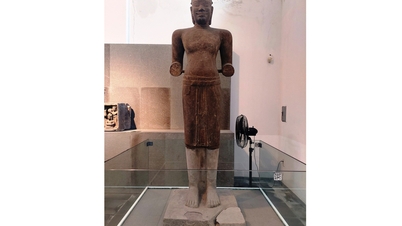
Studies have determined that Oc Eo was a major center for receiving and transmitting Buddhist styles from South Asia to East Asia during the early Common Era. The basic characteristics of Buddhist practice in the community life of Oc Eo have been reconstructed through many representative artifacts. Most notable are two national treasures: the Giong Xoai Buddha statue (wood) and the Khanh Binh Buddha statue (stone). Both show the influence of South Asian/Sri Lankan Buddhist styles, with features such as a round face, spiral hair, and a form-fitting "wet" robe. This is considered evidence of the strong interaction between international Buddhist art and the indigenous elements of the Funan people. In addition, two bronze statues discovered at Go Cay Thi – likely diplomatic gifts between Funan and China – also reflect Oc Eo's strategic position in regional political and cultural relations during the 5th-6th centuries.
Alongside Buddhism, Hinduism played a significant role in the religious and political life of the Oc Eo inhabitants. One of the most prominent artifacts is the statue of Vishnu Anantāśāyana at Linh Son Pagoda, which was Việt hóa (Vietnamese-ized) into a seated Buddha statue during the process of religious assimilation. Many relics in An Giang also contain artifacts characteristic of Hindu pantheons such as Brahma, Yoni-linga, Mukhalinga, Harihara, Durga, Yaksa... This is clear evidence of the process of receiving and localizing Indian culture in the context of strong international exchange in Southeast Asia during this period.
“Unlike previous research which focused heavily on religious statues, we devoted more time to analyzing a group of artifacts that have received less attention but are of special value in understanding the religious life and techniques of the Oc Eo inhabitants,” said Dr. Nguyen Thi Tu Anh from the University of Social Sciences and Humanities, Vietnam National University Ho Chi Minh City.
According to Dr. Nguyen Thi Tu Anh, the Lac Quoi stone pillar, long forgotten, has been deciphered and identified as a unique work depicting three scenes from the life of the Buddha. Two sacred boxes discovered at Go Cay Tung are the only known specimens from the Oc Eo culture, important items used in the ritual of placing a "sacred treasure" at the center of a Hindu temple. Many stone candle trays displayed at the An Giang Museum were once thought to be molds for casting jewelry; however, research shows they were common ritual objects in Hinduism, often placed in niches within temple walls. Correctly identifying the function of these artifacts contributes to clarifying the ritual life of the Oc Eo inhabitants.
The results of the research project are presented in two published works: "Oc Eo Cultural Artifacts at the An Giang Provincial Museum" (152 pages) and "Buddhist and Hindu Art through the Collection of Oc Eo Cultural Artifacts at the An Giang Museum" (240 pages), published by the Social Sciences Publishing House. The highlight of these two works is their multidisciplinary approach – archaeology, art history, religious anthropology – thereby recreating a civilization that is both material and spiritual, reflecting the interplay between indigenous heritage and international culture.
Beyond its academic value, the study also assesses the current state of the Oc Eo heritage site in An Giang, highlighting the advantages and limitations in conservation and tourism development. Based on this, the research team proposes a heritage tourism model based on the experiences of countries with similar conditions such as Thailand, Indonesia, and Cambodia. The goal is to make Oc Eo a unique cultural and archaeological symbol of Vietnam and elevate the country's position on the world heritage map. “The results of this study not only reflect the efforts of the scientists but also demonstrate the heartfelt commitment of the people of An Giang to their homeland's heritage. The new discoveries, new approaches, and new development directions show that An Giang is determined to make the Oc Eo culture a regional symbol, worthy of the value of a civilization that once flourished along the Mekong River,” expressed Master's student Nguyen Hoang Bach Linh.
In December 2025, the Department of Science and Technology will review and approve the results of this project. Mr. Phan Van Kien, Deputy Director of the Department of Science and Technology and Chairman of the Council, affirmed that the research results open up a new approach to linking scientific research, education, culture, and sustainable economic and tourism development, contributing to spreading the value of the Oc Eo heritage within the community.
GIA KHANH
Source: https://baoangiang.com.vn/ve-mien-di-san-ton-giao-oc-eo-a471841.html


![[Photo] General Secretary and President To Lam presides over the meeting to approve the draft report on the results of the second inspection by the Politburo of the Standing Committee of the Hanoi City Party Committee.](https://vphoto.vietnam.vn/thumb/1200x675/vietnam/resource/IMAGE/2026/05/26/1779789811432_a2-bnd-4430-9620-jpg.webp)


![[Infographic] Vietnam-Thailand Comprehensive Strategic Partnership](https://vphoto.vietnam.vn/thumb/402x226/vietnam/resource/IMAGE/2026/05/27/1779854632675_infographic-quan-h_65_1779854266.jpeg)












































Comment (0)