

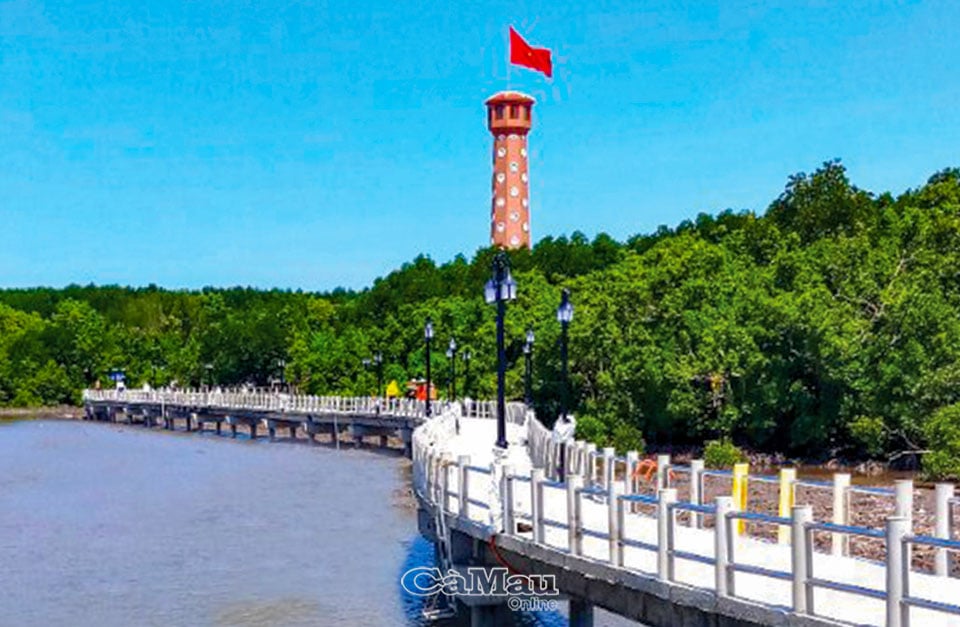
 |
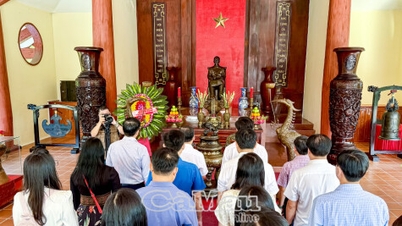
| The Hanoi flagpole at Ca Mau Cape is a sacred symbol of the solidarity between the people of North and South Vietnam, and also affirms national territorial sovereignty . Photo: MINH TAN |
According to Mr. Huynh Cong Thanh, a veteran resident of Mui Hamlet, the first seven houses in this southernmost part of the country were built approximately 100 years ago. He also recounts that these first inhabitants came from a tributary on the southern bank of the Cua Lon River, opposite the present-day town of Nam Can, about 60 kilometers from Mui Hamlet. They were migrants who made a living by fishing, drifting along the river, following the currents of fish and shrimp. Perhaps they settled in Mui Hamlet because all land had been lost, the river had ended, and there was nowhere else to go, only the vast ocean stretching before them.
Because it is a newly formed landmass stabilized by mangrove vegetation, the natural land surface of Xóm Mũi remains below sea level to this day. Due to this geographical characteristic, from its formation until 2015, when the final section of the Ho Chi Minh Highway connecting Năm Căn town to Mũi Cà Mau Tourist Area had not yet been inaugurated, Xóm Mũi was only connected to the outside world by a single waterway: a small, winding canal in the forest, connecting to the Rạch Tàu River 5 kilometers away, not including the detour to the sea. Even that small canal was only navigable by boats during high tide.
From the first seven houses, Mui Hamlet gradually took shape. The mangrove forests along the canals were cleared, and wooden stilt houses with thatched roofs sprang up one after another. Like those who came before, all the later residents made a living by fishing. In the early days, fish and shrimp were abundant here, but it was difficult to sell them fresh because they had to be transported all the way to Nam Can or Ca Mau , and there were no refrigeration facilities. Therefore, the fishermen of Mui Hamlet have a long-standing tradition of processing dried fish, dried shrimp, and various kinds of fish sauce...
The oldest fishing method of the fishermen in Xóm Mũi is bottom trawling. The large nets spread out along the Xóm Mũi canal are bottom trawling nets.
Deep-sea bottom trawling is a unique fishing method found only in the coastal waters from Tra Vinh to Ca Mau Cape. The nets are large, tubular structures stretched by fishermen along offshore currents to catch fish and shrimp. Typically, these deep-sea trawling rigs are located 12-20 nautical miles from the shore, situated in the boundary between clear and murky waters – a local term for the "interval." Depending on the section of the current, each deep-sea trawling rig usually consists of 10 to several dozen nets. Deep-sea trawling can be used year-round, but there are two main fishing seasons: the south monsoon from March to June, and the northeast monsoon from September to December (lunar calendar). During the peak season, fishermen must remain on the rigs for 1 to 10 days each tide. The timing of net placement also varies daily, depending on the ocean current's flow. Therefore, in addition to the hut dwellers, there are also fishermen who always contract with them to bring their boats out to the seabed at the right time to collect shrimp and fish to bring ashore, and at the same time supply essential items for the hut dwellers to survive the tide in their houses, which resemble bird's nests swaying on the stilts at the bottom of the river.
The job of a fisherman working in a deep-sea hut is a dangerous one. When Typhoon No. 5 swept through Ca Mau Cape in 1997, some fishermen were swept into the sea by the storm, drifting aimlessly for two or three days, clinging only to plastic containers, until they were rescued.
The seafood caught from the offshore fishing grounds is abundant, with a wide variety of fish and shrimp, far exceeding the yield from river fishing. When the offshore fishing grounds are full, the Dat Mui market, located in the center of the commune, in Rach Tau hamlet, about 5 kilometers from Mui hamlet, becomes bustling and lively. A stroll around the Dat Mui market reveals the richness of the seafood harvested from the offshore fishing grounds. Dried shrimp is particularly famous. Due to the abundant shrimp catch, Mui hamlet has a unique service industry: the business of boiling and drying shrimp for hire, with fires burning day and night when the offshore fishing grounds are full.
Mũi Cà Mau is commonly known as an alluvial plain formed by the deposition of sediment. However, in reality, in this southernmost village, while the land on the western bank is being reclaimed, many areas on the eastern bank are still experiencing erosion. The historical anecdote of changing times, as described in ancient texts, can be witnessed here in a single lifetime.
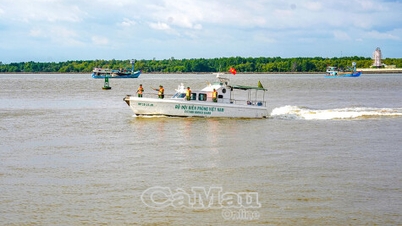
Dat Mui Market is the southernmost market in the country, and also one of the youngest. In the late 20th century, there was no market here. To reach the market, locals had to travel over 50 kilometers through rough seas to reach Nam Can Market in the 1990s. Due to its unique location below sea level, the local people still largely live in stilt houses or houses built on concrete pillars to avoid flooding when the sea level rises. Transportation in this area relies primarily on waterways, using boats and canoes. Therefore, both sellers and buyers mainly travel to Dat Mui Market by water, most commonly by small motorboat. Not only do people from Mui Hamlet travel to the market, but they also use motorboats to get to their cafes every morning.
Ca Mau Cape is an important tourist destination in Ca Mau province. Since the late 1990s, Ca Mau province has established the Ca Mau Cape Cultural and Tourism Park, covering 150 hectares and encompassing the entire tip of Ca Mau Cape, adjacent to Mui Hamlet. Currently, this Cultural and Tourism Park welcomes nearly half a million visitors annually, with 10% being international tourists.
A new form of tourism is developing in Ca Mau Cape, attracting the participation of many households and becoming very popular with tourists, called community tourism. Tourists directly visit the landscape and experience the production and aquaculture activities of the local people. The households of Mr. Nguyen Van Nhuan and Mr. Nguyen Van Ngai in Con Mui hamlet are attracting tourists. The mangrove forests used for ecological shrimp farming offer a fascinating and unforgettable experience as tourists can directly catch clams and snails, set traps to catch crabs, fish with nets, and harvest shrimp... Afterwards, they can immediately enjoy the products they just caught, prepared in the traditional local cuisine: simple, with few spices, honoring the fresh, natural taste. While enjoying the cuisine, visitors can also indulge in a spiritual experience: the traditional Southern Vietnamese folk music (đờn ca tài tử), an art form originating in the South of Vietnam and recognized by the United Nations Educational, Scientific and Cultural Organization (UNESCO) as an intangible cultural heritage of humanity.
In July 2003, Mui Ca Mau National Park was officially established by a decision of the Prime Minister, based on the upgrading of the Dat Mui Nature Reserve, which had been previously established by the People's Committee of Ca Mau province.
The entire Dat Mui commune lies within the boundaries of this national park.
Mui Ca Mau National Park covers a total area of nearly 42,000 hectares, including over 15,000 hectares of inland forest and more than 26,000 hectares of coastal wetlands. This coastal wetland area is extremely important because it is continuously expanding due to sedimentation and is identified as an ideal habitat for many marine species.
The main functions of Mui Ca Mau National Park are the long-term conservation of wetland ecosystems undergoing natural succession; serving ecotourism and sightseeing activities; maintaining and developing coastal sedimentation, developing protective forests, and limiting erosion; and building and developing environmentally friendly, stable, and sustainable communities.
In May 2009, Ca Mau Cape National Park was added to UNESCO's list of world biosphere reserves.
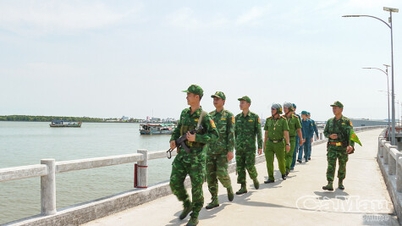
Due to the impact of climate change, since 2007, many areas, especially the eastern coast of Ca Mau Cape, have experienced erosion. To address this, Ca Mau province has spent over 800 billion VND to construct 20 km of seawalls, including more than 6 km of permanent concrete embankment surrounding the tip of Ca Mau Cape. This embankment serves both as a seawall and a tourist access route. After the embankment was built, alluvial deposits continued to build up, and mangrove forests also grew faster on the reclaimed land.
Now, when visiting the southernmost tip of Vietnam, the Ca Mau Cape, after strolling along the wide concrete road, tourists have many restaurants to choose from to enjoy local specialties and the unique cultural experience of Southern Vietnam: traditional Southern Vietnamese folk music (Don Ca Tai Tu).
Visiting the houses at the southernmost tip of Vietnam means arriving at a place that every Vietnamese person dreams of visiting at least once: the southernmost point of Ca Mau. Here, you will experience a feeling that cannot be found anywhere else in the country: simply standing at one spot, you will witness the sunrise over the eastern sea at dawn and the sunset over the western sea at dusk.
Here, we will have the opportunity to touch the last remaining national coordinate marker on the mainland of our country.
Now, our H'Mông brothers and sisters on the summit of Lung Cu, Ha Giang, can simply hop on a bus and travel straight to reach their home at the southernmost tip of the country.
Nguyen Trong Tin - Le Vu Hoang
Source: https://baocamau.vn/ve-noi-cuoi-dat-a1855.html

![[Image] Close-up view of the interchange connecting the two expressways and Long Thanh Airport.](https://vphoto.vietnam.vn/thumb/1200x675/vietnam/resource/IMAGE/2026/05/25/1779703378210_ndo_br_z7863716673926-224453a31600126cce10622af6290afd-4549-jpg.webp)
![[Image] Hanoi's urban life under the challenge of a "scorching hot" environment](https://vphoto.vietnam.vn/thumb/1200x675/vietnam/resource/IMAGE/2026/05/25/1779706979265_nang-nong-t5-2026-minh-duy-7-4636-jpg.webp)


























































































Comment (0)