

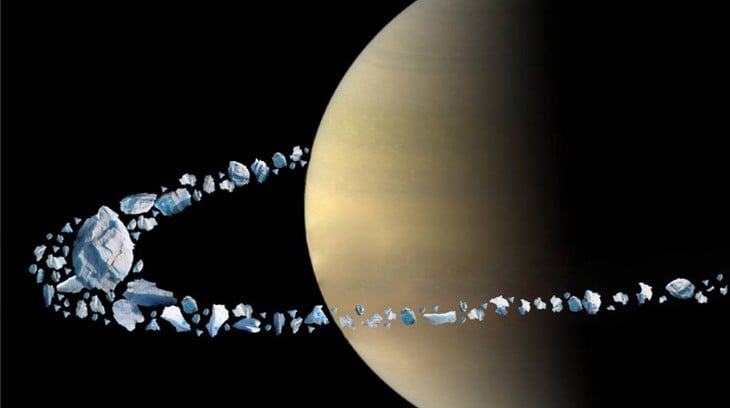
Saturn has just discovered 128 more moons - Photo: NY POST
The newly discovered moons are mostly small, potato-shaped objects, with diameters of only a few kilometers.
This discovery has been officially recognized by the International Astronomical Union (IAU).
New moons often cluster together, suggesting they may be remnants of larger objects that have broken apart over the past 100 million years.
Most moons have elliptical orbits, tilted relative to the orbits of moons closer to the planet.
Scientists believe that closer observation of these small moons will help us better understand the chaotic period in the early Solar System, when planets had unstable orbits and collisions occurred frequently.
So, why does Earth have only one moon, while Saturn has 274?
According to experts, the discrepancy may stem from a number of factors related to the size, gravity, and position of each planet in the Solar System.
Earth's moon is believed to have formed from a massive collision between early Earth and a Mars-sized celestial body called Theia, approximately 4.5 billion years ago.
This collision created a large amount of debris, which then coalesced to form the Moon we see today.
The Moon's relatively large size compared to Earth and the close distance between the two celestial bodies have led to tidal locking, causing the Moon to always point only one side towards Earth.
Conversely, Saturn is a giant gas planet with a strong gravitational pull, allowing it to attract and hold many objects around it.
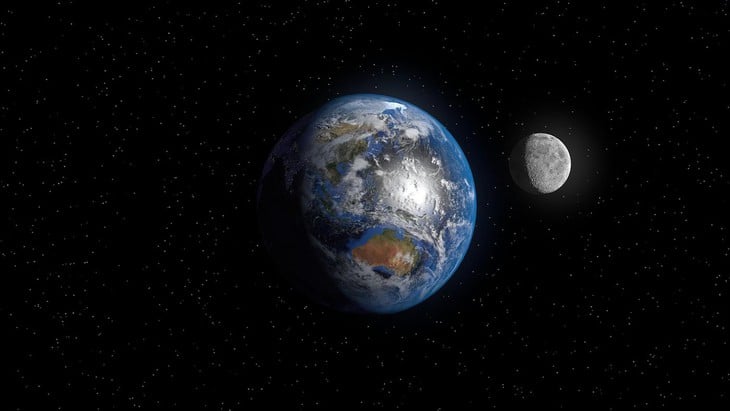
Earth has only one moon - Photo: NY POST
Saturn's moons vary greatly in size and characteristics, from large moons like Titan to small moons just a few kilometers in diameter.
Saturn has a much larger mass than Earth, resulting in a much stronger gravitational pull, allowing it to attract and retain many more natural satellites.
Saturn is located in the outer reaches of the Solar System, where there are many small, icy objects. These objects are easily captured by Saturn's gravitational pull, becoming its moons.
Studies suggest that many of Saturn's smaller moons may be fragments from larger moons that were destroyed in past collisions.
These fragments were then held together by Saturn's gravity, forming new moons.
How many moons do other planets have?
Before the new discoveries about Saturn were announced, Jupiter held the record with over 90 moons. Among them, the most notable were the four Galilean moons – Io, Europa, Ganymede, and Callisto – discovered by astronomer Galileo Galilei in the 17th century.
Ganymede, the largest moon in the Solar System, is even larger than Mercury.
Uranus currently has 27 recognized moons, while Neptune has 14 moons.
Triton, Neptune's largest moon, is notable for orbiting the planet in the opposite direction to most other moons in the Solar System.
Mars has two small moons, Phobos and Deimos, which are thought to be asteroids "captured" by the Red Planet's gravitational pull from the nearby asteroid belt.
Scientists predict that in about 50 million years, Phobos will collide with or break apart as it approaches Mars due to gravity.
Source: https://tuoitre.vn/vi-sao-trai-dat-co-1-mat-trang-con-sao-tho-toi-274-20250318141810082.htm

![[Photo] General Secretary and President To Lam presides over a meeting with the Central Organizing Committee.](https://vphoto.vietnam.vn/thumb/1200x675/vietnam/resource/IMAGE/2026/06/03/1780482764658_a1-bnd-4741-3342-jpg.webp)
![[Photo] First session of the 14th Congress of the Vietnam Trade Union](https://vphoto.vietnam.vn/thumb/1200x675/vietnam/resource/IMAGE/2026/06/03/1780465947883_ndo_br_img-3852-jpg.webp)
![[Photo] Secretary of the National Assembly Party Committee, Chairman of the National Assembly presides over the meeting of the Standing Committee and Executive Committee of the National Assembly Party Committee.](https://vphoto.vietnam.vn/thumb/1200x675/vietnam/resource/IMAGE/2026/06/03/1780480353201_ndo_br_bnd-2585-jpg.webp)










































![[Video] Sunset at Lap An Lagoon – Where the sun sets over the fishing nets](https://vphoto.vietnam.vn/thumb/1200x675/vietnam/resource/IMAGE/2026/05/31/1780192137701_beach-landscape-sea-water-nature-grass-745871-pxhere-com.jpeg)

































Comment (0)