

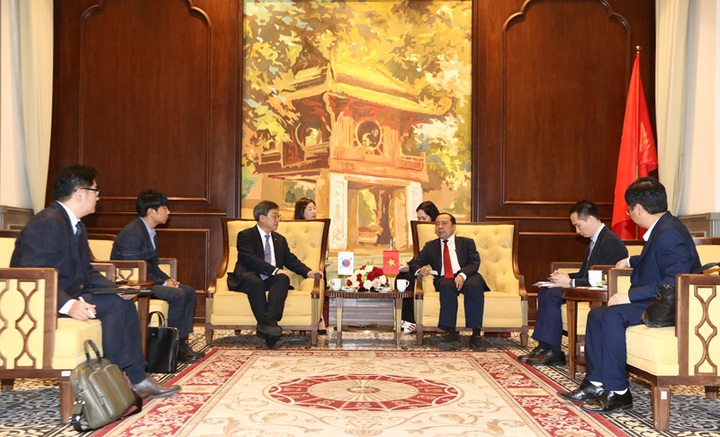
Permanent Deputy Minister of Science and Technology Vu Hai Quan received and held a working meeting with Mr. Park Yunkyu, Chairman of the National Information Technology Industry Promotion Agency of Korea (NIPA).
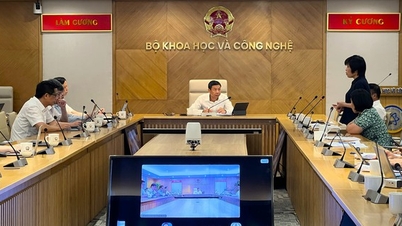
On the morning of March 4, 2026, at the headquarters of the Ministry of Science and Technology (MST), the Permanent Deputy Minister of MST, Vu Hai Quan, met and worked with Mr. Park Yunkyu, Chairman of the National Information Technology Industry Promotion Agency of Korea (NIPA). The two sides exchanged views on strategic directions for the development of artificial intelligence, shared experiences in building an AI ecosystem, and promoted specific cooperation programs between the two countries.
South Korea is investing heavily in computing infrastructure and AI models.
During the meeting, Mr. Park Yunkyu shared South Korea's AI development strategy, given that this technology is becoming a cornerstone shaping the future of the economy , industry, and national security.
According to Mr. Park, South Korea's AI ecosystem is built on four pillars: AI infrastructure, AI models, AI semiconductors, and AI applications. The government is focusing heavily on two core elements: computing infrastructure and the development of foundational AI models.
One notable step is the South Korean government's large-scale investment in computing infrastructure. In 2025 alone, the country purchased 13,000 NVIDIA GPUs for AI research and development. These resources are allocated 50% to national projects, 30% to businesses, and 20% to universities and research institutes.
In addition, South Korea promotes the development of foundational AI models through alliances between businesses and research institutions. These alliances are supported with GPUs, data, and human resources, and undergo periodic six-month evaluations to select the units with the best technological capabilities.
According to Park Yunkyu, this approach creates a continuous competitive environment among research groups, thereby fostering the formation of foundational AI models capable of widely serving society.
Alongside the development of AI models, South Korea is also focusing on building an AI semiconductor industry to reduce its dependence on foreign technology platforms. Businesses in this sector are encouraged to develop energy-efficient AI processors optimized for data centers.
Mr. Park Yunkyu stated that South Korea does not pursue a technology monopoly strategy but aims for international cooperation based on the principle of mutual benefit, with Vietnam considered an important partner in AI cooperation programs.
Vietnam promotes its AI strategy and expands international cooperation.
Speaking at the meeting, Permanent Deputy Minister Vu Hai Quan highly appreciated South Korea's experience in AI development, especially the leading role of the Government in investing in infrastructure and supporting technology businesses.
According to the Deputy Minister, one of the key lessons from South Korea is the political will at the highest leadership level, a factor that helps AI development policies be implemented quickly and effectively.
Vietnam currently places science, technology, and innovation at the center of its national development strategy, with AI being a priority area. The Ministry of Science and Technology is tasked with many important tasks related to AI development, including building a legal framework to promote research, development, and application of this technology.
According to Deputy Minister Vu Hai Quan, Vietnam's AI law, which came into effect on March 1, 2026, aims to create a legal framework to encourage businesses to research, master, and develop AI technology, while also establishing principles of risk management and ethics in technology development.
Furthermore, the Ministry of Science and Technology is developing a national strategy on AI, including plans for developing high-performance computing infrastructure, data centers, and support programs for technology businesses. Therefore, learning from experience and strengthening international cooperation are considered crucial factors in promoting the AI ecosystem in Vietnam.
Collaboration in training AI and semiconductor personnel.
During the meeting, the two sides discussed several specific cooperation proposals, including plans to organize workshops on AI and semiconductors in South Korea and Vietnam, and to connect technology companies from both countries to promote research and development cooperation.
One area of particular interest is the training of semiconductor and AI personnel. Vietnam aims to train approximately 50,000 semiconductor engineers by 2030, with the participation of more than 160 universities.
However, Vietnam currently lacks practical training environments, from laboratories to factories, to train a workforce of semiconductor engineers with practical experience. Therefore, Vietnam proposes strengthening internship and training programs at Korean businesses and research centers.
Units of the Ministry of Science and Technology also proposed cooperating with NIPA in building a model of alliance between businesses and research institutes for AI development in Vietnam, similar to the consortium model that South Korea is implementing.
One notable proposal is to send Korean experts to Vietnam for a short period to advise on building this model, thereby forming AI research and development alliances between businesses and research institutes and universities.
The two sides also discussed the possibility of sharing experiences in building data centers and computing infrastructure for AI, and promoting cooperation in training high-tech human resources.
At the end of the meeting, both sides agreed to continue strengthening professional exchanges, organizing joint workshops and training programs, and promoting specific cooperation projects to develop the AI ecosystem between Vietnam and South Korea.
Source: https://mst.gov.vn/viet-nam-han-quoc-tang-toc-hop-tac-ai-va-ban-dan-197260304161600036.htm

![[Photo] First session of the 14th Congress of the Vietnam Trade Union](https://vphoto.vietnam.vn/thumb/1200x675/vietnam/resource/IMAGE/2026/06/03/1780465947883_ndo_br_img-3852-jpg.webp)


































































Comment (0)