

Green finance is becoming a key factor in driving sustainable growth in Vietnam, with strong commitments and practical solutions for the future.
Green growth and sustainable development have always been strategic goals consistently pursued by the Party and the State. The Government has clearly affirmed: "Green growth is a core element in the process of restructuring the economy and transforming the growth model towards improving productivity, quality, efficiency, and competitiveness, in order to achieve rapid but sustainable development."
Vietnam has actively participated in international efforts, demonstrating a strong commitment at COP26, when the Prime Minister confirmed the target of reducing net emissions to zero by 2050, and further affirmed this goal at COP28.
In this context, green finance has become a crucial tool that not only Vietnam but also the international community are focusing on to promote green and sustainable growth. According to forecasts, Vietnam needs a massive resource of approximately US$368 billion between now and 2040, or about US$20 billion per year. To achieve this goal, establishing effective mechanisms and policies to mobilize domestic and foreign capital, develop the green finance market, and attract private investment into green sectors is extremely urgent.
In addition to funding from the state budget, international loans, or support from international financial institutions, Vietnam needs to develop both a green capital market and green credit simultaneously, creating a solid foundation for sustainable development.
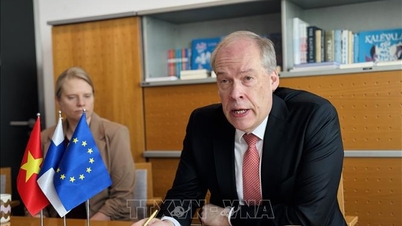
To gain a better understanding of the issue "Promoting Green Finance - Towards Sustainable Development in Vietnam," the Industry and Trade Newspaper conducted an interview with Dr. Le Hai Trung, Deputy Head of the Banking Faculty, Banking Academy, to discuss solutions aimed at contributing to achieving green growth goals.
 |
| Dr. Le Hai Trung - Deputy Head of the Banking Department, Banking Academy |
The Vietnamese government has implemented policies such as: Prime Minister's Decision No. 889 of 2020 approving the National Action Program on Sustainable Production and Consumption for the period 2021-2030; and the legal basis of the Law on Consumer Rights Protection. How do you assess Vietnam's policies on sustainable production and consumption compared to other countries in the world ?
Prioritizing sustainable production and consumption plays a crucial role in the economic transformation towards a green economy. These two elements are considered key pillars for achieving an economy that not only thrives but also protects the environment and natural resources. Sustainable production and consumption are inseparable, as the production process, especially sustainable production, directly impacts the consumption of green products and services, thereby promoting sustainable consumption.
Vietnam's policies in the field of sustainable production and consumption have been designed to be synchronized and proactive, aiming for sustainable economic development in line with international trends. The government has issued tax incentives to encourage businesses to invest in clean energy production, renewable energy, and green products. Alongside this, tax incentives are also applied to sustainable consumption. For example, consumers benefit from tax support policies when purchasing electric cars or vehicles using renewable energy. These are practical policies aimed at promoting both sustainable production and consumption, thereby contributing to pollution reduction and environmental protection.
Vietnam's policies are not only compatible with international development trends but also relatively aligned with those of advanced countries. In Europe, countries are actively implementing circular economy programs, encouraging businesses to use recycled materials and minimize waste. South Korea has also implemented "greening business" policies, encouraging companies to use recycled materials in production. Japan, aiming to reduce greenhouse gas emissions, also encourages businesses to extend product lifecycles to minimize negative environmental impacts. These policies all aim to create a favorable environment to promote sustainable production and consumption, while minimizing pollution and protecting natural resources.
However, despite Vietnam's clear policies and strong political will, practical implementation still faces numerous challenges. One major issue is that current policies are primarily based on large-scale national strategies and general regulations, lacking specific and synchronized adjustments for individual production or consumption sectors. This leads to a lack of consistency in their practical implementation. For example, as Vietnam participates in international environmental protection commitments, current tax incentives may no longer be attractive enough for foreign businesses, especially in green projects. This necessitates supplementary or adjusted policies to ensure that tax incentives remain a driving force for businesses to invest in sustainable production in Vietnam.
Another crucial factor is the relationship between the rights and responsibilities of businesses in implementing sustainable production policies. Businesses participating in sustainability initiatives must clearly see the benefits they will receive, such as access to international markets, improved brand image, and the ability to take advantage of tax incentives. Furthermore, business responsibilities must be closely linked to their rights. This means that businesses need to comply with environmental protection regulations, use recycled materials, and minimize waste, otherwise they will face difficulties participating in global supply chains. For example, if a business exports wood from a deforested area, its products will not be accepted in many countries. This is a clear example of linking responsibility with rights to promote sustainable production.
Furthermore, consumers need to be clearly aware of their role in promoting sustainable consumption. While consuming green products may be more expensive than conventional products, it offers long-term benefits for health and the environment. However, to promote sustainable consumption, public awareness needs to be raised through comprehensive financial education and green finance programs. Providing complete and accurate information about green products, as well as the benefits of using them, will help consumers better understand the long-term advantages they receive from choosing green products. Simultaneously, promotional programs and tax incentives are needed to facilitate consumer transition to green products.
In summary, promoting sustainable production and consumption requires not only clear and specific policies but also close cooperation among businesses, consumers, and the government. Each party must be aware of its responsibilities and act concretely to create a sustainable economy and protect the environment for future generations.
 |
| To develop a green financial market, it is necessary to develop both a green capital market and a green credit market in parallel. |
Besides raising awareness, how should comprehensive financial education for the public be implemented, sir? From the perspective of a financial and banking training institution, what activities has the Banking Academy undertaken, is undertaking, and will undertake to educate not only students but also the entire society about finance?
Our role in deploying green products is somewhat different from that of government agencies and practical units. We are both a research institution and a training unit, especially for training students – future consumers. Therefore, we deeply understand the importance of training, particularly in the context of inclusive finance and sustainable development. In the Banking Institute's development strategy, we have focused on the goal of sustainable development, clearly demonstrated through two main pillars: training and community activities.
In terms of training, we integrate content related to inclusive finance and sustainable development into our training programs, aiming towards the nation's sustainable development goals. We offer multidisciplinary training, from accounting, auditing, and law to information technology, with programs that have clear criteria for sustainable development. Courses such as "Ethics and Sustainable Development" or "Personal Finance" not only provide in-depth knowledge but also raise students' awareness of these issues.
In addition, we also implement volunteer programs linked to community activities, such as the "Knowledge Volunteer" program launched in 2021. Students not only participate in supporting local communities but also organize personal finance classes for students and people in disadvantaged areas. This contributes to raising financial awareness and helping people make more sustainable consumption decisions.
We also collaborate with agencies and organizations to hold events, such as the "Progressive City" program or sustainable development competitions, to create a platform for students, especially those from the Banking Academy and other universities in Hanoi. This is an opportunity for students to express their voices on sustainable development and raise community awareness.
Through these activities, we hope to contribute a small part to the sustainable development of the country. We hope that in the future, we will continue to cooperate with organizations and agencies to expand these financial and community training activities.
Thank you, sir!
Source: https://congthuong.vn/thuc-day-tai-chinh-xanh-viet-nam-tren-hanh-trinh-phat-trien-ben-vung-361230.html
![[Photo] Ba Lang An Lighthouse - the "eye of the sea" amidst the "rock museum" of Quang Ngai province.](https://vphoto.vietnam.vn/thumb/1200x675/vietnam/resource/IMAGE/2026/05/29/1780038698840_anh-man-hinh-2026-05-29-luc-14-10-42.png)



![[Image] Pleasant weather helps students enter the 10th grade entrance exam with confidence.](https://vphoto.vietnam.vn/thumb/1200x675/vietnam/resource/IMAGE/2026/05/29/1780034401612_ngay-1-thi-lop-10-minh-duy-8-5009-jpg.webp)


















































































Comment (0)