

- Launching the Ca Mau Rice Museum and the proposed "three grains of rice" symbol.
- The Soul of Ca Mau
I have never seen a cultural project of such significance and scale built in such a short time. This shows that the Ca Mau Provincial Party Committee and People's Committee have implemented Resolution 80-NQ/TW of the Politburo into practice quickly, vividly, and decisively.
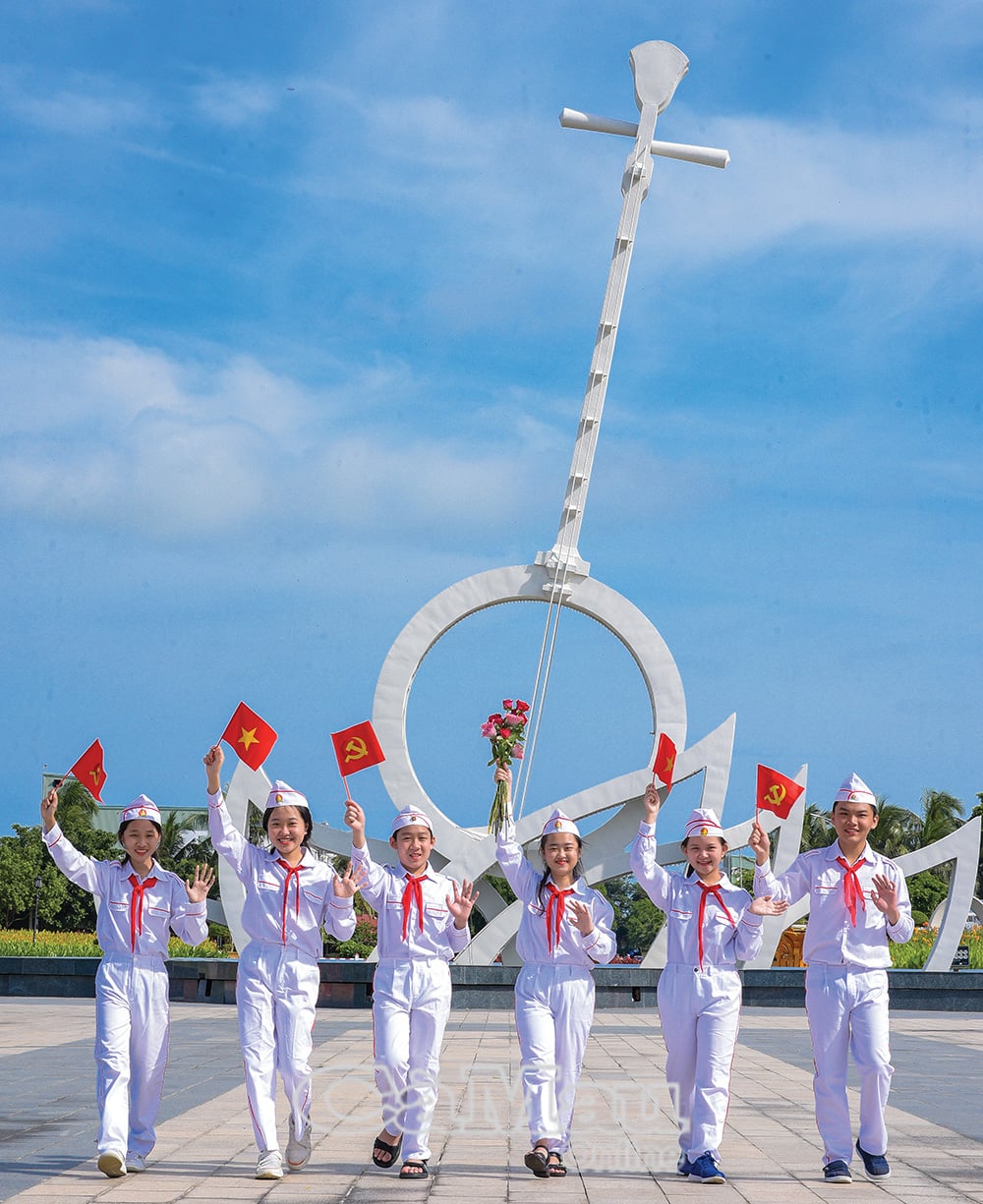 The youth of Ca Mau are proud of the traditions and cultural identity of this southernmost region. (Photo: Phan Thanh Cuong)
To answer the question "Why are the rice museum and the symbols honoring rice, along with their satellites, located in the former Bac Lieu province?", let me clarify: the former Bac Lieu province was a sacred land of culture, the cradle of Southern Vietnamese folk music and cải lương theater, the land of the immortal "Dạ cổ hoài lang" melody, the land of Đồng Nọc Nạng, the land of the heroic spirit of the farmers, and the land of the legendary Prince of Bac Lieu.
Previously, in the years 2010-2014, the Bac Lieu Provincial Party Committee had a policy, abbreviated as "Bac Lieu's rise from culture." This involved tracing the very roots and essence of Bac Lieu, then dissecting, refining, and successively erecting monuments and statues as cultural landmarks. Meanwhile, before this period, some of that cultural potential remained deeply embedded in the land and history, while other aspects had been explored but not to the fullest extent.
I remember a time when the Provincial Party Committee decided to build a museum dedicated to the Prince of Bac Lieu, then proceed with the procedures to recognize it as a cultural relic, turning it into a major tourist destination. Afterward, the Prince of Bac Lieu Historical Site was established, attracting a strong following and becoming a representative tourist spot in the Mekong Delta, helping many realize that the Prince of Bac Lieu contributed to the unique cultural identity of Bac Lieu. Identity is something no one else possesses; it is the inherent strength of the land.
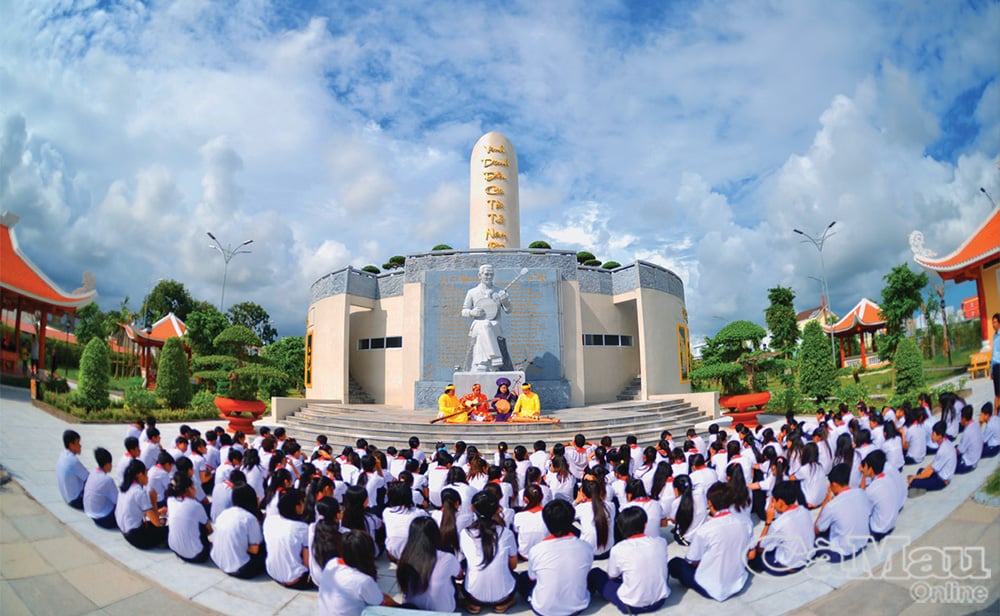 Students visit and listen to traditional Southern Vietnamese folk music performances at the Memorial Area for Southern Vietnamese Folk Music and Musician Cao Văn Lầu (Bạc Liêu ward). (Photo: Phan Thanh Cường)
Then the Memorial Complex for Southern Vietnamese Traditional Music, Cai Luong Theatre, and Musician Cao Van Lau was built, continuing to be a typical tourist destination of the Mekong Delta. Many artists from Ho Chi Minh City came to pay their respects, and were left speechless: Cai Luong theatre and traditional music belong to the South, but with their heartfelt dedication, the people of Bac Lieu, through this project, have shown sincere honor for these art forms.
Similarly, the zither, a cultural symbol of Bac Lieu, placed in Hung Vuong Square, adds depth to the region and leaves a lasting impression on visitors. The Three Conical Hats Theater, imbued with cultural depth, was recognized as a landmark of the 50th anniversary on the occasion of the 50th anniversary of the reunification of the country on April 30, 2025.
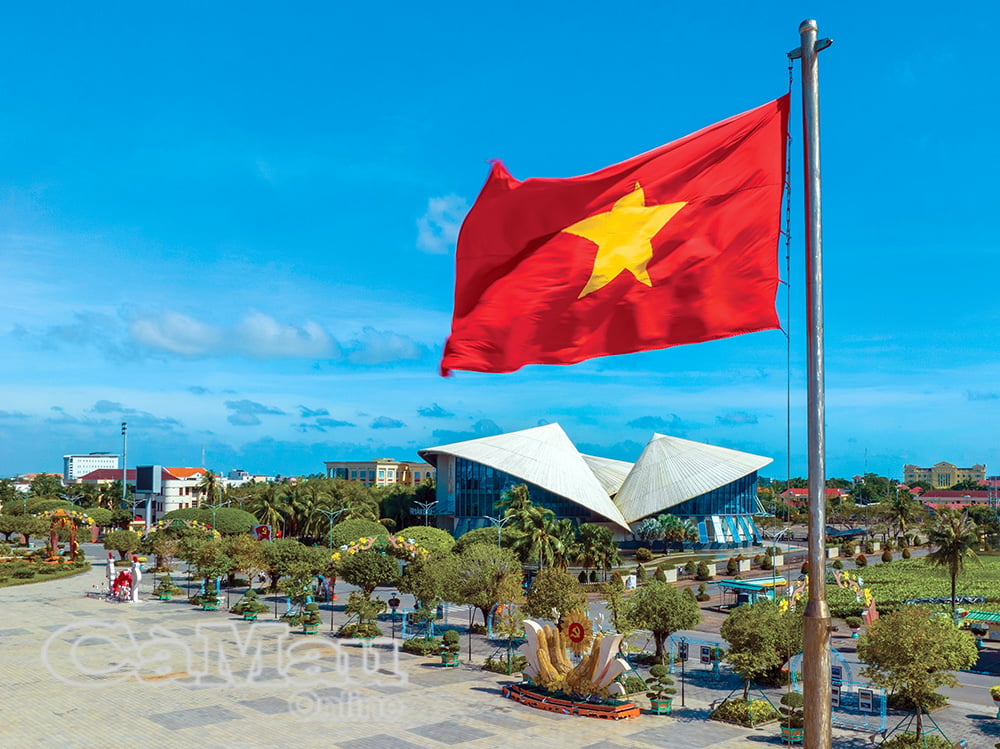 Cao Van Lau Theatre (Three Conical Hats Theatre) has been recognized as a typical tourist attraction of the Mekong Delta. (Photo: Huynh Lam)
In Bac Lieu, the sky is filled with white clouds, the land is covered with lush green rice fields and vast expanses of egrets, stirring deep emotions. Amidst this peaceful and poetic setting stand monuments, statues, and cultural landmarks that speak of the soul and character of the people of Bac Lieu.
When Bac Lieu merged with Ca Mau to form the new Ca Mau province, the first Provincial Party Congress identified the former Bac Lieu area as the cultural and artistic center of the new province. This was not only a vision recognizing the cultural advantages of the region but also a mindset of mobilizing culture to strengthen the homeland's internal resources. Therefore, the construction of the rice museum and symbols honoring rice, along with its satellite sites, further enhances and deepens the cultural and artistic center of the province.
In my opinion, the policy of the Ca Mau Provincial Party Committee and People's Committee has met the aspirations and feelings of many people, helping them realize that it is a way to repay their ancestors and origins; and to mobilize cultural values for the future.
Since ancient times, our people have respected and regarded rice as a precious gift from heaven and earth, with great faith and belief, because hidden within its essence are so many great and magnificent things. Ten thousand years ago, humans chose rice as their main food source, domesticating it, organizing production, forming societies, and making a revolutionary evolutionary leap away from primitive herd life and survival instincts of hunting and gathering.
With this small grain of rice, the Vietnamese people have created an entire rice-based agricultural civilization, becoming a country with one of the longest histories of rice-based civilizations, as identified by archaeologists and ethnographers on the map of Asian rice-based civilizations. From the midland region of Phu Tho during the Hung King era, the Lac Viet people migrated to the Red River Delta. This historical migration opened the first rice-based civilization, demonstrating the evolutionary achievements of the agricultural revolution. More importantly, and more significantly, the Red River Delta is where the nation's internal strength was built, preparing its power for the future.
Historical account: From 214 BC to the 10th century AD, the entire system of the Bai Yue peoples was Sinicized and their territories were annexed. The Lac Viet people were the only ones who "survived" and remained resilient after 1,000 years of foreign domination. Not only did they regain independence, but they also developed strongly, expanding their territory southward to the Ca Mau peninsula, tripling their land area and dominating the vast Mekong Delta, which is 2.7 times larger than the Red River Delta.
In the Ca Mau peninsula region – a land famous for its brackish, saline soil – purebred rice cultivation has suddenly transformed into a distinctive feature of the area with a different irrigation farming method.
It is truly miraculous how, in the rough hands of our ancestors, wherever the rice grains reached, sacred forests and dangerous waters, ferocious beasts, bowed their heads and retreated, giving way to green fields, egrets spreading across the new land, and simple, poetic villages springing up like a watercolor painting bearing the name of Vietnam. Years passed, hair turning gray, but the elements of nature and the cultural roots of the three ethnic groups, like grains of alluvial soil, accumulated and settled into a deep layer of culture, enough to warm, nurture, and cultivate the souls and characters of the people in this new land, giving them the resilience to overcome the storms of the times and war. And so today we have a developed land, where the way of life is beautiful, compassionate, generous, and chivalrous.
We can imagine that when the "Three Grains of Rice" symbol, standing 24 meters tall, rises, it will create a magnificent structure in space, fulfilling the aspirations in the hearts of many generations of Vietnamese people who cherish rice grains to the point of reverence. The three grains stacked on top of each other also represent the growth cycle of rice: milky grains, ripe golden grains, and germinating grains; suggesting to viewers the vibrant life of the rice plant and the rice farming profession.
Therefore, honoring the rice grain is honoring our ancestors, a duty of human morality. Thus, the policy of Ca Mau province is a policy of returning to and remembering our ancestors and origins.
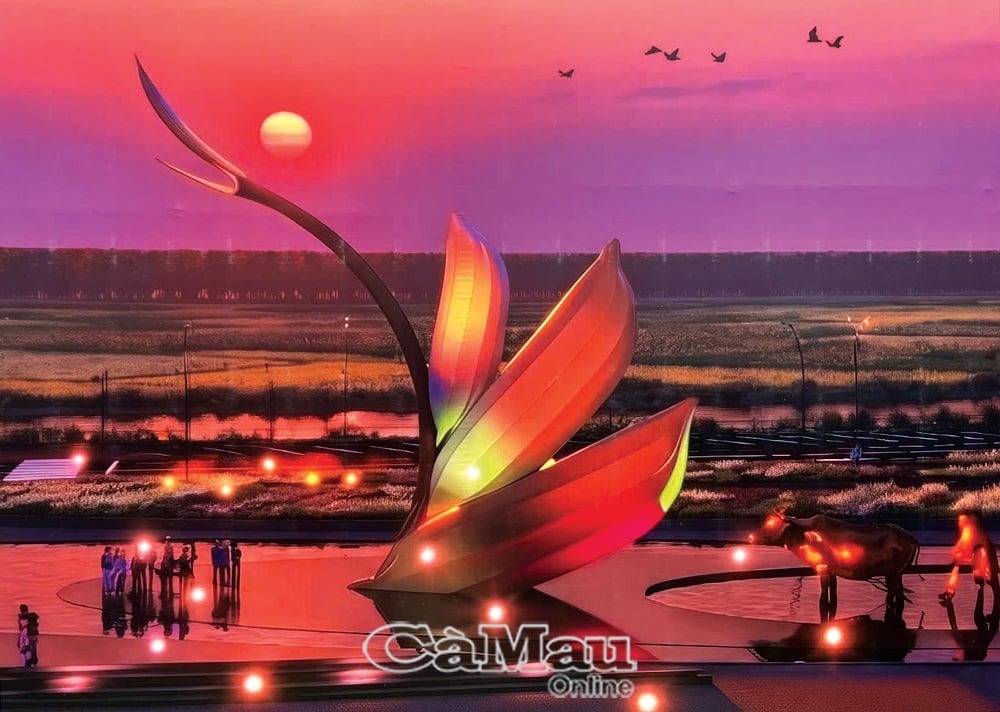 Perspective view of the Three Grains of Rice symbol. (Photo: Huu Tho)
I attended the ceremony announcing the establishment of the rice museum and the concept of a symbol honoring rice. It was a very solemn ceremony, with most of the province's top leaders in attendance, and the press and public opinion unanimously supported it. Those attending understood that this cultural project was a way for the people of the southernmost tip of the country, a stopping point on a 4,000-year journey, to reflect on and honor the historical message as a responsibility of future generations to their ancestors and to preserve these sacred values for future generations.
During the implementation of these cultural projects, I was also invited to participate in a small part as a writer about the countryside. Regarding the symbol honoring rice, besides the creative talent of architect Duong Hoang Le, who achieved a remarkable feat with the design of the Three Conical Hats Theater, there was also the synergy from those who love their homeland, aiming to create a cultural work within an artistic context. I understand the intention of the creators: there are 180 countries in the world that cultivate rice, and the spiritual concept of worshipping the rice grain is part of their culture; each country has its own unique way of venerating the rice grain, its rice-based civilization very different. We, as citizens of a country with a leading history of rice cultivation in the world, must demonstrate our reverence with sincerity through the differences and scale of this sacred object.
Memoirs of Phan Trung Nghia
Source: https://baocamau.vn/vinh-danh-coi-nguon-dan-toc-a128802.html
![[Photo] General Secretary and President To Lam presides over a working session with the Central Policy and Strategy Committee on the development of the materials industry.](https://vphoto.vietnam.vn/thumb/1200x675/vietnam/resource/IMAGE/2026/05/21/1779359935432_a3-bnd-3129-1412-jpg.webp)

![[Photo] National Assembly Chairman Tran Thanh Man working with the Standing Committee of the Law and Justice Committee](https://vphoto.vietnam.vn/thumb/1200x675/vietnam/resource/IMAGE/2026/05/21/1779378929214_ndo_br_1-4610-jpg.webp)























































Comment (0)