

According to RT, since mid-March, Ukrainian long-range unmanned aerial vehicles (UAVs) have repeatedly violated the airspace of the Baltic and Northern European countries, prompting several NATO nations to report UAV crashes on their territory.
Russia accuses NATO members of tacitly allowing Ukraine to use their airspace to attack Russian targets, particularly energy facilities in the Leningrad region.
The most recent major incident occurred in Latvia, where the failure to intercept two drones that attacked an oil storage facility on May 7th led to the resignation of the Defense Minister and the collapse of Prime Minister Evika Silina's government.
Speaking at a press conference on May 21, Fico suggested that Ukraine's drone operations could spark a wider conflict, although he did not directly accuse Kyiv of planning a staged attack.
"I am extremely concerned that some provocation could trigger a mechanism that would then become uncontrollable. If UAVs begin flying over the airspace of NATO member states, and most of those drones are Ukrainian, that would be a serious problem," Prime Minister Fico warned.
Fico added that even a relatively minor incident could quickly escalate if communication between Russia and Western leaders remains frozen.
"What do we do when the presence of such a drone somewhere is a provocative act, not just a coincidence?"
"One target is attacked, then someone says a NATO member state is attacked, and now we all have to fight together. That would be a terrible situation," he said.
The Slovak leader also criticized what he called the "endless hypocrisy" of the West regarding diplomatic contacts with Russia, saying that politicians publicly condemned his meetings with Russian President Vladimir Putin while secretly inquiring about the progress of those meetings.
"If leaders engage in dialogue as they should, the likelihood of a provocative act (by drones) leading to a major conflict would be very low."
"If everyone remains silent and no one wants to engage in dialogue, even a small act of provocation can lead to disaster," he declared.
Prime Minister Fico has long opposed Europe's stance toward Russia, including military aid to Ukraine and sanctions against Russia.
He was the only EU leader to attend the Victory Day celebrations on May 9 in Moscow, Russia, where he warned of a "new iron curtain" and called for a resumption of dialogue.
Fico's stance on Ukrainian drone attacks is in stark contrast to that of some NATO partners.
Swedish Prime Minister Ulf Kristersson said on May 21 that NATO countries should actually help Ukraine direct its drone attacks in the right direction.
Former Latvian Defense Minister Andris Spruds defended these operations, saying Ukraine has every right to self-defense, following similar remarks by Estonian Foreign Minister Margus Tsahkna.
Earlier this week, Russia's Foreign Intelligence Agency accused Latvia of allowing Ukraine to use its territory to carry out drone attacks over Russian territory.
Latvia has denied the accusation, although former Riga City Council member Aleksey Roslikov, who was recently dismissed, told the RIA Novosti news agency that it was "absolute truth".
According to this former official, the Baltic states are also quietly allowing such activities and are even trying to acclimate their citizens to living under the constant threat of drones so that living in bomb shelters becomes a normal part of life.
Source: https://giaoducthoidai.vn/vu-khi-co-the-cham-ngoi-cho-cuoc-chien-nato-nga-post778831.html




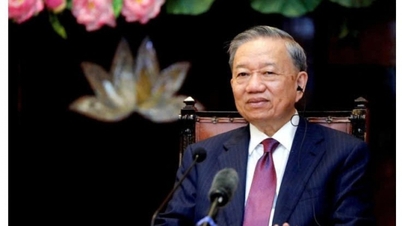
![[Photo] General Secretary and President To Lam presides over the meeting to approve the draft report on the results of the second inspection by the Politburo of the Standing Committee of the Hanoi City Party Committee.](https://vphoto.vietnam.vn/thumb/1200x675/vietnam/resource/IMAGE/2026/05/26/1779789811432_a2-bnd-4430-9620-jpg.webp)















































































Comment (0)