


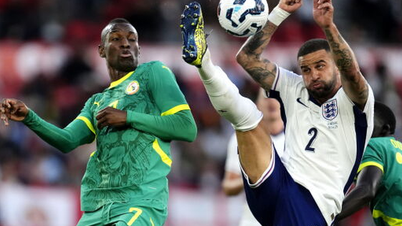
FIFA's adjustments promise to definitively resolve the frustrating issue of "delayed flag signals" for offside, which has annoyed both players on the field and spectators. The breakthrough of this improvement is that the signal is transmitted directly to the assistant referee on the field instead of only being sent to the VAR room as before.
Specifically, if the system detects an attacking player is clearly offside (more than 10cm from the last opposing defender), an alert is immediately sent to the assistant referee. From there, the linesman can raise the flag to stop the game immediately.
Since the introduction of VAR, linesmen have often been instructed to "hold their flags until the situation is resolved" in sensitive offside situations, to avoid making an incorrect call that could disallow a valid goal.
However, this leads to the downside of meaningless prolonged play. Players from both sides still have to sprint, compete, tackle, or shoot in an attack that is essentially dead. Then, if the situation results in a goal, VAR intervenes to review the decision.
The semi-automatic offside system implemented at the 2026 World Cup operates based on a combination of artificial intelligence (AI), multi-directional camera tracking, and sensors embedded directly in the ball to calculate the player's position.
FIFA emphasizes that the role of video assistant referees (VAR) remains unchanged. The VAR room will continue to be responsible for handling close and complex offside situations, with a difference of less than 10cm, or sensitive plays requiring subjective decisions (whether the offside player obstructed the goalkeeper's view or actively participated in the play).
Source: https://tienphong.vn/world-cup-2026-xoa-bo-uc-che-phat-co-viet-vi-cham-tre-post1848498.tpo
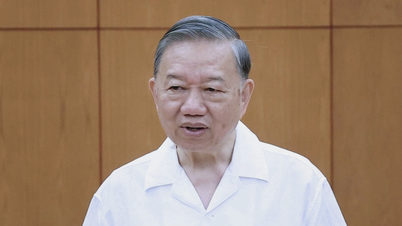
![[Photo] Secretary of the National Assembly Party Committee, Chairman of the National Assembly presides over the meeting of the Standing Committee and Executive Committee of the National Assembly Party Committee.](https://vphoto.vietnam.vn/thumb/1200x675/vietnam/resource/IMAGE/2026/06/03/1780480353201_ndo_br_bnd-2585-jpg.webp)
![[Photo] First session of the 14th Congress of the Vietnam Trade Union](https://vphoto.vietnam.vn/thumb/1200x675/vietnam/resource/IMAGE/2026/06/03/1780465947883_ndo_br_img-3852-jpg.webp)

![[Photo] General Secretary and President To Lam presides over a meeting with the Central Organizing Committee.](https://vphoto.vietnam.vn/thumb/1200x675/vietnam/resource/IMAGE/2026/06/03/1780482764658_a1-bnd-4741-3342-jpg.webp)






































![[Video] Sunset at Lap An Lagoon – Where the sun sets over the fishing nets](https://vphoto.vietnam.vn/thumb/1200x675/vietnam/resource/IMAGE/2026/05/31/1780192137701_beach-landscape-sea-water-nature-grass-745871-pxhere-com.jpeg)
































Comment (0)