


The massive black cypress trees clinging to the rocky soil help to prevent forest erosion - Photo: Bac Hai Van Management Board
During the war, the Hai Van Pass area suffered heavy damage from bombing. While landslides occurred repeatedly in central provinces and cities in 2020, the forests north of Hai Van Pass in Hue remained standing and lush green.
Carrying loads over mountains to plant forests.
Bac Hai Van is a forest located south of Hue city, a particularly valuable area in terms of biodiversity and environmental landscape. The forest lies in a biological intersection zone between plant flows from the north and south. This has resulted in a diverse and rich ecosystem, home to many endangered and rare plant and animal species that require priority protection.
The history of Bac Hai Van is marked by grasslands of cogon grass, reeds, and rushes. During the rush season, residents living near the forest would harvest them to sell, then repeatedly burn the forest to obtain the cogon grass. The forest land is increasingly degraded. During the dry season, the forest faces the risk of fire, affecting the ecological environment.
In 1987 and 1988, the former Binh Tri Thien government invested in reforestation of areas previously covered with cogon grass using acacia trees. Three years later, the acacia forest had formed a dense canopy, covering the area with greenery.
In 1994, with the assistance of the PAM 4304 Project Management Board, the Bac Hai Van Forest Management Board conducted a trial planting of 21.3 hectares of native tree species using project funding. A year later, the native trees were growing and developing well. They also gained some experience in planting techniques.
To address the capital constraints and meet the requirements for expanding the nutritional and light space for native trees, the project management board proposed thinning combined with utilizing the intermediate products of Melaleuca alternifolia as raw materials. From 1995 onwards, the investment capital for planting native trees mainly came from the revenue generated from thinning Melaleuca forests, with some funding support from various projects.
Using the method of "using forest products to replant forests," to date, 406.7 hectares of native trees under the canopy of acacia mangium have been planted and cared for using revenue from thinning the planted forest in sub-area 250. Planting native trees under the canopy of acacia mangium is a typical model in Bac Hai Van.
In the memory of Mr. Tran Quoc Hung, Deputy Director of the Bac Hai Van Protective Forest Management Board, those were the days when they directly went into natural forest areas to select seedlings such as Shorea spp., Dipterocarpus spp., Dipterocarpus spp., Dalbergia spp., and other species... to monitor and harvest seeds or uproot regenerating trees to bring back for planting.
The seeds and seedlings were brought back and sown. When the time was right, they carried them over the mountains to plant the trees. As a result, the entire forest now has more than 40 native tree species growing and developing well. Some tree species adapted to the site conditions after being cleared of acacia trees and cared for, creating a multi-layered forest, contributing to the accelerated restoration of the North Hai Van forest.
"Thanks to the efforts of members over many periods, the diligent care and protection have restored and created a lush green forest. This model has been visited, studied, and highly appreciated by forestry units in the country and international organizations," Mr. Hung proudly said.

Forest rangers diligently trek through mountain passes and streams, protecting every tree and every animal - Photo: Bac Hai Van Forest Management Board
Blood was shed for the lush green forest.
For Bac Hai Van to develop well and sustainably, it is not only the result of the planting efforts, but also the tireless efforts of the members who constantly strive to protect the forest.
The lush forests and peaceful wildlife here are the result of the blood and tears of the patrol team protecting them. The Hai Van Pass area has a complex, heavily dissected terrain with steep slopes, allowing local residents to exploit the landscape for illegal logging and hunting of wild animals. This leads to the risk of extinction for many rare and endangered wild forest species, causing a serious decline in biodiversity and impacting the forest ecosystem.
The high profits from hunting wildlife have led to extremely sophisticated and aggressive tactics by those involved, who are willing to resist law enforcement to escape. When pursued during the day, they switch to setting traps at night.
Twenty years ago, while sitting in a tea shop, Hung was hit hard in the neck with a glass by a young man. He had to stay in the hospital for half a month, with the wound requiring 15 stitches. He thought it was probably revenge for the ambushes he had conducted to confiscate timber from illegal loggers.
Generations of forest rangers in Bac Hai Van have always faced destruction from those who illegally deforest and set animal traps. Five years ago, Nguyen Van Luong (36 years old), the team leader of the forest protection task force, was also attacked by someone who threw stones, breaking his nose and causing 24% injury. The perpetrator was later sentenced to two years in prison.
On another occasion, during a trip with his comrades, they rode their motorbikes to the edge of the forest, then went deep inside to chase away those who had set animal traps. When they returned, Luong's motorbike and two others belonging to his teammates had been burned to the ground, leaving only the metal frames. Their salaries were meager, so the other comrades pooled their money to help their comrade buy a new motorbike.
Incidents of being beaten, slashed, burned, and having vehicles vandalized are commonplace in the North Hai Van forest. According to the forest rangers, their motorbikes have even had their oil tanks opened and sand poured into them by malicious individuals. Just one careless start of the engine and the need to replace it. Many of the rangers here have experienced this.
The minor damage that forest rangers here have to endure, such as having their tires chopped off or rearview mirrors smashed, is the ultimate blow. But for the sake of the forest, they cannot back down.
Deep in the forest, ancient trees appear, sturdy and majestic. Their trunks and roots cling tightly to the soil and rocks, preventing erosion. Troops of colorful langurs leap from tree to tree, their calls echoing throughout the forest.
The patrol teams continue their daily patrols, traversing mountain passes and wading through streams to stand guard. New generations of trees are continuously sown and planted, forming a forest with multiple layers of canopy, bringing beauty and fresh green to the hills.
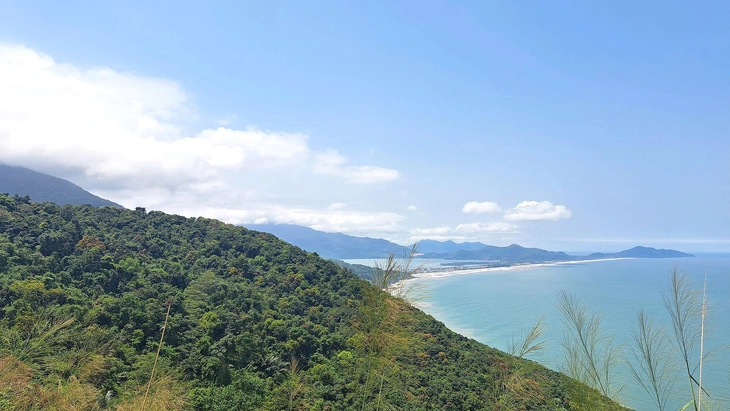
Thanks to effective protection and a persistent restoration effort, the North Hai Van forest has been upgraded to a Landscape Protection Area.
At the Workshop on Sharing Experiences - Joint Efforts in Maintaining Biodiversity and Promoting Comprehensive Community-Based Conservation in 2025, Mr. Nguyen Hoai Khuong, Project Manager (WWF-Vietnam), stated: "North Hai Van plays a special role in maintaining the ecological connectivity of the entire central Truong Son mountain range."
Effective protection of this area means safeguarding the comprehensive biological structure of the landscape, while supporting the implementation of the national biodiversity strategy and promoting nature-based solutions at the local level.
Source: https://tuoitre.vn/xanh-mat-rung-bac-hai-van-20260409234434724.htm



![[Video] Sunset at Lap An Lagoon – Where the sun sets over the fishing nets](https://vphoto.vietnam.vn/thumb/1200x675/vietnam/resource/IMAGE/2026/05/31/1780187239592_2222.jpeg)

















![[Video] Sunset at Lap An Lagoon – Where the sun sets over the fishing nets](https://vphoto.vietnam.vn/thumb/800x450/vietnam/resource/IMAGE/2026/05/31/1780187239592_2222.jpeg)












































































Comment (0)