

The model of training in narrow disciplines emerged in the context of an industrial economy that clearly revealed its limitations in the face of technological and social interaction. Interdisciplinary training has therefore become a vital requirement for higher education today.
WHEN AI TRANSCENDS ITS ROLE AS A "TOOL"
For a long time, AI was seen as a product of information technology, associated with programming, data, and algorithms. This approach was relatively suitable in the narrow stage of AI, when systems only performed well in a few specialized tasks such as image recognition, language processing, or process optimization.
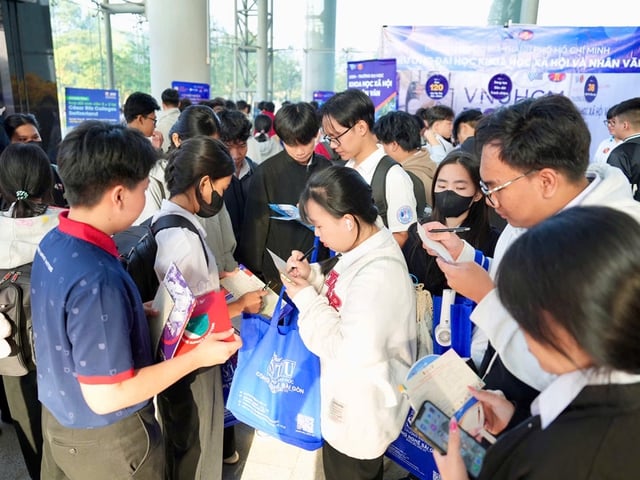
Students learn about the majors offered by universities at the Thanh Nien Newspaper's Exam Season Counseling program.
PHOTO: INDEPENDENT
However, reality is changing rapidly. AI today has entered fields once considered "exclusive" to humans: writing, policy analysis, assisting in medical diagnosis, providing legal advice, making financial decisions, and even participating in organizational management. The prospect of AGI – as predicted by American billionaire Elon Musk – becoming a reality in the coming years forces us to view AI as a force impacting all aspects of life simultaneously, no longer confined to a specific profession.
In this context, the question for higher education is not just "how to train more AI skills," but more profoundly: how to train people to be able to work with, adapt to, and collaborate with increasingly comprehensive and superior intelligent systems.
LIMITATIONS OF THE SINGLE-DISCIPLINARY TRAINING MODEL
Most universities today still organize training according to a single-discipline or fragmented multi-disciplinary model: engineering is separated from social sciences, technology from humanities, and economics from ethics and law. Students are trained in a narrow specialized "domain," but lack the ability to connect knowledge across fields, making them vulnerable to increasingly complex social and technological changes.
This model was once suitable in industrial economies, where jobs were stable, career boundaries were clear, and knowledge changed slowly. But in the age of AI, it is the intersection of fields that creates added value.
An AI engineer lacking ethical and legal understanding could create technology that harms society. An economics graduate who doesn't understand data and algorithms will struggle to make decisions in the digital economy. A doctor without a background in data science and AI will fall behind in precision medicine. Conversely, someone who only understands AI but not people, culture, and society will also struggle to create sustainable solutions.
BLURRING INDUSTRY BOUNDARIES
AGI – if achieved – will not "belong" to any one specific discipline. It is a convergence of computer science, mathematics, neuroscience, philosophy, linguistics, economics, cognitive science, and ethics. AI itself is an interdisciplinary entity.
In reality, the major problems arising from AI—such as job losses, algorithmic bias, privacy, legal liability, or digital inequality—cannot be solved by a single industry. They require systemic thinking, multi-dimensional analytical capabilities, and coordination among technology, society, and policy.
If university education continues to "divide" knowledge, society will face generations of workers who are technically skilled but lack social awareness, or who understand society but cannot master technology.
Around the world, many universities have quickly shifted towards interdisciplinary approaches. Programs such as data science-economics, biomedical technology, law-technology, philosophy-AI, or cognitive science-machine learning are becoming increasingly popular. In these programs, students not only study "many subjects," but are also trained through integrated curricula centered around complex real-world problems.
Interdisciplinary training does not mean diluting specialization. On the contrary, it requires learners to have a solid core foundation in one field while also being able to "dialogue" with other fields: understanding the methods, language, and limitations of each discipline. In the age of AGI, human value lies not in memorizing knowledge—something AI does better—but in the ability to ask the right questions, assess consequences, and make responsible decisions.
In Vietnam, the trend of interdisciplinary training is gradually emerging. Several universities have implemented integrated programs to meet the requirements of comprehensive human resource training. The Vietnam National University Ho Chi Minh City (VNU-HCM) has opened many more interdisciplinary and inter-university programs in fields such as new energy, logistics, educational technology, and land economics. Thai Nguyen University is implementing interdisciplinary programs such as semiconductor technology, combining engineering, information technology, and practical skills. Many other universities also have interdisciplinary training programs…
These examples illustrate the initial transformation of Vietnamese higher education. However, interdisciplinary training is still in its early stages and requires additional policies, resources, and a shift in management thinking to achieve a scale and quality commensurate with its potential.

Interdisciplinary training is not only a way to adapt to AI, but also a path to affirming the irreplaceable role of humans in the era of AI progressing towards AGI.
Photo: Nhat Thinh
UNIVERSITY TRAINS INDIVIDUALS WITH TECHNOLOGICAL ORIENTATION CAPABILITIES
A major risk in the age of AI is that humans are relegated to the role of "operators" or "supervisors" of machines, while their power to determine values and strategies is diminished. Interdisciplinary training, if properly designed, helps universities maintain a crucial role: training individuals capable of leading technology, rather than simply following it.
This is especially important in fields such as education, healthcare, public administration, media, and finance—where every technical decision is tied to profound social consequences. University graduates need to understand that every AI-based decision involves value choices, not the "absolutely objective" outcome of an algorithm.
The emergence of AGI—sooner or later—forces higher education to reconsider the fundamental question: What is the purpose of universities in a world where knowledge is increasingly cheap and no longer scarce?
The answer is that universities should not only impart knowledge, but also help students understand the world in its complexity, connect with it, think critically, and act responsibly. Interdisciplinary training, therefore, is not only a way to adapt to AI, but also a path to affirming the irreplaceable role of humans in the age of AI progressing towards AGI.
Limitations of single-subject teacher training and the need for innovation.
To meet the requirements of the 2018 General Education Program, teacher training colleges have offered interdisciplinary teacher training programs such as natural science teacher training, history and geography teacher training, etc.; however, many fields still offer single-subject teacher training programs such as mathematics, physics, chemistry, biology, computer science, history, geography, and foreign languages.
In the context of AI advancing towards AGI, single-subject teacher training reveals clear shortcomings. This model produces teachers with deep expertise but narrow scope, making it difficult to meet the requirements of integrated teaching. At the same time, this training method, which focuses on knowledge transmission, is increasingly losing its advantage as AI effectively provides information.
Furthermore, teacher training programs lack a foundation in AI, educational data, and digital ethics, leaving teachers unprepared to embrace the use of AI in schools.
Therefore, it is also necessary to research the shift towards interdisciplinary and multidisciplinary teacher training, focusing on the ability to integrate knowledge and design thematic and project-based learning. Future teachers must be prepared to work alongside AI as a pedagogical assistant, focusing on values that AI cannot replace: critical thinking, humanistic education, and social responsibility.
Source: https://thanhnien.vn/xu-huong-dai-hoc-dao-tao-lien-nganh-185260209210227085.htm

![[Photo] General Secretary and President To Lam presides over a meeting with the Central Organizing Committee.](https://vphoto.vietnam.vn/thumb/1200x675/vietnam/resource/IMAGE/2026/06/03/1780482764658_a1-bnd-4741-3342-jpg.webp)

![[Photo] Secretary of the National Assembly Party Committee, Chairman of the National Assembly presides over the meeting of the Standing Committee and Executive Committee of the National Assembly Party Committee.](https://vphoto.vietnam.vn/thumb/1200x675/vietnam/resource/IMAGE/2026/06/03/1780480353201_ndo_br_bnd-2585-jpg.webp)


































![[Photo] General Secretary and President To Lam attends the 14th Congress of the Vietnam Trade Union](https://vphoto.vietnam.vn/thumb/1200x675/vietnam/resource/IMAGE/2026/06/04/1780543339765_anh-man-hinh-2026-06-04-luc-10-22-07.png)



























![[Video] Sunset at Lap An Lagoon – Where the sun sets over the fishing nets](https://vphoto.vietnam.vn/thumb/1200x675/vietnam/resource/IMAGE/2026/05/31/1780192137701_beach-landscape-sea-water-nature-grass-745871-pxhere-com.jpeg)




































Comment (0)