

Japan's tourism industry experienced an impressive May with 3.04 million international visitors, marking the third consecutive month exceeding 3 million. According to official figures, international tourist arrivals in May increased by 60.1% year-on-year, significantly boosting Japan's tourism economy , which is already recovering from the Covid-19 pandemic.
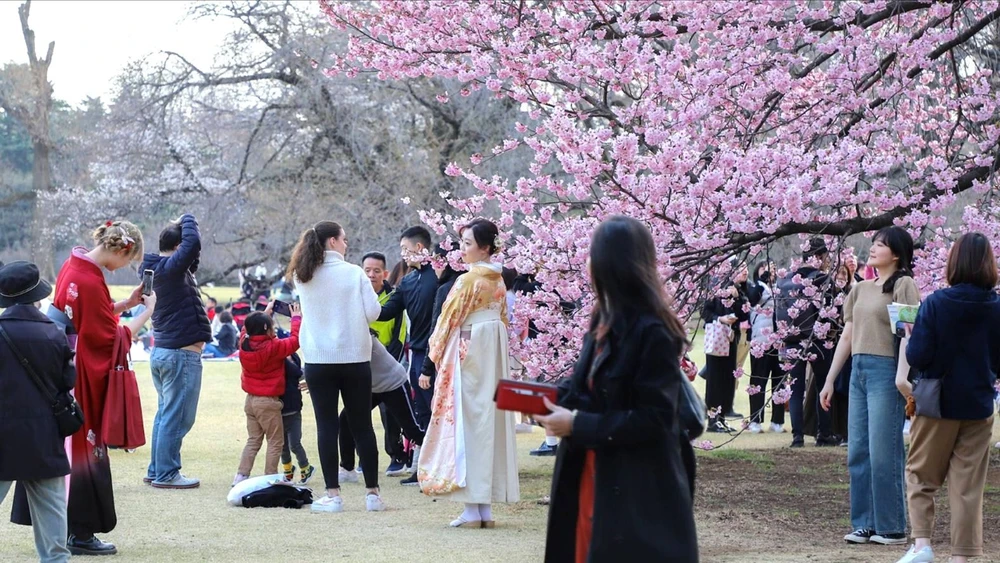
According to the Japan National Tourism Organization (JNTO), the sharp increase in international visitors is attributed to several factors, including the depreciation of the yen, which makes products and services cheaper for international tourists, encouraging them to spend more. In addition, the number of flights and ships arriving from East Asia has increased.
Visitors to Japan mainly come from more than 12 countries and territories, including South Korea and the United States. Data from the Japan National Tourism Organization (JNTO) shows that the total number of tourists from January to May was 14.64 million, a 6.5% increase compared to the same period in 2019, before the Covid-19 pandemic outbreak.
By country and region, South Korea leads with 738,800 visitors, a 43.3% increase year-on-year and a 22.4% increase compared to 2019. This is followed by Chinese tourists, with 545,400 visitors, more than four times the number from the same period last year, but still down 27.9% compared to 2019. Japan Tourism Agency Commissioner Ichiro Takahashi predicts that, with the current growth rate, Japan expects the number of international visitors this year to surpass the record of 31.88 million recorded in 2019.
Innovation and increased investment in tourism products have made Japan's image increasingly attractive. Developing transportation infrastructure, connecting tourist destinations with a highway system, and restoring and developing traditional local tourism industries have become highlights of Japanese tourism.
The application of high technology in tourism development is also emphasized. Japan uses technology to support the application and visa issuance process, implementing a visa-free policy for 68 countries and territories. Japan has also built new tourism corridors, allowing tourists to travel to all parts of the country.
To support this policy, Japan Railways (JR) has released the "Japan Railway Pass," designed to make traveling in Japan easier and more convenient for foreign tourists. This special pass allows unlimited travel on trains and buses nationwide operated by JR, including the Shinkansen, at the most economical cost.
However, in addition to bringing enormous economic benefits to Japan, the tourism industry is also causing problems for the country, most notably the issue of overcrowding by foreign tourists. This is highlighted in the Japan Tourism White Paper 2024, recently published by the Japanese government . The excessive concentration of foreign tourists in major cities such as Tokyo, Osaka, and Nagoya has caused overcrowding and several problems such as traffic congestion, littering, and unauthorized entry into private areas to take photos.
Starting in March of this year, the Japan Tourism Agency selected 20 high-traffic areas to pilot a model for addressing tourism overcrowding. The Japan Tourism White Paper emphasizes that, in the future, the Japanese government will support local authorities in overcoming this issue while simultaneously continuing to promote attracting foreign tourists to Japan for leisure and shopping.
SOUTHERN
Source: https://www.sggp.org.vn/xu-so-mat-troi-moc-hap-dan-du-khach-post745829.html
![[Photo] General Secretary and President To Lam presides over a working session with the Central Policy and Strategy Committee on the development of the materials industry.](https://vphoto.vietnam.vn/thumb/1200x675/vietnam/resource/IMAGE/2026/05/21/1779359935432_a3-bnd-3129-1412-jpg.webp)

![[Photo] National Assembly Chairman Tran Thanh Man working with the Standing Committee of the Law and Justice Committee](https://vphoto.vietnam.vn/thumb/1200x675/vietnam/resource/IMAGE/2026/05/21/1779378929214_ndo_br_1-4610-jpg.webp)






























































































Comment (0)