

The Hamas attack on Israel caused a major shock; was Hamas deliberately trying to fight a losing battle, or did they have a more calculated plan?
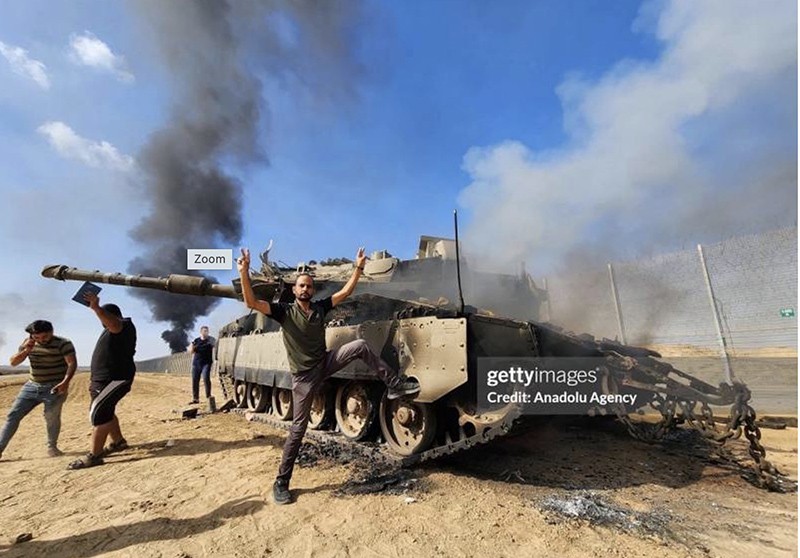 |
| Hamas fighters and a destroyed Israeli tank. |
"Fake red flags" mislead intelligence.
The Hamas attack on Israel on October 7th was shocking not only because of its unexpectedness but also because of unprecedented events related to the attack: the Israeli intelligence community was unprepared; the Israeli army initially lacked a quick response; and the militia's success in the first few hours.
Although it is still too early to determine the cause of these situations, some reasonable assumptions can be made.
Clearly, Israel did not anticipate the fierce conflict that was about to erupt. In recent years, the Israeli intelligence community had focused primarily on Iran and its border regions with Syria and Lebanon.
Essentially, Israel uses its intelligence capabilities primarily to counter the development of Iran's nuclear and ballistic missile programs, and to prevent the transfer of advanced military equipment from Iran to Hezbollah in Lebanon via Syria.
The shift in the Israeli intelligence community is evidenced by Tel Aviv's recent heightened vigilance regarding Iran and Hezbollah's construction of an airport in southern Lebanon, the activities of the Iranian-backed Hussein Brigades in Syria, and Hezbollah's establishment of a camp in the city of Ghajar.
Therefore, it can be argued that Hamas and its supporters, primarily Iran and Hezbollah, are misleading Israel. To date, neither Israel nor other sources know exactly what is inside the Hezbollah camp, leading some to speculate whether it is a "fake red flag" operation.
Just three weeks ago, on September 12th, the office known as the Joint Operations Room in the Gaza Strip, comprising Palestinian resistance forces commanded by Hamas's military branch, the al-Qassam Brigades, conducted an exercise that included rehearsing large-scale missile attacks, utilizing drone strike capabilities, and refining urban guerrilla warfare techniques.
All of these tactics were employed in the current attack; however, the Israeli intelligence community did not anticipate the attack.
Aside from being distracted, Israel's recent attack doesn't seem to have demonstrated its main advantage: the element of surprise.
Strategic paralysis
In most conflicts, Israel has the advantage of surprising its opponents with massive airstrikes aimed at achieving "strategic paralysis." However, in this conflict, Hamas not only deprived Israel of that advantage but also caught the Israel Defense Forces (IDF) off guard.
The Hamas Islamic movement has employed a strategy similar to Blitzkrieg – a lightning-fast, concentrated force at specific entry points, followed by rapid advances and successive attacks behind Israeli defenses.
Furthermore, Hamas appears to have attempted to sow public discord and distract the Israeli military while conducting attacks by sea and air.
In addition, Hamas's tactical innovations include the use of new weapons and the deployment of unprecedented firepower. Learning from the 2021 conflict with Israel, Hamas realized that while they couldn't technologically surpass Israel's "Iron Dome" missile defense system, they could neutralize it with a barrage of rockets.
By concentrating firepower, launching numerous missiles, artillery shells, and suicide drones toward Israeli territory, Hamas hopes to overwhelm the capabilities of the "Iron Dome." Learning from the Russia-Ukraine conflict, Hamas has used stealthy, quadcopter drones to target Israeli troops and observation posts.
In this conflict, Hamas appears to be attempting to neutralize key Israeli advantages, such as air superiority, by taking hundreds of Israelis hostage.
The primary objective of taking hostages may be to use them as bargaining chips in future negotiations – as Hamas leaders have claimed they have enough hostages to force Israel to release all Palestinian prisoners.
However, it should be noted that Hamas may be holding hostages in bunkers and tunnels. This tactic not only restricts the freedom of movement of Israeli air forces but also increases the likelihood of secondary casualties.
In previous conflicts, militias have stockpiled ammunition and soldiers in civilian areas to create human shields. Hamas has now created a double-edged sword: If Israel attacks, its citizens will be in danger; if it doesn't attack, Israel continues to face attacks from the Palestinians.
Ultimately, despite these tactics, the military asymmetry between Israel and Hamas is evident.
The IDF has an absolute advantage in every respect, which raises the question: Why was the attack launched? Currently, it seems that Hamas is hoping that, by exploiting the hostages, they can pressure Israel to ease restrictions on the Gaza Strip or release prisoners.
Furthermore, every action by Hamas could be part of a larger strategy, provoking and drawing DIF forces into a war of attrition. Clearly, only time will tell!
Source































![[Photo] Reception to welcome General Secretary and President To Lam and his wife on their State visit to the Philippines](https://vphoto.vietnam.vn/thumb/1200x675/vietnam/resource/IMAGE/2026/06/01/1780295488620_vna-potal-chieu-dai-chao-mung-tong-bi-thu-chu-tich-nuoc-to-lam-va-phu-nhan-tham-cap-nha-nuoc-toi-philippines-8798060-7855-jpg.webp)










































































Comment (0)