

Along the Cau River, both the North and South banks still preserve and maintain the traditional custom of "ket cha" (brotherhood) between villages, which can be between two villages or one village forming a brotherhood with several villages. Van Village (also known as Yen Vien Hamlet), Van Ha Commune, Viet Yen Town (formerly Bac Giang Province) is not only a famous village for its traditional rice wine making with the brand "Van Huong Fine Wine" but also possesses many unique heritages and beautiful customs. Therefore, in 1703, King Tu Duc bestowed upon the village a royal decree with the four characters "My Tuc Kha Phong" (Beautiful Customs Worthy of Commendation).
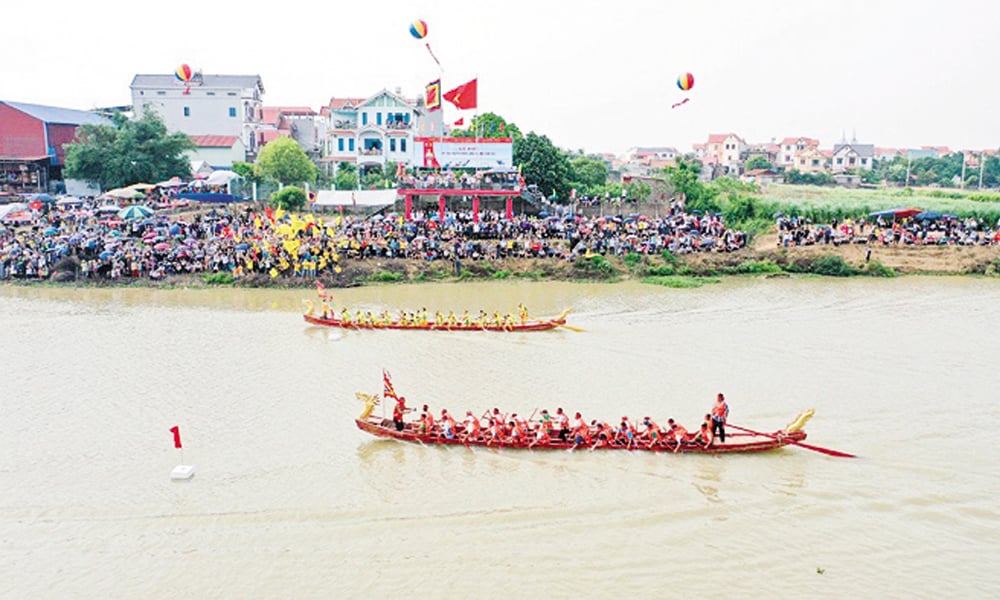 |
The boat racing festival in Tieu Mai village (Hiep Hoa district) attracts a large number of people from both banks of the Cau River to participate and cheer. |
Mr. Do Viet Tien, a resident of Van village, recounted: To bring this royal decree back, the elders of the village had to walk all the way to Thang Long (Hanoi). Upon reaching Truc Market, in Dong Gao village (also known as Phong Nam hamlet), Nguyen Xa commune, Yen Phong district (formerly Bac Ninh province), a torrential rain and thunderstorm broke out, making further travel impossible. Seeing this, the people of Dong Gao village brought out palanquins and sedan chairs to welcome the elders from Yen Vien village. The royal decree was placed on a palanquin and carried into the Dong Gao village temple, where precious betel nuts were picked for the ceremony. Throughout that night, the elders from Yen Vien village were warmly welcomed by the people of Dong Gao village, and they only parted ways the following day.
Grateful for that gesture, the following year, when Dong Gao village renovated the temple, the people of Yen Vien village donated four main pillars. From then on, the people of the two villages regarded each other as brothers. They made an agreement to maintain friendly relations, not charging each other ferry fees or taxes on goods sold. Today, the two villages still consider each other as brothers.
Mr. Bui Minh Quyet from Dong Gao village said: Every year on the 4th day of the 8th lunar month, people from Yen Vien bring offerings to Dong Gao to meet their elder brother. On the 16th day of the first lunar month, people from Dong Gao return the favor to Yen Vien. During Tet (Lunar New Year), especially on the village festival day, both sides organize a ceremony to welcome the elder brother to their village temple for a ritual, where they can reminisce and recall the tradition of brotherhood between the two villages. What's special is that although they are bound by the "Brother Village - Younger Village" brotherhood, in their interactions there is no distinction between "older" and "younger," only addressing each other as "Brother" regardless of age difference.
In Van Ha commune, there is also Tho Ha village, which has long been allied with three other villages: Dai Lam, Tam Da commune, Yen Phong district; Dang Xa residential area, Van An ward; and Qua Cam residential area, Hoa Long ward, Bac Ninh city (all in the former Bac Ninh province). Mr. Nguyen Duc Thanh, head of Tho Ha village, said: "Both sides consider themselves younger and respect the other as older. Every year, they choose a day to visit each other, with the elderly and officials meeting once a year. In addition, whenever either village has a major event, they invite the other to attend. The village festival is always the most lively day because the villages from 'the older brother' also come to celebrate. The two allied villages organize welcoming ceremonies for each other."
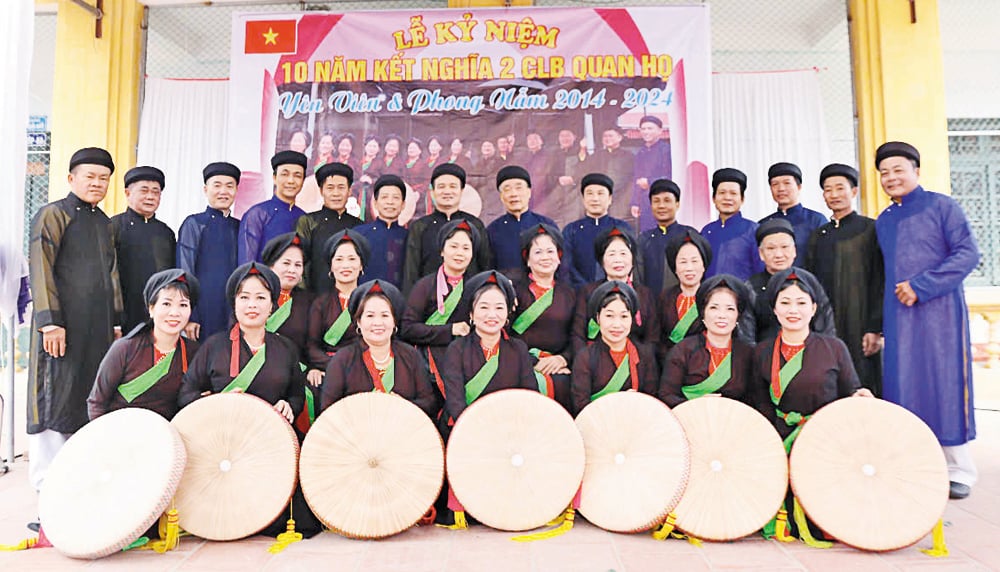 |
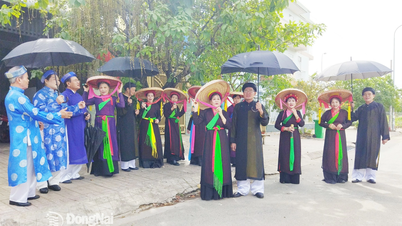
The Quan Ho singers from Yen Vien and Phong Nam villages exchanged ideas and formed a brotherhood. |
At the appointed time, both villages, with their full contingents, set out from their respective villages to the other. Midway, they met, and the two villages respectfully bowed in greeting. Then, one after the other, both villages proceeded to the village temple or pagoda where the festival was held, offering prayers and wishing each other a year of favorable weather, prosperity, and a strong, enduring brotherhood. Songs, dances, and games of the festival were performed by both villages, competing until late into the night. Upon departure, the other village always sent a delegation to see the first village off at the same meeting point, respectfully bowing and promising to meet again next season. Their bond of brotherhood was abundant, not for money, but for deep affection.
| Nowadays, the villages along the Cau River have gradually abandoned outdated customs and elaborate rituals; lavish feasts lasting for days are no longer common. Instead, the gifts exchanged are simple, and young men and women from both villages can exchange vows and marry each other. In times of hardship and adversity, they stand side by side, supporting each other through danger. |
Nowadays, the villages along the Cau River have gradually abandoned outdated customs and elaborate rituals; lavish feasts lasting for days are no longer common. Instead, the gifts exchanged are simple, and young men and women from both villages can exchange vows and marry each other. In times of hardship and disaster, they stand side by side, supporting each other through adversity. Last year, when Typhoon No. 3 (Typhoon Yagi ) struck, upon hearing the announcement on the loudspeakers that Tho Ha village was submerged in floodwaters, the people of Dai Lam village, without being asked, went to the village's cultural center to donate tens of millions of dong, sending people to help Tho Ha overcome the damage.
Not only were villages united in fraternal ties, but along the Cau River, many Quan Ho singing groups and clubs in communes and wards of Yen Dung district, Viet Yen town, and Hiep Hoa district (formerly Bac Giang province) also formed sister-village relationships with communes in Que Vo district, Bac Ninh city, and Yen Phong district (formerly Bac Ninh province). Notable examples include: Huu Nghi with Tieu village; Tien Lat with Hoai Biu; Quang Bieu with Qua Cam; Nui Hieu with Thi Cau and Dap Cau; Tam Tang with Do Han; Trung Dong with Thuong Dong and Ha Dong; Noi Ninh with Han and Diem…
During festivals, celebrations, and gatherings, the young men and women from both sides often row boats across the river to meet, socialize, and sing. When there are joyous occasions or important events, they never forget to invite each other to share in the joy and enjoy a heartfelt reunion. The Dong Bun ferry crossing, located in Tam Da commune, Yen Phong district, connects to Tien Son commune, Viet Yen town. People from both sides still cross daily to socialize, trade, visit relatives, and work in the industrial zones of the two provinces.
Today, in harmony with the flow of national renewal and development, the Cau River no longer separates Bac Giang and Bac Ninh but has merged them into one, depositing "alluvial soil" that illuminates the future of the new Bac Ninh province, enabling it to move forward rapidly and steadily.
Source: https://baobacninhtv.vn/yeu-thuong-doc-dai-song-cau-postid421164.bbg
![[Image] 20 islands in the Spratly Islands special administrative region hold early elections.](https://vphoto.vietnam.vn/thumb/1200x675/vietnam/resource/IMAGE/2026/03/08/1772949669607_img-20260308-112026-90-jpg.webp)
![[Image] Vietnam's diverse colors on its journey of innovation](https://vphoto.vietnam.vn/thumb/1200x675/vietnam/resource/IMAGE/2026/03/09/1773041390813_anh-man-hinh-2026-03-09-luc-14-28-17.png)
![[Photo] Diary of the photojournalism contest “Vietnam on the journey of innovation”](https://vphoto.vietnam.vn/thumb/1200x675/vietnam/resource/IMAGE/2026/03/09/1773041117692_anh-man-hinh-2026-03-09-luc-14-24-45.png)










































![[Photo] Diary of the photojournalism contest “Vietnam on the journey of innovation”](https://vphoto.vietnam.vn/thumb/402x226/vietnam/resource/IMAGE/2026/03/09/1773041117692_anh-man-hinh-2026-03-09-luc-14-24-45.png)
















Comment (0)