

During his six-day visit to Australia, Prime Minister Pham Minh Chinh had more than 30 activities, the highlights being his speech at the ASEAN-Australia Special Summit, talks with Prime Minister Anthony Albanese, and the upgrading of bilateral relations to a Comprehensive Strategic Partnership.

Prime Minister Pham Minh Chinh and his wife visited Australia from March 4-9, marking his first visit to the country as head of government.
The Prime Minister's first activity was cutting the ribbon to inaugurate the Australia-Vietnam Policy Institute at RMIT University in Melbourne on the morning of March 5th. The institute was established to study the strategic relationship between Australia and Vietnam, contributing to the implementation of Australia's "Southeast Asia Economic Strategy to 2040".
According to the Prime Minister, the Institute will actively and effectively participate in the policy-making process, promoting and improving the quality of relations between the two countries.

The government leader then spoke at the Vietnam-Australia Business Forum. He called on Australian entrepreneurs to invest in Vietnam with the spirit of "harmonious benefits, shared risks". With a policy of selective cooperation and foreign investment attraction, Vietnam prioritizes attracting projects in the fields of green economy, digital economy, semiconductors, and renewable energy.
Currently, Australian businesses have over 630 projects and more than US$2.03 billion in registered capital, ranking 20th out of 145 countries and territories investing in Vietnam, mostly in the processing and manufacturing sectors. Conversely, Vietnam has invested in more than 90 projects in Australia with a total investment of over US$550 million.

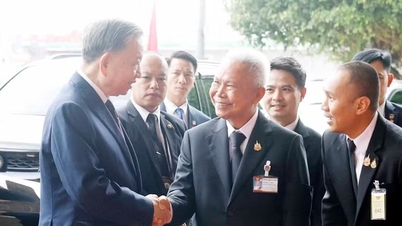
On the evening of March 5th, Australian Prime Minister Anthony Albanese welcomed Vietnamese Prime Minister Pham Minh Chinh at the Convention Centre in Melbourne, in an official welcoming ceremony for the heads of delegations attending the ASEAN-Australia Special Summit.
The conference was held over two days, March 5-6, with the participation of leaders from ASEAN countries, Australia, and the ASEAN Secretary-General. The Prime Minister of Timor Leste was invited to attend as an observer.
Australia was one of the first partners to establish a dialogue relationship with ASEAN in 1974. The two sides upgraded their relationship to a Strategic Partnership in 2014 and a Comprehensive Strategic Partnership in 2021.

At the sessions of the ASEAN-Australia Special Summit on March 6, Prime Minister Pham Minh Chinh proposed directions for ASEAN-Australia relations, including three breakthroughs, three enhancements, and three commonalities.
The Prime Minister stated that breakthroughs are needed in economic, trade, and investment cooperation towards balance and sustainability; human resource development; and cooperation in science and technology and innovation.
He proposed strengthening political trust and cooperation to ensure regional peace and security; increasing sub-regional cooperation and narrowing the development gap for inclusive and sustainable development; and increasing cultural cooperation and people-to-people exchanges.
The "Three Together" principle between ASEAN and Australia is to jointly build a united and resilient region; to jointly promote respect for international law and rules-based conduct in the region; and to jointly build and shape an open, inclusive regional structure that upholds multilateralism, with ASEAN playing a central role as a core factor in bringing together and harmonizing the interests of major powers.

Following two days of attending the conference, Prime Minister Pham Minh Chinh began his official visit to Australia from March 7-9. A welcoming ceremony for Prime Minister Pham Minh Chinh and his wife was held at the Parliament House in Canberra on the morning of March 7, featuring a 19-gun salute.

Prime Minister Pham Minh Chinh reviews the honor guard before meeting with Prime Minister Anthony Albanese.
Vietnam and Australia established diplomatic relations in February 1973, which were later upgraded to a Strategic Partnership in March 2018.

Following the talks, Prime Minister Pham Minh Chinh and Australian Prime Minister Anthony Albanese agreed to upgrade Vietnam-Australia relations to a Comprehensive Strategic Partnership.
Vietnam has established Comprehensive Strategic Partnerships with China, Russia, India, South Korea, the United States, and Japan.

At the subsequent joint press conference, the two Prime Ministers affirmed that this new framework would contribute to strengthening political trust and further deepening Vietnam-Australia cooperation, fulfilling the common aspirations of the people of both countries.
The two sides will work closely together to implement the "six improvements," including: higher and more strategic political and diplomatic trust; more inclusive, substantive, and effective economic, trade, and investment cooperation; stronger promotion of cooperation in science and technology, innovation, digital transformation, and green transformation; more comprehensive and in-depth cooperation in culture, education and training, environment, and climate change response; broader and more sincere people-to-people exchanges and intergenerational connections; and greater understanding, empathy, and sharing regarding defense and security cooperation.

Prime Minister Pham Minh Chinh and his wife Le Thi Bich Tran also met with the Governor-General of Australia, David Hurley, and his wife, Linda Hurley; received Ms. Sharon Claydon, Deputy Speaker of the House of Representatives and Chair of the Australia-Vietnam Parliamentary Friendship Group; met with the President of the Australian Senate, Sue Lines; and received the leader of the Liberal Party of Australia, Peter Dutton.
Following the meeting, the Governor-General of Australia drove the Prime Minister and his wife in an electric car to tour the Governor-General's residence. Mr. Tran Ba Phuc, Chairman of the Vietnamese Business Association in Australia, said that Australia's reception of the Prime Minister was very special. "The fact that the Governor-General of Australia personally drove the Prime Minister on a tour of the Governor-General's residence is very rare; not every national leader is given such a ceremony," Mr. Phuc said.

Science, technology, and innovation are among the areas prioritized by the Prime Minister for cooperation. On the morning of March 8th, the Prime Minister visited and worked at the Commonwealth Scientific and Technological Research Organisation (CSIRO) of Australia, one of the world's largest multidisciplinary science and technology organizations.
Prime Minister and Co-Secretary of Foreign Affairs Tim Watts witnessed the signing of a Memorandum of Cooperation in the fields of science, technology and innovation between Minister of Science and Technology Huynh Thanh Dat and CSIRO Director General Doug Hilton.
According to the memorandum of understanding, the two sides will cooperate in seven main areas, including: encouraging joint research activities; exchanging information, documents, and technology transfer; supporting training; co-funding joint research projects; encouraging the joint publication of cooperation results; supporting the implementation of cooperation programs; and identifying new areas of cooperation.

With the desire to further promote educational cooperation between the two countries, the Prime Minister visited and worked with the President of RMIT University, attended the inauguration ceremony of the Vietnam-Australia Policy Institute, and attended and spoke at the Vietnam-Australia Education and Training Cooperation Forum.
Speaking at the Forum, the Prime Minister requested that Australia double the number of scholarships in the next 2-3 years, as well as facilitate visa procedures for Vietnamese students. He hoped that the two countries would increase the number and improve the quality of cooperation and joint training programs between higher education institutions, with a focus on research, development, and application of science and technology.
Prime Minister Pham Minh Chinh, along with Minister of Education and Training Nguyen Kim Son and Australian Minister of Education Anthony Chisholm, then witnessed the signing ceremony of eight cooperation documents between universities; prioritizing cooperation in railway construction, smart cities, semiconductor technology, artificial intelligence, biotechnology, etc.
On his last day in Australia, the Prime Minister met with and listened to representatives of the Vietnamese Business Association and the Association of Intellectuals and Scientists in Australia, who offered suggestions for national development.

![[Photo] Admire the coral "masterpiece" amidst the million-year-old heritage of Dak Lak province.](https://vphoto.vietnam.vn/thumb/1200x675/vietnam/resource/IMAGE/2026/05/30/1780107638639_y25-jpg.webp)
































































Comment (0)