

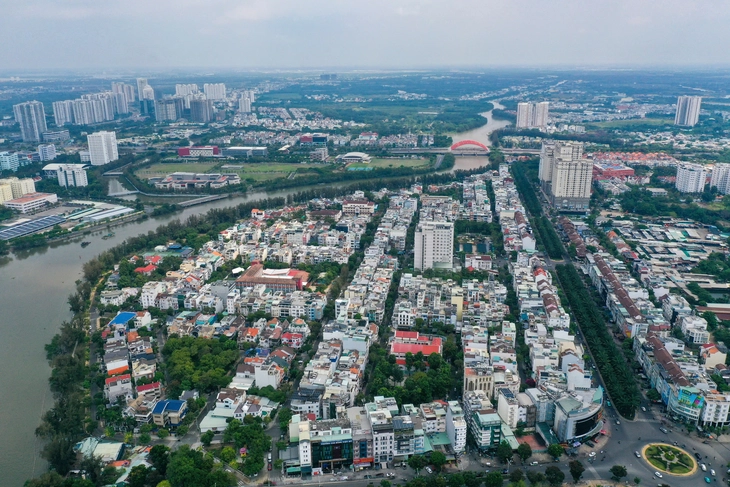
A view of the modern Trung Son residential area (Binh Hung commune - Ho Chi Minh City) - Photo: TRI DUC
The Ministry of Justice is currently reviewing the draft decree on the organization and operation of villages and residential areas, which is being developed by the Ministry of Interior. This will provide a unified legal basis for the reorganization of villages and residential areas nationwide in the near future.
Number of villages, residential areas, and part-time workers nationwide
According to the Ministry of Interior , implementing Resolution 18 and current legal regulations, the reorganization of villages and residential areas has achieved significant results, reducing the number from 136,824 units in 2015 to 89,574 in 2025 (a reduction of 47,250 villages and residential areas, equivalent to 34.53%).
However, many villages and residential areas still do not meet the criteria regarding the size of the number of households as stipulated in current regulations, and this is uneven across different regions.
According to statistics, there are many villages with fewer than 150 households, specifically about 21,199 villages, concentrated in the mountainous areas of the North, while in Hanoi and Ho Chi Minh City there are many large residential areas (over 1,000 households).
Following the reorganization of provincial and commune-level units in 2025, the average number of villages and residential areas per commune-level unit will increase significantly.
Accordingly, the number of villages and residential areas per commune level increased from approximately 9 to approximately 27 (three times the previous number).
The Ministry of Interior argues that this increases the number of administrative units, creating significant management pressure on commune-level authorities, and that current regulations have not been adjusted to suit current practices.
According to data compiled by the Ministry of Interior from localities (December 2024), there are 271,945 part-time community workers in villages and residential areas nationwide.
After the restructuring, 268,722 people are still being assigned positions and receiving allowances as prescribed.
The state budget spends approximately 943 billion VND per month (equivalent to about 11,316 billion VND per year) on allowances.
Over the past period, the deployment and utilization of this workforce has been basically carried out in accordance with current regulations, initially meeting the operational requirements at the grassroots level.
However, when implementing restructuring towards increasing the size of villages and residential areas, the volume and nature of work change, requiring continued review and adjustment of regulations, policies, and arrangement plans to ensure they are commensurate with the scale, nature of work, and task requirements in the new context.
Naming and renaming villages and residential areas must comply with legal regulations and be in line with customs, traditions, and the wishes of the residents.
Regarding the principles for establishing, arranging, reorganizing, dissolving, naming, and renaming villages and residential areas, the draft basically inherits the current regulations, while amending and supplementing the principles to suit the two-tiered local government organizational model and the management requirements of the commune-level government.
Accordingly, the establishment, arrangement, reorganization, dissolution, and naming or renaming of villages and residential areas must ensure compliance with legal regulations, and be democratic, open, and transparent.
At the same time, it must be in accordance with the natural, socio-economic conditions, demographic characteristics, customs, traditions, and aspirations of the local community.
Implement the rearrangement and reorganization of villages and residential areas that do not meet the criteria in order to streamline administrative structures and improve the efficiency of local government operations.
The drafting agency proposed that in Hanoi and Ho Chi Minh City, villages must have at least 500 households, and residential areas must have at least 700 households. For the midland and mountainous regions of Northern Vietnam, villages must have at least 150 households, and residential areas at least 300 households.
In the Red River Delta, Southeast Vietnam, and the Mekong Delta, a village must have at least 400 households, and a residential area must have at least 550 households.
In the North Central region, a village must have at least 350 households, and a residential area must have at least 450 households. Along the South Central coastal region and the Central Highlands, a village must have at least 350 households, and a residential area must have at least 500 households.
Specifically in Gia Lai, Lam Dong, and Dak Lak provinces, villages must have at least 300 households, and residential areas must have at least 450 households.
Regarding the procedures and documentation for implementation, according to the draft, the People's Committee at the commune level is responsible for developing the plan and organizing public consultations in a suitable manner in accordance with the law on grassroots democracy implementation.
At the commune level, the commune-level authorities compile, receive, and explain the opinions of the people to complete the dossiers for submission to the People's Council at the same level for consideration and decision on the establishment, rearrangement, reorganization, dissolution, naming, and renaming of villages and residential areas.
In areas without a local government structure, the People's Committee at the commune level develops the plan and makes decisions within its authority.
According to Directive 21 of the Prime Minister, the People's Committees of provinces and cities must complete the review and develop a comprehensive plan for rearranging and reorganizing villages and residential areas before June 10th.
The People's Committee at the commune level must complete the plan for rearranging villages and residential areas, gather public opinions, and submit it to the People's Council at the commune level for approval before June 30th.
The directive also instructs the People's Committees of provinces and cities to terminate the employment of part-time officials at the commune level before May 31st.
Urgently develop, issue, and implement a plan for the arrangement, utilization, and resolution of benefits and policies for part-time officials at the commune level, ensuring its completion in conjunction with the completion of village and neighborhood reorganization before June 30th.
Source: https://tuoitre.vn/89-574-thon-to-dan-pho-ca-nuoc-se-thuc-hien-sap-nhap-ra-sao-20260522075608748.htm

![[Image] Hanoi's urban life under the challenge of a "scorching hot" environment](https://vphoto.vietnam.vn/thumb/1200x675/vietnam/resource/IMAGE/2026/05/25/1779706979265_nang-nong-t5-2026-minh-duy-7-4636-jpg.webp)




























































































Comment (0)