Men aged 20-34, those with undescended testicles, or those with a family history of testicular cancer are at high risk.
Testicular cancer is rare, accounting for about 1% of all cancers in men. It tends to affect younger men. According to the American Cancer Society (ACS), approximately 9,600 men were diagnosed with the disease in the US in 2020. In the UK, around 2,300 men are diagnosed with testicular cancer each year.
Since there are no screening tests, detection largely relies on common symptoms such as a lump in the testicle, a feeling of heaviness in the scrotum, testicular pain, fatigue, lower back pain, and unexplained weight loss. Some cases are asymptomatic and are only diagnosed during a reproductive health check-up or routine health examination.
Below are the risk factors that increase a man's risk of developing the disease.
Undescended testicles: This is a condition where one or both testicles fail to descend from the abdomen into the scrotum before a baby boy is born. According to the ACS, approximately 3% of baby boys are born with undescended testicles.
Men with this condition have a much higher risk of testicular cancer than the average person. The risk is increased in men whose testicles are located in the abdomen compared to those whose testicles have partially descended.



Males with this defect require surgery to move the testicles down into the scrotum. Experts recommend that the surgery be performed as soon as the child is one year old to avoid affecting physiology and fertility.
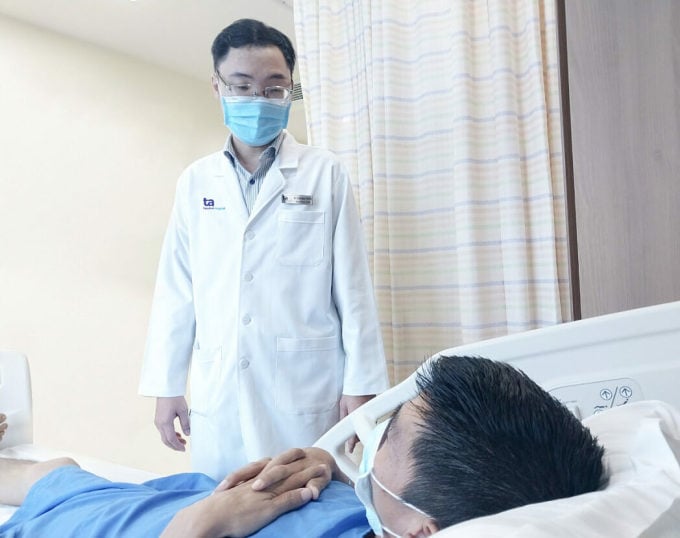
A doctor from the Urology - Nephrology - Andrology Center, Tam Anh General Hospital, Ho Chi Minh City, visits a patient after surgery. Photo: Thang Vu.
Genetic factors : Men whose fathers or brothers have had testicular cancer have a higher than normal risk of developing the disease. Klinefelter syndrome, a chromosomal abnormality that causes hypogonadism and infertility in men, is also associated.
Age: Approximately half of testicular cancer cases occur in men between the ages of 20 and 34. However, the disease can affect men of all ages, including infants and older men.
History of cancer in one testicle : Approximately 3-4% of men who have been cured of cancer in one testicle experience recurrence in the other.



The most common sign of testicular cancer is a lump in one, and sometimes both, testicles. The lump is usually painless, may be movable or immobile, smaller than a pea but can also be larger than a marble, and may feel hard like a stone.
If a lump is detected on the testicle, men should see a urologist as soon as possible for an accurate diagnosis. According to the ACS, with timely treatment, stage one testicular cancer has a 5-year survival rate of approximately 99%, while stage three has a rate of 74%.
Anh Ngoc (According to Verywell Health )
Source link