

According to several rice processing and export businesses, the peak harvest season is about a week away in An Giang, Dong Thap, and Kien Giang provinces.
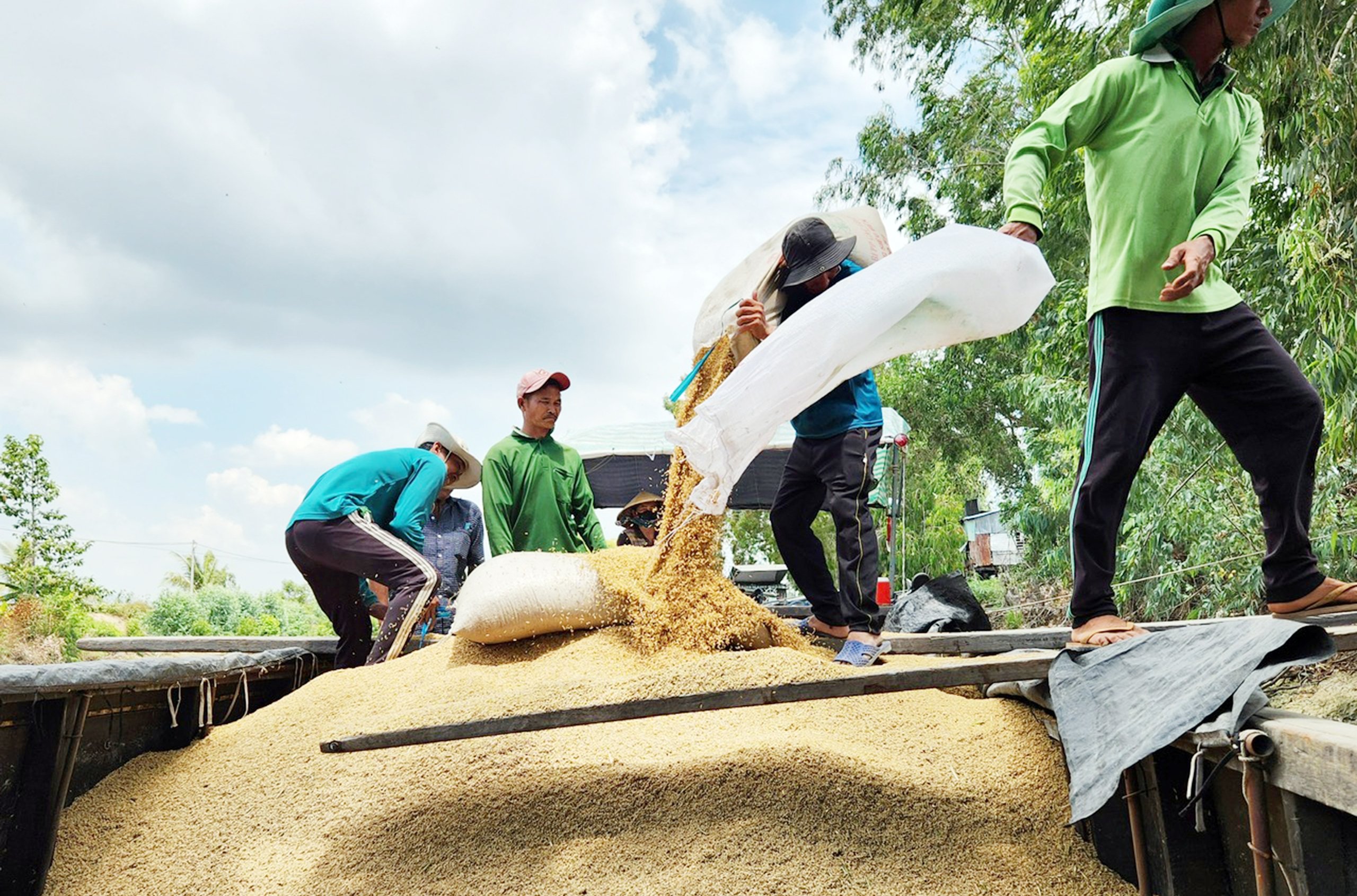
Traders buying OM18 rice at 6,400 VND/kg assert that farmers who rent land to grow rice will suffer losses, while those who cultivate their own land will break even - Photo: BUU DAU
According to rice processing and export businesses, Vietnam does export broken rice, but in small quantities. They also stated that India's resumption of 100% broken rice exports will compete with broken rice used in food processing, not with regular rice for consumption, and therefore will not significantly impact the price of Vietnamese exported rice.
Observations in several areas of the Mekong Delta show that this year's winter-spring rice crop has achieved quite high yields, with some places reaching about 1 ton per hectare of rice.
Therefore, even though rice prices have dropped sharply compared to the same time last year, farmers who grow rice on their own land are still making a profit. However, farmers who rent land to grow rice will certainly suffer losses.
Rice prices have risen slightly, but farmers remain worried.
Mr. Nguyen Thanh Nhon (residing in Vinh Khanh commune, Thoai Son district, An Giang province) said that traders are buying OM34 rice directly from the field at 5,400 VND/kg, an increase of 100 VND/kg compared to the price his family sold it for after harvesting 5 hectares of rice previously, with a high yield of about 1 ton/acre.
"Compared to the same period last year, the price of rice is currently 2,000 VND/kg lower, while fertilizer prices are trending upwards."
Specifically, I used to buy frozen fertilizer for 550,000 VND per bag, but now it's gone up to 650,000 - 670,000 VND per bag.
"It would be better if fertilizer prices hadn't increased, but now everything is going up. If rice prices don't recover during the summer-autumn rice crop season, rice farmers will be in trouble," Mr. Nhon said.
According to Mr. Nhon, the government's request to increase temporary stockpiling has delighted farmers, but the winter-spring rice crop is almost gone.
Even if prices go up, farmers won't have any rice left to sell. They hope that rice prices will rise again in the upcoming summer-autumn rice crop so they can feel secure.
"With India opening up its rice exports, our people will be affected to some extent. We feel that with this situation, Vietnam's rice exports will find it difficult to achieve the same effectiveness as in previous years."
"Many farmers in the Thoai Son area are switching to growing long-grain, fragrant rice varieties such as OM18 and Dai Thom 8 because they fetch higher prices than short-grain rice varieties like OM34," Mr. Nhon said.
While watching workers load rice onto boats, Mr. Vo Thanh Dat (residing in Tho Son commune, Hon Dat district, Kien Giang province) said that he has been a rice trader for over 10 years, specializing in buying rice from farmers, milling it, and selling it everywhere.
At the price of 6,400 VND/kg for OM18 rice, which he buys from farmers in Tan Tuyen commune (Tri Ton district, An Giang province), rice growers are finding it difficult to make a profit.
This winter-spring season, he bought over 120 tons of rice to take to Dong Thap or An Giang for milling and then sell as rice. "With the current price of rice and supplies, farmers are not making a profit. The price of rice needs to reach 7,000 VND/kg for farmers to make a profit," Mr. Dat affirmed.
Farmers do not benefit much from stockpiling.
According to traders, the price of Vietnamese 5% broken rice was offered at $389 per ton on March 6th, down $4 per ton from the previous week.
Meanwhile, Thai traders said demand remained relatively stable and price fluctuations would largely depend on the exchange rate. Thai 5% broken rice prices held steady at $415/tonne, compared to the $415-$420/tonne range quoted last week.
Speaking with us, Mr. Nguyen Chi Thanh - director of the rice sector at An Giang Import-Export Joint Stock Company (Angimex) - said that Vietnam does export broken rice, but in small quantities. He added that India's decision to resume exporting 100% broken rice will compete with broken rice used in food processing, not with rice for consumption.
Vietnam exports white rice, including varieties with 5%, 10%, 15%, and 25% broken grains. 25% broken rice is considered edible rice, but its quality is lower than 5% broken rice. Indian broken rice is primarily used for animal feed, flour, and alcohol production.
"India's opening up of this steel sheet export segment will have little impact on Vietnam. For many years, Vietnam has been importing steel sheets from India, while the amount of steel sheets exported from Vietnam is very small," Mr. Thanh analyzed.
According to several rice processing and export businesses, the peak harvest season in An Giang, Dong Thap, and Kien Giang provinces is about a week away.
However, the rice crop at this time has already been pre-ordered by traders. Therefore, even with the government's request for temporary stockpiling, farmers are not benefiting as much as the government had hoped.
One business asserted that following the government's directive, ministries and agencies would begin implementation, which would take at least over a month. By then, the rice harvest would be over, and farmers were preparing for the summer-autumn rice crop. Businesses typically use winter-spring rice as a reserve.
"Even though rice prices are rising right now, farmers don't have much rice left. In my opinion, planning for temporary stockpiling at this time will only help farmers to a certain extent. Because the price of rice has already been fixed between businesses and factories and farmers once the rice is ripe," this person added.
The price of broken rice from Vietnam is currently lower than the price of 100% broken rice from India.
Earlier on March 7, India decided to fully restore rice exports by allowing the export of 100% broken rice, raising concerns that this would cause a sharp drop in rice prices for competing countries.
Indian 100% broken rice is being offered at $330 per ton, higher than the $300 per ton offered by Vietnam, Myanmar, or Pakistan.
Despite the price difference, the return of Indian rice will cause the market to adjust prices downwards.
Indian parboiled rice with 5% broken grains is being offered at $409-$415 per ton, down from $413-$420 per ton last week. Indian white rice with 5% broken grains is priced at $390-$400 per ton this week.
The Ministry of Industry and Trade plans to meet with the Vietnam Food Association (VFA) and businesses in March 2025 to organize trade promotion programs in the Philippines and China.
According to VFA, only broken rice from Thailand, priced at $356/ton, is higher than that from India, while broken rice from Vietnam is priced at $307/ton and from Pakistan at $308/ton.
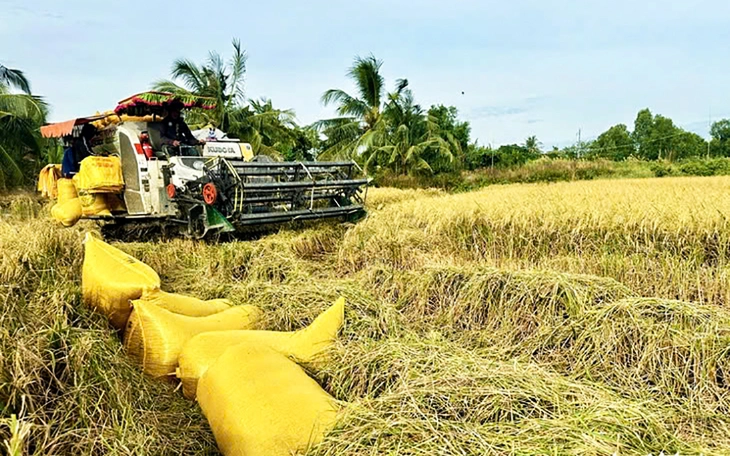 Preventing fluctuating rice prices.
Source: https://tuoitre.vn/an-do-mo-cua-xuat-khau-gao-100-tam-gao-viet-khong-bi-anh-huong-nhieu-20250312081925133.htm


![[Photo] Prime Minister Pham Minh Chinh attends the Conference on the Implementation of Tasks for 2026 of the Industry and Trade Sector](/_next/image?url=https%3A%2F%2Fvphoto.vietnam.vn%2Fthumb%2F1200x675%2Fvietnam%2Fresource%2FIMAGE%2F2025%2F12%2F19%2F1766159500458_ndo_br_shared31-jpg.webp&w=3840&q=75)




















































































Comment (0)