

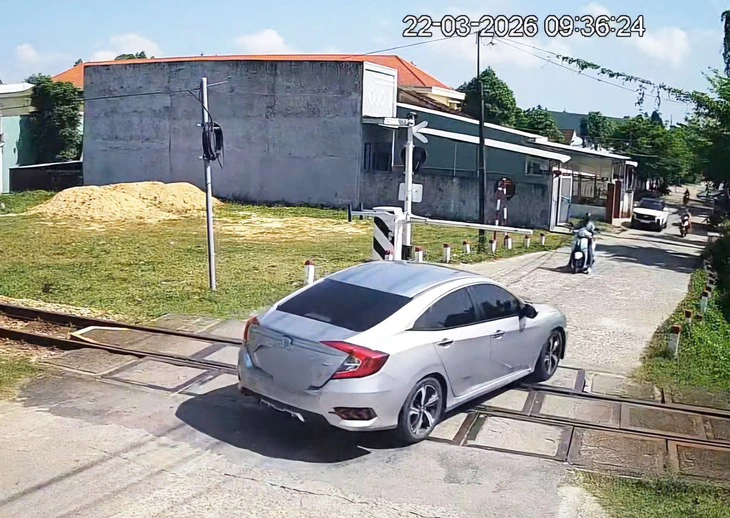
A car ran a red light at a level crossing in Tam Xuan commune, Da Nang city.
The driver managed to get out before the collision. No one died, but this traffic violation warrants reflection, just like those cases that resulted in fatalities.
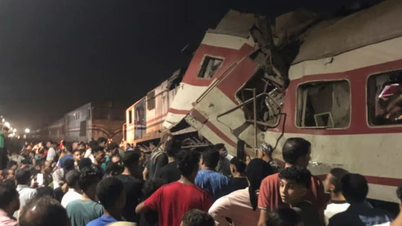
In the first four months of the year, 65 railway accidents occurred nationwide, resulting in 32 deaths and 30 injuries. Accidents at level crossings accounted for approximately half of these, with unauthorized crossings accounting for 42%.
Across the entire network, 2,356 unauthorized crossings still exist. This number is not a product of poor awareness. It is the result of decades of residential planning along railway lines without alternative access roads.
The incidents from the beginning of the year until now show two extremes. One extreme is passivity, as in the case in Dai Xuyen commune, Hanoi, just mentioned, or the case in Dak Lak where a 10-year-old boy died when his grandfather's farm vehicle crossed an unauthorized, unprotected crossing without signals or barriers.
The other extreme is actively disregarding regulations. On the evening of April 6th, at a level crossing in Thanh Khe ward (Da Nang), two female crossing guards were repeatedly struck on the head and face with helmets by a woman and her daughter, simply because they had performed their duty of lowering the barrier to receive the train.
I understand that stricter penalties are necessary. Decree 81/2026/ND-CP, effective May 15th, raises the fine for individuals to up to 25 million VND.
But looking at the recidivism pattern, the problem isn't the nominal penalty. It lies in three other loopholes.
Firstly, there's the technology of the barrier itself. Current automatic barriers operate in reverse, counting down from when the train arrives, and lack sensors to detect vehicles still on the tracks before lowering.
Secondly, there's the issue of urban planning. If you close a road without creating an alternative, people will still use it.
Thirdly, there is the legal identification of the personnel directly responsible for maintaining safety. Level crossing guards belong to a joint-stock company and do not have the authority to impose penalties; they can only issue warnings.
Experience from many countries shows that the overarching principle of the safest railway systems is not about appealing to people's awareness.
In Japan, research shows that level crossings equipped with obstacle detection sensors record only about 0.12 accidents per million train journeys, significantly lower than the 0.43 accidents at level crossings without sensors. JR East has reduced the number of level crossing accidents from 247 in 1987 to 39 in 2016, mainly through the elimination of level crossings and upgrades to safety technology .
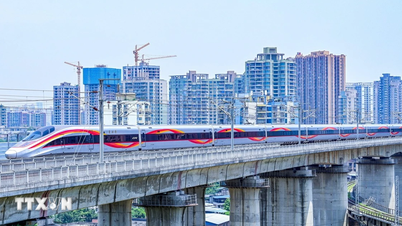
From there, I propose three solutions. First, it is necessary to expedite the implementation of Decision 358/QD-TTg on eliminating unauthorized access points, with the mandatory condition that alternative access roads or underpasses must be built before closure.
Subsequently, the regulations under the 2025 Railway Law need to be amended to include a requirement to install obstacle detection sensors at high-traffic level crossings.
Furthermore, the North-South high-speed railway line currently under preparation for investment must be designed without any level crossings from the outset. In particular, an inter-agency guideline is needed to clearly define whether level crossing guards on duty are considered to be performing their official duties, ensuring consistent application of the law nationwide.
When a violation of ethics is repeated nationwide, involving diverse groups of people and geographical locations, over many years, it is no longer a matter of individual morality.
This signals that the system's design is forcing people into a situation where they are compelled to violate the law or pay with their lives. The primary responsibility in such cases does not lie with the road users. It lies with the agency that issued the regulations, approved the plan, and allocated the budget.
Source: https://tuoitre.vn/an-toan-duong-sat-khong-the-trong-vao-y-thuc-20260420222316538.htm
![[Image] Pleasant weather helps students enter the 10th grade entrance exam with confidence.](https://vphoto.vietnam.vn/thumb/1200x675/vietnam/resource/IMAGE/2026/05/29/1780034401612_ngay-1-thi-lop-10-minh-duy-8-5009-jpg.webp)
![[Photo] Ba Lang An Lighthouse - the "eye of the sea" amidst the "rock museum" of Quang Ngai province.](https://vphoto.vietnam.vn/thumb/1200x675/vietnam/resource/IMAGE/2026/05/29/1780038698840_anh-man-hinh-2026-05-29-luc-14-10-42.png)
























































































Comment (0)