

Poland says it will not immediately stop providing weapons to Ukraine, but will continue to implement previously agreed-upon agreements.
"Poland will deliver shipments of weapons and ammunition in accordance with previously reached agreements, including contracts signed with Ukraine," Polish government spokesman Piotr Muller said today.
The Polish government's statement came a day after Prime Minister Mateusz Morawiecki said he would halt arms aid to Ukraine to focus on building its defense capabilities, amid escalating tensions between the two countries over agricultural exports.
Commenting on Prime Minister Morawiecki's statement, Polish Minister of State Property Jacek Sasin said that grain tensions do not mean Poland will stop supporting Ukraine in its war with Russia, but Warsaw needs to replenish its arms reserves.
"Poland's interests must come first. We cannot disarm the Polish army, nor can we get rid of weapons essential to our security," Sasin said.
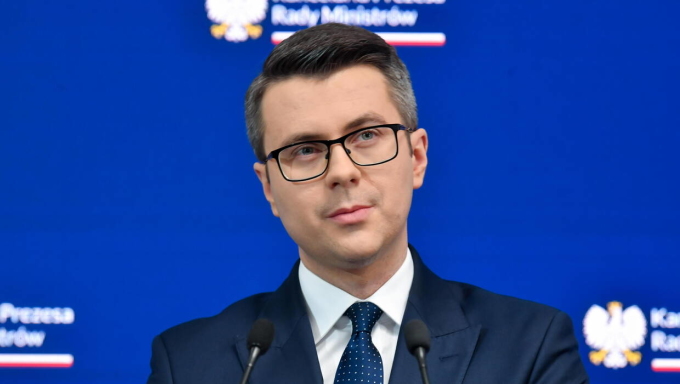
Polish government spokesperson Piotr Muller. Photo: PAP
Spokesperson Muller's statement indicated that Poland would not immediately cut off arms supplies to Ukraine. Minister Sasin also stated that the country had tried to assist in the transfer of weapons to Ukraine, "so we have nothing to blame ourselves for."
Poland has been one of Kyiv's most ardent supporters since Russia launched its war in Ukraine in late February 2022 and is one of the main arms suppliers to its neighbor. Poland has supplied Ukraine with T-72 tanks, armored vehicles, artillery, and other weapons.
In addition to supplying weapons from its domestic stockpiles, Poland is also a crucial transit country for arms shipments that the US and its Western allies are sending to Ukraine. Poland has also hosted approximately one million Ukrainian refugees.
Relations between Warsaw and Kyiv have escalated in tension after Poland unilaterally maintained its ban on Ukrainian grain imports last week, despite the European Commission announcing the lifting of the ban imposed in May. Hungary and Slovakia also protested the European Commission's decision.
In May, the EU imposed a ban on Ukrainian agricultural exports to five neighboring countries – Poland, Bulgaria, Romania, Hungary, and Slovakia – to protect local farmers. Under the ban, four Ukrainian agricultural products – wheat, corn, rapeseed, and sunflower seeds – are only permitted to pass through the territories of these neighboring countries if they are to be sold elsewhere.
The grain issue is particularly sensitive for Poland, as the country prepares for a general election next month. The ruling Law and Justice Party currently enjoys strong support among rural voters.
"We were among the first to do a great deal for Ukraine, and that's why we expect them to understand our interests," Morawiecki said on September 20. "Of course, we respect all their concerns, but for us, the interests of the farmers are paramount."
Ukrainian Trade Representative Taras Kachka said on September 18 that Poland's measures would significantly affect Ukrainian exports. Kyiv said it would file a complaint with the World Trade Organization (WTO).
"Putting pressure on Poland in multilateral forums or filing complaints with international courts are not appropriate measures to resolve disagreements between the two countries," the Polish Foreign Ministry warned.
Thanh Tam (According to AFP, Reuters )
Source link

![[Photo] General Secretary and President To Lam presides over a meeting with the Central Organizing Committee.](https://vphoto.vietnam.vn/thumb/1200x675/vietnam/resource/IMAGE/2026/06/03/1780482764658_a1-bnd-4741-3342-jpg.webp)


![[Photo] Secretary of the National Assembly Party Committee, Chairman of the National Assembly presides over the meeting of the Standing Committee and Executive Committee of the National Assembly Party Committee.](https://vphoto.vietnam.vn/thumb/1200x675/vietnam/resource/IMAGE/2026/06/03/1780480353201_ndo_br_bnd-2585-jpg.webp)

















![[Photo] First session of the 14th Congress of the Vietnam Trade Union](https://vphoto.vietnam.vn/thumb/1200x675/vietnam/resource/IMAGE/2026/06/03/1780465947883_ndo_br_img-3852-jpg.webp)



















![[Video] Sunset at Lap An Lagoon – Where the sun sets over the fishing nets](https://vphoto.vietnam.vn/thumb/1200x675/vietnam/resource/IMAGE/2026/05/31/1780192137701_beach-landscape-sea-water-nature-grass-745871-pxhere-com.jpeg)






















Comment (0)