

New impetus for development
History has shown that Bac Ninh and Bac Giang were merged to form Ha Bac province from 1962 to 1996. In 1963, President Ho Chi Minh attended and spoke at the First Congress of the Ha Bac Provincial Party Committee, held in Bac Giang town on October 17, 1963. He instructed: “Today, the two provinces have merged into one. Party members and cadres of the two provinces must absolutely avoid localism. They should not think that one province has been merged into the other. The truth is that the two provinces have merged into one large province of the Democratic Republic of Vietnam. This is a good expansion. The organizational merger is merely a formality. Unity in thought, action, and sentiment is necessary.”
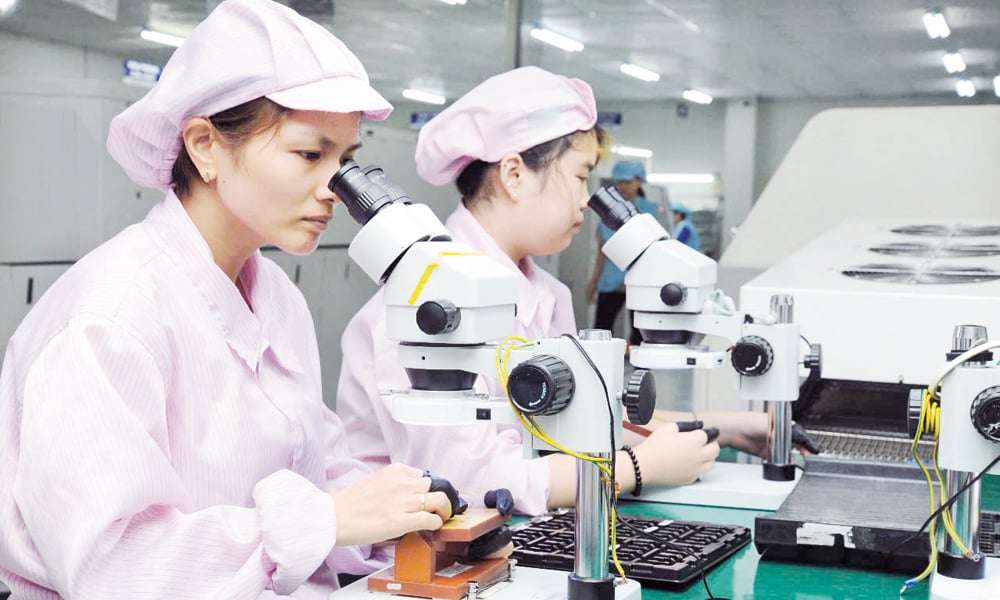 |
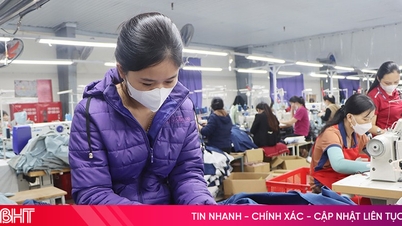
Workers are seen on the production line at Bao Sen Vietnam Co., Ltd. (Song Khe - Noi Hoang Industrial Park). Photo: Doan Anh Tuan. |
On July 1, 2025, the two provinces of Bac Ninh and Bac Giang were reunited once again. The teachings of President Ho Chi Minh resonated, guiding the newly merged Bac Ninh province to "spread its wings" towards the future. This reunification symbolizes the harmonious combination of two regions, two economies , and two cultures, enabling it to accelerate development and become the first centrally-governed city in the country after establishing a two-tiered local government system.
Since their separation in 1997, both provinces have achieved significant accomplishments. Bac Ninh has become an industrial center attracting substantial foreign investment, while Bac Giang has also experienced strong growth, consistently ranking among the top in the country in terms of economic development in recent years. It has become an industrial province with a solid agricultural base and significant potential for tourism and culture.
The new Bac Ninh province covers an area of over 4,700 km², has a population of over 3.6 million people, and comprises 99 commune-level administrative units. The administrative center is located in Bac Giang city, not only because of its favorable geographical location, but also because of the existing infrastructure, including modern administrative buildings. With strong public support (over 98% of voters support it), the new province is being built on a foundation of unity and determination.
Platform for creating momentum
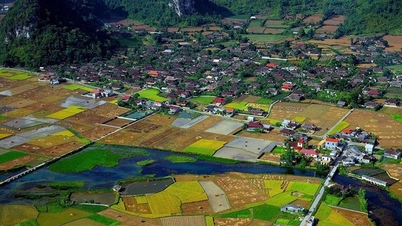
Bac Ninh province, formerly small in area but densely populated and with a strong industrial sector, has now combined with Bac Giang province, which has a larger area, abundant natural resources, and potential for tourism and agriculture. This combination creates a diversified and balanced economy capable of attracting greater investment.
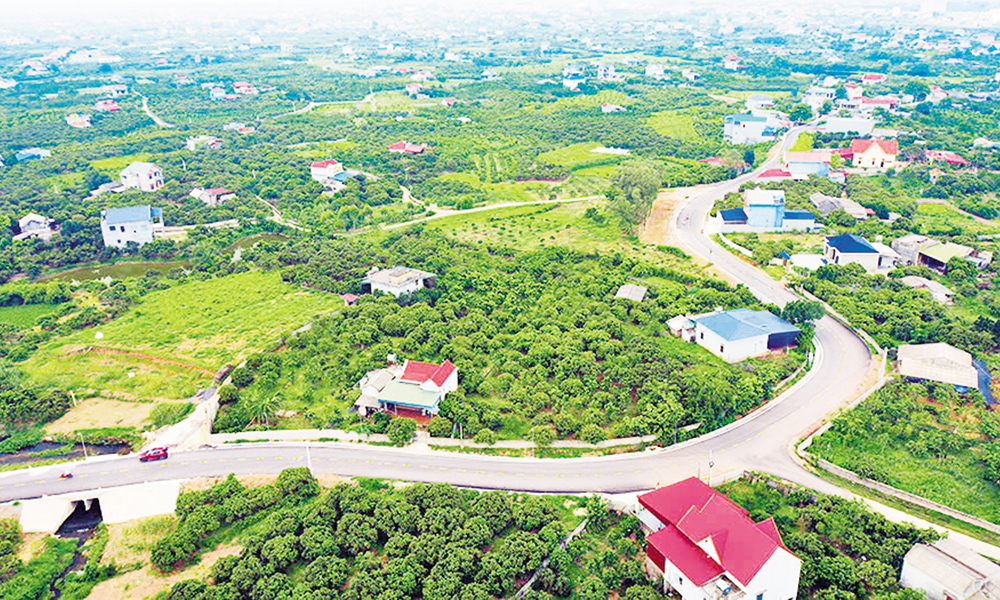 |
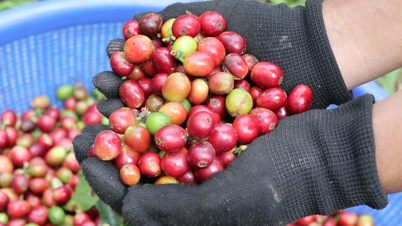
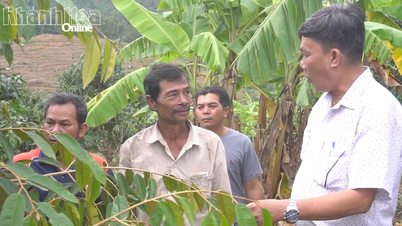
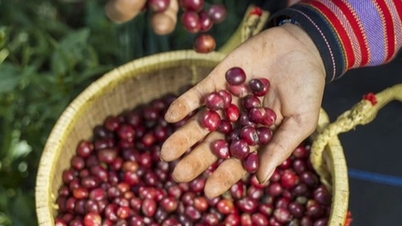
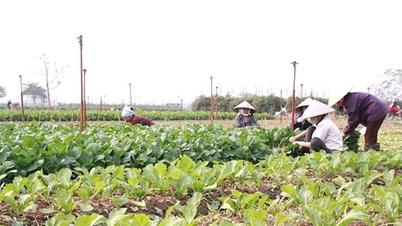
Fruit-growing area in Phuong Son ward. Photo by Viet Hung. |
Former Bac Ninh province leads the country in attracting FDI with nearly $5 billion in 2024, while former Bac Giang province reached $2.04 billion, ranking 10th. This combination will create a new industrial center and growth pole for the Capital Region and the Northern Key Economic Zone.
The former Bac Ninh province is strategically located, serving as a gateway to Hanoi and situated within the Hanoi-Hai Phong-Quang Ninh economic triangle. The former Bac Giang province boasts a favorable transportation location, connecting to major transport arteries such as the Hanoi-Lang Son expressway, Ring Road 4, and international border gates in the North. In 2024, Bac Ninh province is estimated to have a total state budget revenue of over 33 trillion VND and an estimated GRDP of over 221 trillion VND. Similarly, Bac Giang province is expected to have a budget revenue of nearly 20 trillion VND and an estimated GRDP of over 218 trillion VND in 2024.
Following the merger, the new Bac Ninh province became an economic entity with a GRDP of over 439 trillion VND, ranking 5th in the country in terms of economic size, after Ho Chi Minh City, Hanoi, Hai Phong, and Dong Nai. This provides a strong foundation for the new Bac Ninh to become an economic and urban center with strong connectivity and development potential.
Like many other provinces and cities, the streamlining of the administrative apparatus in the former provinces of Bac Ninh and Bac Giang has highlighted many exemplary Party members who are willing to "step down" from their positions, sacrificing their ego and personal interests for the common good. This is especially true for comrades holding key positions in agencies and units who do not have enough time for reappointment. These are comrades who have affirmed their leadership roles and are in a phase of strongly developing their capabilities in their work, yet they willingly resign when the organization needs them. Speaking at the ceremony announcing the establishment of the new Bac Ninh province on June 30, 2025, Provincial Party Secretary Nguyen Van Gau affirmed: "We are confident because we have the strong support of over 3.6 million people of Bac Ninh, always full of determination, working together with the Party committees and authorities at all levels to make Bac Ninh a more prosperous, civilized, and developed homeland."
Reducing the number of administrative units from two provinces to one not only lowers costs but also enhances coordination, minimizes duplication, and improves management efficiency. This is especially important in the context of administrative reform aimed at building a streamlined, effective, and efficient state. After the merger, the new Bac Ninh province reduced 80 commune-level administrative units, achieving a reduction rate of 66.11%, creating conditions for more effective management.
The door opens to the future.
The construction of Gia Binh Airport, a key national project, is one of the gateways to unlocking the development potential of the newly established Bac Ninh province. The project not only has economic significance but also plays a crucial role in national security and defense, contributing to enhancing Bac Ninh's position in the Red River Delta region. The project is progressing rapidly, with the land clearance for phase 1 completed ahead of schedule and construction starting on schedule. Phase 2 is currently under study to upgrade it into an international airport, helping to alleviate congestion at Noi Bai Airport. By 2050, Gia Binh International Airport is planned to handle approximately 3 million passengers and 1 million tons of cargo annually. The airport will operate B777, B787, A350, A321 aircraft, and other specialized and private aircraft. Gia Binh Airport is not just an infrastructure project but also opens the door to comprehensive development.
| In 2024, Bac Ninh province had an estimated total state budget revenue of over 33 trillion VND, and an estimated GRDP of over 221 trillion VND; Bac Giang province had a budget revenue of nearly 20 trillion VND, and an estimated economic size of over 218 trillion VND. After the merger, the new Bac Ninh province became a single economic entity with a GRDP of over 439 trillion VND, ranking as the 5th largest economy in the country, after Ho Chi Minh City, Hanoi, Hai Phong, and Dong Nai. |
Right from the first meeting of the newly established Bac Ninh Provincial People's Committee, Chairman Vuong Quoc Tuan directed relevant units to urgently begin adjusting the provincial planning with projects to build a transportation system connecting Gia Binh Airport with Hanoi and Hai Phong cities, and a logistics center that will create a modern industrial ecosystem; planning a new central administrative urban area aiming to build Bac Ninh into a green, smart, modern, livable city, reflecting the cultural identity of Bac Ninh - Kinh Bac, harmoniously combining tradition and modernity. The vision for 2050 is for the new Bac Ninh to be among the leading localities nationwide in terms of economic scale, becoming a leading high-tech industrial center, research and development center, and smart manufacturing hub in Asia and the world.
The merger of Bac Ninh and Bac Giang into the new Bac Ninh province is opening a new chapter for the development of the Red River Delta region. With its combination of plain and mountainous areas, the new Bac Ninh province is ready to "spread its wings" and become a leading economic, cultural, and urban center of the country.
Source: https://baobacninhtv.vn/bac-ninh-dong-bang-mien-nui-chap-canh-vuon-minh-postid422324.bbg




















































































Comment (0)