

Researchers from Hokkaido University (Japan) analyzed 27 fossilized octopus beak specimens dating back 72-100 million years and made a shocking discovery: Some of them once had bodies up to 19 meters long, not unlike the sea monsters described in mythology.
Octopuses are mollusks, so their bodies are unlikely to be preserved as fossils. However, they do have one sturdy feature: a beak similar to that of a parrot.
That's what Japanese scientists used to study ancient octopus species. They analyzed 15 fossilized octopus specimens preserved in museums and 12 others recently unearthed.
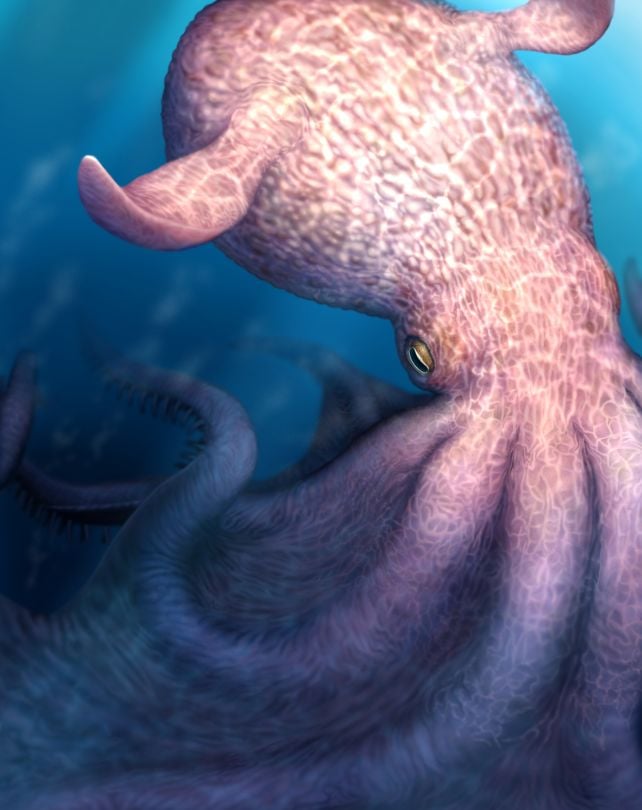
Giant octopus of the Cretaceous period - Graphic image: HOKKAIDO UNIVERSITY
According to the article published in Science , all of these specimens belong to two known species, Nanaimoteuthis jeletzkyi and Nanaimoteuthis haggarti, ancient octopuses that lived during the Cretaceous period, also the golden age of dinosaurs.
From this beak, the authors estimated the animal's body size based on detailed models. The results were shocking: Of the two species, the larger one, Nanaimoteuthis haggarti – whose fossils have been found in Japan and Canada – measured between 7 and 19 meters in length.
To put it into perspective, most estimates of the size of the extinct Megalodon are around 13-18 meters, while the largest known mosasaur reached a maximum size of 17 meters.
The largest living mollusk in the world is the giant squid, which can grow up to 12-13 meters in length, while the largest animal currently is the blue whale, which can be over 30 meters.
With its length and octopus-like body structure, the sea monster Nanaimoteuthis haggarti was almost certainly a top predator in the seas where it once lived.
More dangerously, it may be very intelligent. Some fossils, especially the largest specimens, are more worn on one side, which could be evidence of "handedness," meaning one side of the body is more flexible, similar to humans.
This can only occur in an organism with a well-developed brain and high cognitive abilities.
This new discovery suggests that the giant, cunning "monster octopus" of mythology and films may not be just a figment of imagination.
Source: https://giadinh.suckhoedoisong.vn/bach-tuoc-quai-vat-dai-19-m-lo-dien-o-nhat-ban-1722604280721021.htm


![[Image] Hanoi Police officially crowned champions of V-League 2025/2026](https://vphoto.vietnam.vn/thumb/1200x675/vietnam/resource/IMAGE/2026/05/31/1780244769054_ndo_br_039d561b692be875b13a-jpg.webp)
![[Photo] Solemn bathing ceremony and Buddha procession in Hue](https://vphoto.vietnam.vn/thumb/1200x675/vietnam/resource/IMAGE/2026/05/31/1780228263543_1-jpg.webp)
![[Photo] The General Secretary, President and his wife begin their state visit to the Philippines.](https://vphoto.vietnam.vn/thumb/1200x675/vietnam/resource/IMAGE/2026/05/31/1780230559452_anh-man-hinh-2026-05-31-luc-19-28-11.png)
![[Photo] Admire the coral "masterpiece" amidst the million-year-old heritage of Dak Lak province.](https://vphoto.vietnam.vn/thumb/1200x675/vietnam/resource/IMAGE/2026/05/31/1780221235105_anh-man-hinh-2026-05-31-luc-16-53-27.png)













![[Video] Sunset at Lap An Lagoon – Where the sun sets over the fishing nets](https://vphoto.vietnam.vn/thumb/340x192/vietnam/resource/IMAGE/2026/05/31/1780192137701_beach-landscape-sea-water-nature-grass-745871-pxhere-com.jpeg)



































![[Photo] Admire the coral "masterpiece" amidst the million-year-old heritage of Dak Lak province.](https://vphoto.vietnam.vn/thumb/402x226/vietnam/resource/IMAGE/2026/05/31/1780221235105_anh-man-hinh-2026-05-31-luc-16-53-27.png)





























Comment (0)