

The digital space is expanding rapidly.
Over the years, Quang Ninh has been one of the localities that has strongly invested in digital infrastructure, considering it a crucial foundation for building a digital government, digital economy , and digital society. The province's telecommunications infrastructure has been gradually modernized and expanded to almost all residential areas, urban areas, industrial zones, tourist areas, and remote regions. The entire province currently has 5,827 mobile communication base stations; the 4G coverage rate reaches approximately 99.6% of the population. The 5G network has been deployed with 677 stations, concentrated in key urban areas, industrial zones, and tourist areas, achieving coverage of about 94% of the population. The percentage of households with access to fiber optic internet services is approximately 97.74%.
On that foundation, state management activities, public service provision, electronic transactions, learning, telemedicine, cashless payments, and online shopping are becoming increasingly common. People have more opportunities to access information, use digital services, and participate in socio-economic activities in the online environment.
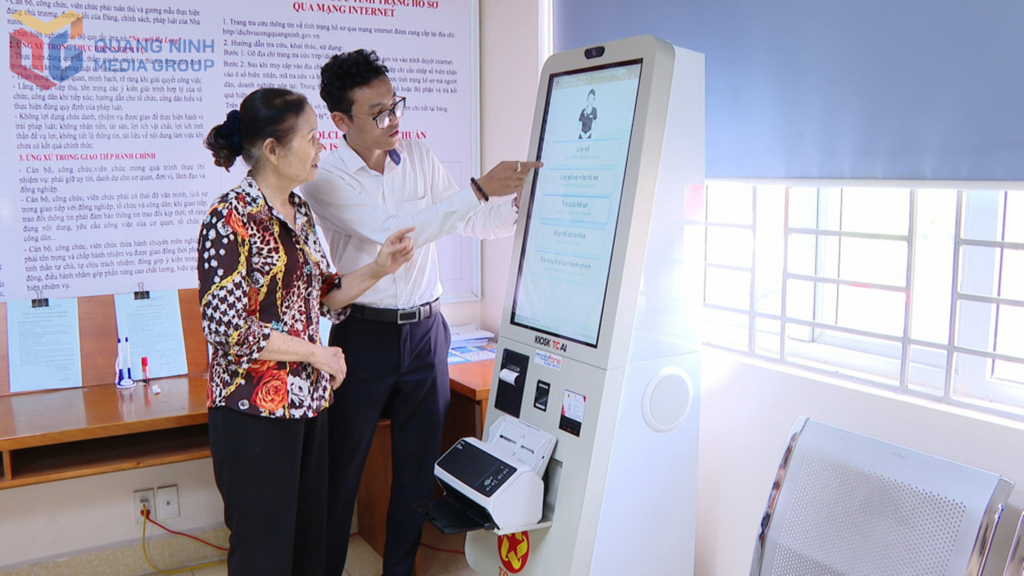
The infrastructure serving Party and State agencies is also ensured to be synchronized. Agencies are connected to a dedicated data transmission network; the online video conferencing system remains stable down to the commune, ward, and special zone levels; and the LAN/WAN network infrastructure operates smoothly. This is a crucial condition for the province to effectively operate e-government and digital government, especially in the context of the two-tiered local government model which places higher demands on connectivity, sharing, and the rapid and secure processing of information.
Inheriting the information technology infrastructure from the e-government and smart city development project, Quang Ninh continues to effectively utilize shared systems. Currently, the province has three data integration centers, including the Provincial Data Integration Center (IDC) which operates the entire e-government system; along with the Party Data Center at the Provincial Party Committee and the Data Center of the Provincial People's Committee Office. The IDC, managed by the Department of Science and Technology, is invested according to Tier 3/TIA-942 standards, ensuring continuous, safe, and stable operation. The center maintains important shared systems such as document management and administration, administrative procedures, the electronic portal, and official email; while also providing infrastructure for many information systems of departments, agencies, and localities.

Along with infrastructure, digital data development is also a priority for the province. To date, the province has completed 90 out of 104 databases, reaching approximately 86.5%, basically covering all areas of state management. Some key databases have initially proven effective, such as the education database with 100% digital student records; the civil registration database with over 1 million digitized records; the health database with over 1.3 million electronic health records, reaching approximately 97% of the population; and the database for officials, civil servants, and public employees with over 31,000 synchronized accounts.
Quang Ninh has also connected and integrated with 15 central government systems and databases; deployed a provincial-level data integration and sharing platform; and completed a shared data warehouse and data analysis platform. Data is gradually being standardized according to the principles of "accuracy, completeness, cleanliness, viability, consistency, and shared use," better serving management, administration, and socio-economic development.
The rapid development of digital technology and the internet has opened up a vast information space, facilitating access to knowledge, social connection, and promoting development in many fields. With its wide coverage, rapid dissemination, and diverse forms of expression, digital transformation helps Party and government leadership at all levels to be more effective and efficient, enhancing transparency, strengthening closer ties, reducing corruption, and creating a healthy social environment. Digital transformation also strengthens interaction between the Party, the State, and the people, thereby consolidating and enhancing trust and responsibility among individuals, creating opportunities for citizens to participate in the management, supervision, and decision-making processes of public agencies.
In the work of protecting the Party's ideological foundation, digital transformation promotes innovation in activities implemented in practice. Because with modern technologies, we can build and organize many diverse activities and products, meeting the diverse needs of the community and adapting to the new demands of society.
Identifying the challenges
Along with opportunities, the digital age also poses numerous challenges to the protection of ideological foundations, especially in the face of increasing misinformation, distorted narratives, and subversive activities in cyberspace. Furthermore, as digital infrastructure expands, digital data grows rapidly, and interconnected systems become increasingly complex, the risk of information insecurity also increases. If data protection is not strictly implemented, hostile forces and high-tech criminals can exploit vulnerabilities to steal information, disseminate harmful content, and even create fraudulent schemes and manipulate public sentiment in cyberspace. This not only causes financial losses but also creates public confusion and undermines social trust. Therefore, digital transformation must go hand in hand with digital security. Expanding the digital space must simultaneously strengthen the capacity for protection within that space. This is a crucial condition for digital transformation to serve development while contributing to maintaining the Party's ideological stronghold.
In the process of digital transformation, high-tech crimes are increasing in number and sophistication. Notably, perpetrators are exploiting cyberspace to spread malicious information, distorting the Party's guidelines and policies, and the State's laws; inciting extremist ideologies and causing public panic. They often use fake accounts, create closed groups, employ anonymity software, and host servers abroad to conceal their identities and entice users to share false information. These tactics are usually carried out secretly, but their impact is significant. The perpetrators often exploit complex cases and issues of public concern to make assumptions, generalize, and sow seeds of doubt. The ultimate goal is to erode public trust in the Party, the State, and all levels of government.

Along with subversive ideological activities, crimes against social order and security in cyberspace are also becoming increasingly complex. Most common are online fraud schemes aimed at stealing property. Common scenarios include impersonating police officers, bank employees, or delivery personnel; scamming people into financial investments or cryptocurrencies; hijacking social media accounts to obtain loans; and sending fake links to steal personal information, causing significant economic losses. According to a report by the Ministry of Public Security at the national scientific conference held at the Police Academy on December 29, 2025, from 2020 to 2025, more than 24,000 cases of online fraud occurred, causing nearly 40,000 billion VND in losses. These figures show that cybercrime is no longer a distant threat but has directly impacted social life.
In Quang Ninh, authorities have also detected and handled many cases of fraud exploiting cyberspace. For example, on March 21, 2026, the Criminal Police Department (Provincial Police) dismantled a criminal ring operating across multiple provinces, using Facebook to create numerous fan pages for livestreaming and soliciting people to participate in "fundraising" and "betting on behalf of others" activities, promising 100% winnings. The perpetrators staged fake winning transactions to gain trust, tricked victims into transferring money, and then cut off contact. From February 2025 until their discovery, this group carried out nearly 2,000 fraudulent transactions, appropriating billions of VND from numerous victims nationwide. The Quang Ninh Provincial Police Investigation Agency has initiated a criminal case and prosecuted the suspects involved for further investigation and legal action.
This incident serves as a clear warning about the risks in cyberspace. With just a simple offer of "high returns," "guaranteed wins," or "sure-profit investments," many people can become victims. When personal data is leaked and risk assessment skills are limited, cybercriminals can more easily devise sophisticated scams.

According to Mr. Nguyen Lam Viet (Deputy Director of VNPT Quang Ninh), the risk of information theft often stems from easily overlooked "blind spots." These include people, processes, and technology. Users lacking knowledge of information security are easily deceived through phishing attacks; revealing passwords, sharing passwords, providing OTP codes, or clicking on suspicious links can create opportunities for malicious actors to infiltrate the system.
In agencies and organizations, officials and employees use information systems daily. If individuals lack the habit of protecting their accounts and official data, and do not adhere to security procedures, even a small oversight can affect the entire system. This is a point that needs special attention, as many management, operational, and document processing activities are now conducted in a digital environment. Technologically, software, integrated platforms, and end-user devices such as personal computers, smartphones, cameras, and IoT devices, if not strictly controlled, can become gateways for cybercriminals. In terms of procedures, if access control, data backup, account management, and incident handling are not clearly defined, the risk of information insecurity remains ever-present.
More worryingly, hostile and reactionary forces both domestically and internationally are thoroughly exploiting the internet to collect state secrets for their dark political schemes. Statistics from relevant agencies show that in the past 10 years, more than 1,000 cases of leaking state secrets have been discovered. Besides cases of deliberate leaking of state secrets that have been severely punished by law, there are still many cases of information leaks stemming from negligence, lack of vigilance, lack of understanding of digital technology, weak infrastructure and equipment, limited security technology, etc. This is a "lucrative opportunity" for hostile forces to exploit and undermine the country. This has, to varying degrees, negatively impacted the thinking and awareness of a segment of cadres, Party members, and the people; causing confusion, suspicion, and a decline in trust in the country and the Party's leadership.
Identifying the right challenges is the first requirement for finding the right solutions. For Quang Ninh, digital transformation is a crucial driving force for development. However, digital transformation is only sustainable when it is accompanied by safety, security, and trust. This is also the basis for the province to continue implementing solutions to ensure cybersecurity and information security, contributing to maintaining the Party's ideological foundation in the new situation.
Source: https://baoquangninh.vn/bai-1-cuoc-chien-khong-tieng-sung-tren-khong-gian-so-3409739.html



![[Photo] General Secretary and President To Lam presides over a meeting on preparations for the review of one year of operation of the three-tiered government system.](https://vphoto.vietnam.vn/thumb/1200x675/vietnam/resource/IMAGE/2026/06/02/1780391821195_a1-bnd-4595-9717-jpg.webp)


































































































Comment (0)