

During a recent National Assembly session, Representative Le Hoang Anh ( Gia Lai ) expressed concern about the long-standing problem of misdirected credit flow. He suggested that the government should implement solutions to control speculative real estate lending using market mechanisms, rather than relying on administrative orders.
In addition, delegate Le Hoang Anh proposed the early implementation of financial instruments related to land, focusing on efficient use. Specifically, land use fees could be linked to the time it takes to put the land into operation; a progressively increasing fee could be applied to projects delayed for more than 24 months; and progressive taxes and fees could be applied to houses and land from the second property onwards that are not put into use or leased.
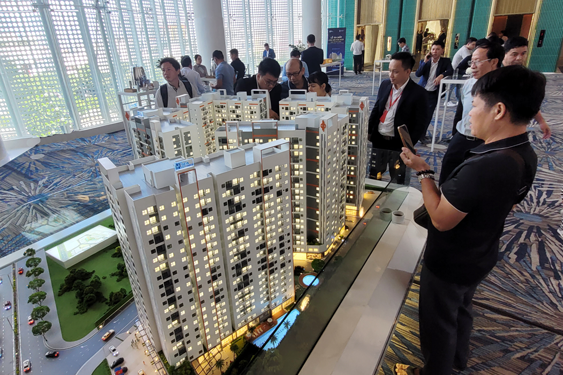
Some argue that taxing second properties may not be enough to impact those who own multiple properties. (Photo: TAN THANH)
"Revenue from these policies should be prioritized for the development of social housing, the renovation of old apartment buildings, and investment in essential urban infrastructure, thereby contributing to restoring land to its true value," Representative Hoang Anh emphasized.
The aforementioned proposal has generated mixed opinions from real estate owners, businesses, and industry experts. Many argue that the tax measure may not be sufficient to impact those who own multiple properties, as most have strong financial resources and purchase numerous houses and land for investment and business purposes. The tax costs will accumulate on the selling and renting prices, burdening buyers or renters. In that case, those with genuine housing needs will be the most affected.
Furthermore, some argue that the sudden imposition of taxes could cause a "psychological shock," disrupting transactions and affecting the goal of stabilizing the real estate market. Mr. Vo Hong Thang, Deputy General Director of DKRA Group, believes that taxing second properties is a positive measure in the long term, but it needs to be implemented rationally and with a suitable roadmap.
"Implementing this policy abruptly would not be good for the economy . This is the right time to discuss and develop a plan before implementation. If not implemented carefully, this policy could have a significant impact on the real estate market and the macroeconomic situation," Mr. Thang expressed his concern.
Dr. Tran Viet Luong, Deputy Director of the Vietnam Real Estate Market Research and Evaluation Institute, said he agrees with applying real estate tax as in international practice. However, the approach needs to be designed to suit domestic realities.
Mr. Luong argued that while many countries apply different tax rates to real estate, relying solely on the criterion of "second home" for taxation is inaccurate. "A second property, if put into business, pays taxes, and creates jobs, is an investment activity, not an idle asset," he explained.
According to Mr. Luong, the essence of tax policy should focus on asset value and efficiency of use, rather than treating assets equally based on quantity. High-value properties exceeding certain thresholds or those that do not generate new cash flow should be subject to taxation. Meanwhile, for those owning second properties in rural areas with low value, applying a rigid tax would become a burden on the people.
This expert proposed applying a tax mechanism based on the length of real estate ownership to curb short-term speculation. Tax policies need to be flexible according to different market contexts to ensure fairness and effectiveness. "A roadmap and thorough preparation are necessary. Without a suitable data system and management platform, implementation will be difficult for the public and easily lead to negative reactions. Real estate tax should aim for social balance, therefore it must be designed rationally and in line with reality," Mr. Luong emphasized.
Mr. Le Hoang Chau, Chairman of the Ho Chi Minh City Real Estate Association (HoREA), said he had previously proposed taxing houses and land based on the length of ownership as a tool to control speculation, short-term trading, and abandoned real estate. Accordingly, if real estate is transferred within 6 months, the tax rate could be 5%; reduced to 4% for ownership periods of 6-12 months; and further reduced to 3% and 2% for ownership periods of 1-2 years and over 3 years, respectively.
According to Mr. Chau, this solution can be applied flexibly during periods of significant volatility in the real estate market.
Source: https://nld.com.vn/ban-khoan-khi-danh-thue-luy-tien-tu-nha-dat-thu-2-196260423201121711.htm
![[Image] Hanoi's urban life under the challenge of a "scorching hot" environment](https://vphoto.vietnam.vn/thumb/1200x675/vietnam/resource/IMAGE/2026/05/25/1779706979265_nang-nong-t5-2026-minh-duy-7-4636-jpg.webp)





































































































Comment (0)