

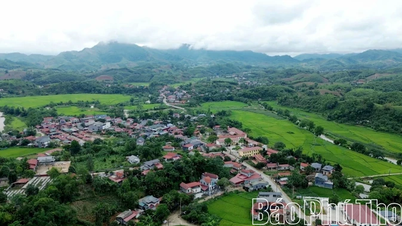
The once terrifying mountain trail that wound through the forest to the village, a major obstacle to travel and trade for the locals, has now been replaced by a smooth, winding concrete road that follows the verdant hills. The dilapidated shacks with their faded thatched roofs have gradually been replaced by sturdy, solid houses... On the way to the village, we occasionally encountered trucks parked at the foot of the hills, waiting for the villagers to harvest cinnamon and transport it down to the lowlands. The national power grid has reached the village, dispelling the silence and desolation that descends upon this highland region at night...
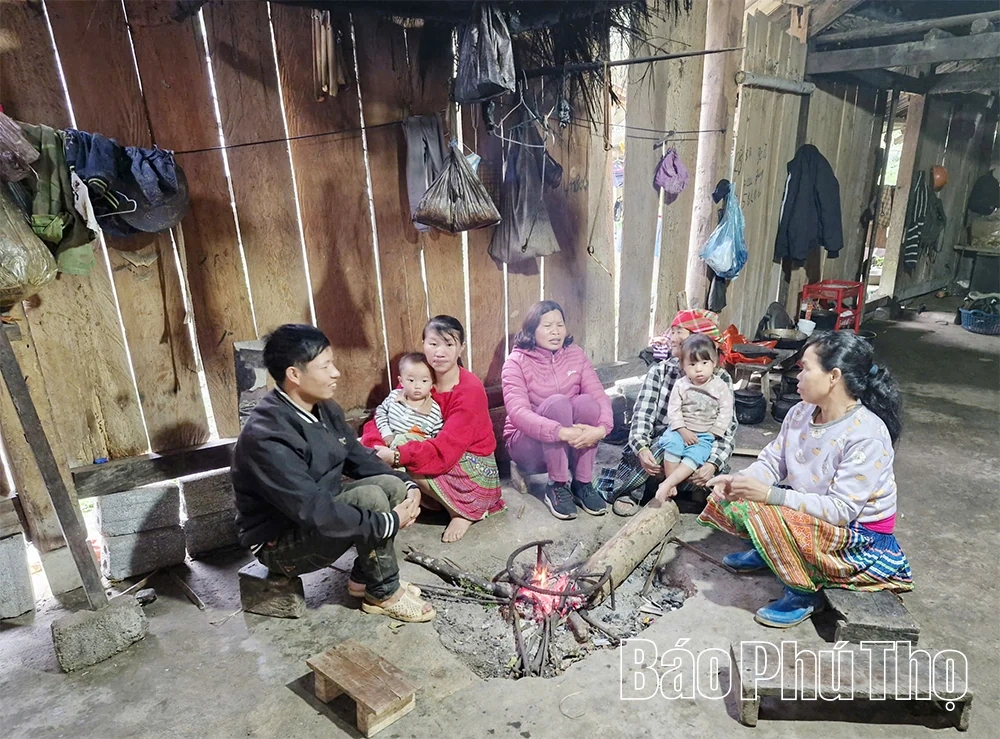
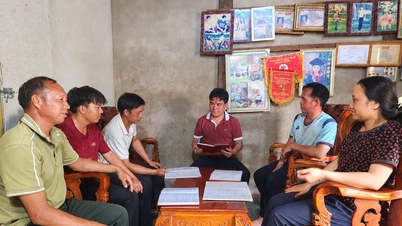
Party Branch Secretary Dinh Thi Linh (sitting in the middle) educates households about the dangers of child marriage and consanguineous marriage.
In her small, three-room, two-wing house, still smelling of fresh paint, Ms. Dinh Thi Linh, the Party branch secretary, had just sold 1.2 hectares of cinnamon trees to supplement the funds for her new home. Ms. Linh shared: “Since the road was opened and the national power grid reached our community, it has not only shortened distances and illuminated the village, but also made it easier for us to access information, policies, and guidelines from the Party and State, and to apply scientific and technological advancements to production.” Pouring a cup of green tea brewed with cinnamon leaves from her backyard, Ms. Linh recounted the story of how the people here first established their village and how they escaped poverty.
Exactly 30 years ago, the village of Nhồi had only 5 households of Muong and Dao people who had come to clear land, and 5 households of Mong people who had migrated from Suoi Giang, Yen Bai province (formerly). They built huts, tilled the land, cultivated fields, and planted rice; they had children and established the village. The people of Nhồi mainly live by farming and forestry; however, agricultural land is scarce. The entire area has nearly 6 hectares of rice paddies, averaging a few acres per household for two harvests, with the recent rice yield reaching 250 kg/acre; 1.5 hectares of corn for food security and livestock; and 200 hectares of production forest, mainly planted with cinnamon and other timber trees. The village has 16 buffaloes and cows; 150 pigs, nearly 3,800 poultry, and 2 hectares of water surface for fish farming. The protective forest has not been encroached upon, and no forest fires have occurred. People of working age often leave home to find work in remote areas, taking on menial jobs that require physical strength, such as construction laborers, painters, and carpenters.
Deep inside the village, along the winding roads on the slopes of Dat Hop mountain, what used to be only 5 households has now grown to 46 Mong households with 281 people. Although the Party and Government have shown concern and provided opportunities for the Mong people here with buffaloes, cows, pigs, chickens, rice seeds, cinnamon trees, and acacia saplings to develop the economy and alleviate poverty, poverty still largely persists due to outdated customs such as: having many children, child marriage, and backward farming practices. Today is also the day that Party Secretary Dinh Thi Linh is visiting the village to educate the people about not child marriage and not marrying within the family.
Ms. Linh shared: "There was a case where a Hmong couple, who were very close cousins, fell in love, so the commune and neighborhood officials had to educate, persuade, and convince them to prevent consanguineous marriage." I remember around the end of 2020, Ms. Linh took me to Mr. Ly A. H's house to advise his family against early marriage. At that time, Mr. H's daughter, Ly T. L, was only 14 years old. Thanks to the efforts of the officials, Mr. H finally married his daughter off in 2024. This demonstrates the care and support of the entire political system, combined with the sound policies of the National Target Program for socio-economic development in ethnic minority and mountainous areas, which has helped unleash internal strength and create a new impetus, changing the mindset, way of thinking, and practices of the people here. Nothing is more gratifying than seeing the lives of the villagers improve day by day. A recent review revealed that the village now has 30 poor households and 3 near-poor households, mostly Hmong people. Outdated farming practices and mindsets have changed. Many households have invested in developing services, transportation, and livestock farming, creating stable and high incomes.
Having endured countless hardships and struggles, from living scattered across high mountain ranges, generations struggling by the dim light of oil lamps, burdened by the fear of hunger and poverty, this remote village has now welcomed a new dawn of vitality, prosperity, and well-being. This achievement is the result of the people's efforts, the hard work of Party committees and authorities at all levels, and Party members who have successfully implemented policies and resolutions on socio-economic development in this challenging land.
Thuy Hang
Source: https://baophutho.vn/ban-xa-don-nang-ve-244063.htm




![[Video] Sunset at Lap An Lagoon – Where the sun sets over the fishing nets](https://vphoto.vietnam.vn/thumb/1200x675/vietnam/resource/IMAGE/2026/05/31/1780192137701_beach-landscape-sea-water-nature-grass-745871-pxhere-com.jpeg)








![[Video] Sunset at Lap An Lagoon – Where the sun sets over the fishing nets](https://vphoto.vietnam.vn/thumb/800x450/vietnam/resource/IMAGE/2026/05/31/1780192137701_beach-landscape-sea-water-nature-grass-745871-pxhere-com.jpeg)










































![[Video] Sunset at Lap An Lagoon – Where the sun sets over the fishing nets](https://vphoto.vietnam.vn/thumb/402x226/vietnam/resource/IMAGE/2026/05/31/1780192137701_beach-landscape-sea-water-nature-grass-745871-pxhere-com.jpeg)




























Comment (0)