

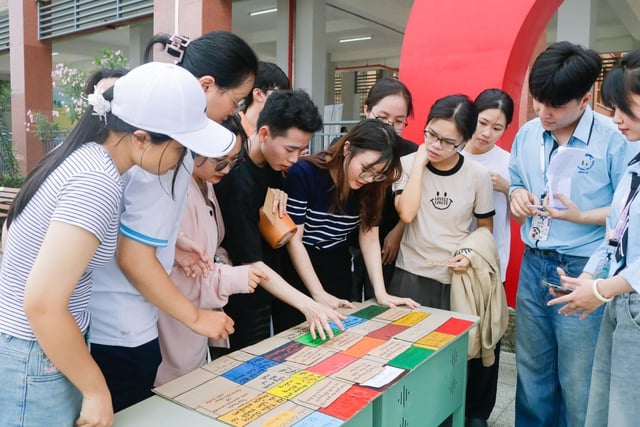
Students learn about a green living activity.
PHOTO: PROVIDED BY THE SUBJECT
More and more initiatives and products are emerging that help promote a green lifestyle.
As a Vietnamese delegate who has participated in international exchange programs on the topic of environment and sustainable development, Ms. Nguyen Minh Huyen (Ho Chi Minh City) shared that the practice of green living among young people is significantly different from 2-3 years ago. For example, when asked "Are you living green?", instead of being confused about the standards of green living, young people now measure their carbon footprint (the total amount of greenhouse gases an individual emits through daily activities, transportation, etc.) using free tools.
Or, when choosing environmentally friendly products, instead of trusting advertisements, young people now thoroughly investigate the business from the raw material collection stage to the finished product to determine if it is truly "green" or just a greenwashing tactic (spreading false information to appear environmentally responsible when in reality they are not). "They have better receptiveness, evaluation, and critical thinking skills," Ms. Huyen said.
Looking at the bigger picture, Ms. Huyen believes that Vietnam is increasingly developing initiatives and products that promote a green lifestyle and sustainable development. Furthermore, Vietnam is one of the Asian countries with a strong commitment to Net Zero (zero net emissions), pledging to reduce emissions by 43.5% by 2023 and achieve Net Zero by 2050. "We are in a favorable position to promote green transition," Ms. Huyen concluded.
However, it's necessary to acknowledge the reality that in developing countries like Vietnam, people are using many convenient, single-use products that are certainly not sustainable. In comparison, a developed country like Japan, although they also consume a lot of single-use plastic, has processes that require the participation of all parties, such as how to clean them before disposal, how to recycle them, etc., according to the female delegate.
"This is a bottleneck that Southeast Asian countries haven't been able to address effectively," Ms. Huyen observed. "Many young people unconsciously support greenwashing by consuming products that are considered sustainable but are actually not, such as cloth or paper bags, because these products consume a large amount of electricity and water."
Therefore, the key message the female delegate wanted to convey to the students was "consume in moderation," striving to extend the lifespan of personal items and limiting single-use. Because continuous waste disposal not only puts pressure on natural resources like water but also increases the amount of materials needed to process them.
Addressing the students, Ms. Huyen advised them to find motivation to maintain a green lifestyle. This could be the desire to access more opportunities for studying abroad and international exchange, as up to 50% of current exchange programs are said to be on the topic of sustainable development; it could also be the desire to change the face of their hometown... "Start with a small action like choosing an item you use only once, for example, a coffee cup, and find a replacement for long-term use. Make green living a habit, something programmed into you...", Ms. Huyen shared.
Green living extracurricular activities
Beyond simply practicing a green lifestyle, young people, especially students, are also contributing to spreading the spirit of sustainable development to their peers. A prime example is the University of Social Sciences and Humanities (Vietnam National University Ho Chi Minh City), which initiated the "Green University" program in 2018, divided into three phases and expected to last until 2030.
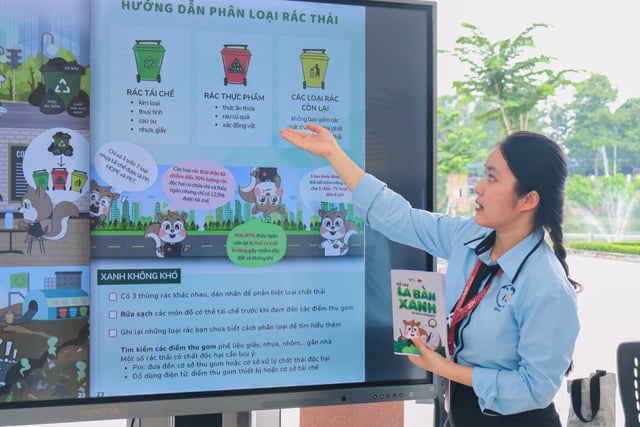
The Green Compass Handbook is published by the University of Social Sciences and Humanities (Vietnam National University Ho Chi Minh City).
PHOTO: NGOC LONG
Most recently, on June 30th, the university published a handbook on sustainable living practices called "Green Compass" to help students understand in detail the core knowledge about sustainable development and green living; build green habits through small actions while still students; learn about environmental protection organizations and activities; and find useful advice from their teachers.
What makes this handbook special is that it was created entirely by students under the guidance of an advisory board consisting of school leaders and industry experts. Based on the information in this handbook, the University of Social Sciences and Humanities in Ho Chi Minh City organized its first ever "Green Living" festival with the theme "Weaving Green," attracting a large number of young people to participate in a series of activities from morning to afternoon.
Nguyen Minh Thu, a second-year student in the International Relations department at the University of Social Sciences and Humanities in Ho Chi Minh City and head of the organizing committee for the event, shared that the activities were planned and organized in a rush within about three weeks. The name "Green Weaving" signifies both connecting and spreading a green lifestyle, and alludes to promoting sustainable fashion, especially since fast fashion – a trend harmful to the environment – is extremely popular among young people.
"Weaving hope, greening the future – that's the message we want to convey," Thu said.
To realize this aspiration, the student said the event was structured with three main activities: a green living exhibition "Weaving Healthy Land," a station-based event "Weaving Green Feet," and a talk show "Unfinished Weaving" about sustainable fashion. Each main activity also included smaller activities so that participants could not only observe and listen but also directly interact to gain a deeper understanding of green living and sustainable development, Thư explained.
One notable aspect of the event, according to Thu, was that the students didn't bring any plastic items. Furthermore, participants listened attentively to the speakers' presentations, and almost no one used their mobile phones. These signs partly indicate that young people are genuinely interested in a green lifestyle, rather than just viewing it as a slogan on paper.
"It's not just you guys who have changed; I've changed too. Now I minimize my use of plastic as much as possible, and this has spread to my friends," Thu said.
Source: https://thanhnien.vn/bang-cach-nao-luu-y-gi-de-bat-dau-song-xanh-185250630235336841.htm

![[Photo] Solemn bathing ceremony and Buddha procession in Hue](https://vphoto.vietnam.vn/thumb/1200x675/vietnam/resource/IMAGE/2026/05/31/1780228263543_1-jpg.webp)
![[Photo] The General Secretary, President and his wife begin their state visit to the Philippines.](https://vphoto.vietnam.vn/thumb/1200x675/vietnam/resource/IMAGE/2026/05/31/1780230559452_anh-man-hinh-2026-05-31-luc-19-28-11.png)

![[Photo] Admire the coral "masterpiece" amidst the million-year-old heritage of Dak Lak province.](https://vphoto.vietnam.vn/thumb/1200x675/vietnam/resource/IMAGE/2026/05/31/1780221235105_anh-man-hinh-2026-05-31-luc-16-53-27.png)
















![[Video] Sunset at Lap An Lagoon – Where the sun sets over the fishing nets](https://vphoto.vietnam.vn/thumb/340x192/vietnam/resource/IMAGE/2026/05/31/1780192137701_beach-landscape-sea-water-nature-grass-745871-pxhere-com.jpeg)






































![[Photo] Admire the coral "masterpiece" amidst the million-year-old heritage of Dak Lak province.](https://vphoto.vietnam.vn/thumb/402x226/vietnam/resource/IMAGE/2026/05/31/1780221235105_anh-man-hinh-2026-05-31-luc-16-53-27.png)





























Comment (0)