

Lesson 1: Bringing national policies and culture closer to the Khmer people.
As part of Vietnam's revolutionary press, Khmer-language newspapers in Southern Vietnam emerged during the resistance against foreign invaders in two areas with large Khmer populations. They met the propaganda needs of wartime conditions, such as the propaganda bulletins in Soc Trang and the Khmer-language version of the Tra Vinh Newspaper. Currently, most localities with large Khmer populations in the Mekong Delta have Khmer-language newspapers to convey the Party and State's policies and guidelines to the Khmer people. This has significantly contributed to preserving and promoting the Khmer language, writing system, and cultural identity.
A bridge to help bring ethnic policies into practice.
Throughout the revolutionary leadership process, the Party and State of Vietnam have always paid attention to ethnic minorities, including the Khmer people, as demonstrated through sound and comprehensive policies. The content of ethnic policies has become increasingly diverse and far-reaching, meeting the needs of Khmer officials, monks, and the people, creating positive socio -economic changes and ensuring security and defense stability in the region. The Khmer-language press system has consistently supported all levels and sectors in disseminating information, encouraging, and motivating the Khmer people and monks to actively participate in the successful implementation of these policies.
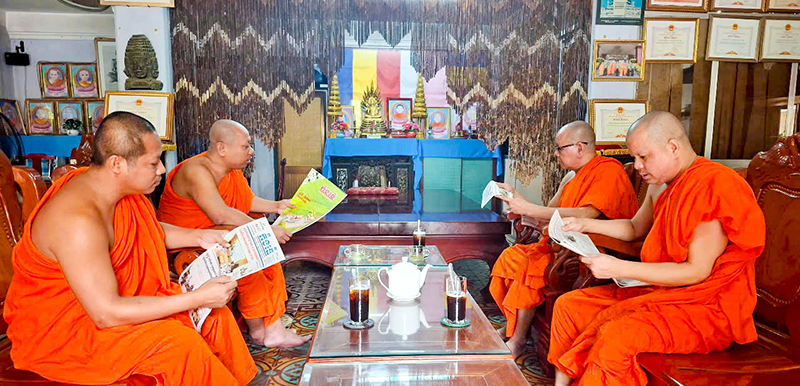
The monks often read the Can Tho Newspaper in Khmer to stay informed and disseminate the Party and State's policies and guidelines to the Khmer ethnic community. Photo: Ma Lai
Soc Trang province has over 30% of its population belonging to the Khmer ethnic group. The province has invested in the "Improving the Quality of Khmer Language Broadcasting Programs" project: 3 billion VND per year for the 2018-2020 period; and 5 billion VND per year for the 2021-2025 period… The Khmer language program of the former Soc Trang Radio and Television Station was highly appreciated for its rich content. According to Mr. Nguyen Van Trieu, Editor-in-Chief of the Soc Trang Provincial Radio and Television Station, the Khmer language broadcasting program focuses on improving the quality of current affairs news. The Soc Trang Radio and Television Station also added many special topics: Ethnic Groups and Development, Gender Equality, Prevention of Child Marriage, Soc Trang - My Homeland, Policies for Ethnic Minorities…
Tra Vinh province also has over 30% of its population belonging to the Khmer ethnic group, so the Tra Vinh Provincial Radio and Television Station dedicates significant time to Khmer-language radio programs, with a duration of 135 minutes per day. Specifically, the morning broadcasts are from 6:30 AM to 7:15 AM; midday from 10:30 AM to 11:15 AM; and evening from 6:00 PM to 6:45 PM. Mr. Ky Chane Do Ra, Deputy Director of the Tra Vinh Provincial Radio and Television Station, stated: Through television, radio, and social media platforms of Tra Vinh Television (Facebook, YouTube) in Khmer, the Tra Vinh Provincial Radio and Television Station has worked with the Party Committee and government to concretize the content and bring resolutions to the Khmer people. In particular, Khmer-language media in Tra Vinh always closely follows the practical activities and events related to economic development, national security and defense, and socio-cultural issues among the Khmer people. Therefore, it essentially meets the needs of readers, viewers, and listeners who are members of the Khmer ethnic group.
The Khmer-language Can Tho Newspaper, with 8 pages of content, officially launched on April 16, 2007, and was distributed to over 600 Khmer temples, border guard posts, ethnic boarding schools, etc., in the Mekong Delta, where a large Khmer ethnic population lives. On December 22, 2007, the online version of the Khmer-language Can Tho Newspaper, integrated into the official Can Tho online newspaper, was launched globally.
According to the Editorial Board of Can Tho Newspaper, since its inception, the Khmer-language Can Tho Newspaper has continuously improved its form and content to become more accessible to its readers. The Khmer-language Can Tho Newspaper consistently adheres to the principles and objectives of a Party newspaper, with practical and relevant propaganda orientations that resonate with the vast majority of its readers, including monks, students, officials, intellectuals, and influential figures within the Khmer ethnic community. In particular, the Khmer-language Can Tho Newspaper maintains its distinctive ethnic character, focusing on disseminating the policies and laws of the Party and State to the people. Through this, it reflects the material and spiritual lives of the Khmer people in Southern Vietnam, encourages labor and production movements, and contributes to strengthening their trust in the Party and State. Mr. Thach Rich, Vice Principal of the Southern Intermediate Pali Cultural Supplementary School, said: "Reading the Can Tho Newspaper in Khmer language allows us to learn about the economic, social, cultural, educational, and health aspects of life in the Khmer ethnic minority areas of the Mekong Delta, where a large Khmer population lives. The Can Tho Newspaper in Khmer language is widely read by Khmer monks, intellectuals, and scholars in the Mekong Delta."
Besides disseminating information on ethnic policies and guidelines, Khmer-language newspapers also participate in responding to the opinions of religious leaders, monks, influential figures, and various segments of the Khmer ethnic community. Venerable Truong Huong, Vice Chairman of the Association of Patriotic Monks and Nuns of Tra Vinh Province, stated: Thanks to the information disseminated by Khmer-language newspapers and radio, the Khmer ethnic community has become more conscious and responsible in complying with the law and changing their ideological perceptions. Through newspapers and radio, the people can express their thoughts and aspirations to the authorities so that the State and local governments can make appropriate adjustments to socio-economic development.
Preserving community culture, language, and beliefs.
A prominent feature of Khmer culture is that, among Vietnam's ethnic minorities, they possess their own distinct and relatively complete language (spoken and written). Furthermore, throughout their existence and development, the Khmer people of Southern Vietnam have continuously created cultural values and traditional festivals related to their ethnic groups and religions. Therefore, in addition to its role in communicating policies, Khmer-language newspapers also contribute to preserving culture and language, thereby building trust within the Khmer community. Mr. Nguyen Van Trieu, Editor-in-Chief of Soc Trang Newspaper and Radio Station, stated: "Most entertainment programs in Khmer-language newspapers feature Dù kê, Rô băm, and Khmer music and dance performances... In recent years, Soc Trang Newspaper and Radio Station has successfully organized the Khmer Folk Song Festival of the Mekong Delta region; and the Khmer Music and Dance Festival of Southern Vietnam." The Dù kê and Rô băm theatrical excerpts festival of the Mekong Delta region features over 1,000 artists and artisans of Khmer ethnicity from the provinces of Tra Vinh, Kien Giang, An Giang, Bac Lieu, Ca Mau, and Soc Trang... This contributes to preserving and promoting the unique cultural identity, spreading the distinctive cultural values and national pride of the Khmer people in Southern Vietnam.
Mr. Chau Kim Son, a retired official in O Lam commune, Tri Ton district, An Giang province, said: “I used to worry that the 'di ke' art of the Khmer people in O Lam would fade away. But recently, a TV station came to film it and broadcast it on television and YouTube... Then this art form was recognized as a National Intangible Cultural Heritage. Thanks to that, our descendants know how to preserve it, learn to sing and dance again... Not only that, during major festivals of the Khmer people, such as the bull racing in the Bay Nui region of An Giang during the Sene-Dolta festival, the Ngo boat racing in Soc Trang, Tra Vinh, Bac Lieu… during Ok-Om-Bok…, Vietnamese and Khmer-language newspapers all report extensively, even broadcasting live with commentary in Khmer for the people to follow. Khmer-language newspapers have contributed to introducing, preserving, and promoting the beautiful culture of ethnic minorities in general, and the Khmer people in particular. It is very valuable and worthy of respect!”
In the Khmer-language Can Tho Newspaper, the "Translation Exchange" section occupies one-quarter of page 7 and has been maintained from the first issue to the present. Mr. Thach Rich, Deputy Principal of the Southern Intermediate Pali Cultural Supplementary School, said: "The 'Translation Exchange' section regularly updates new and difficult words and quotes appropriate translations in context – very useful for students and teachers of the School in studying, researching, and teaching the Khmer language…". Mr. To Do from Thanh Phu commune, My Xuyen district, Soc Trang province, shared: "I often follow both the old Soc Trang Radio and Television Station and the Khmer-language Can Tho Newspaper. I am very proud that the Party and State not only care about investing in the development of the lives of the Khmer people but also care about the unique characteristics of the Khmer ethnic group. Khmer-language newspapers not only help people keep up with current events and changes in the villages but also play an important role in preserving the spoken and written language of the Khmer people." From then on, the Khmer people became even more proud of their ethnic group and worked together to build increasingly prosperous and beautiful villages."
***
Over the years, Khmer-language journalism in Southern Vietnam has continuously developed in both form and content. The number of newspapers and broadcasting stations using the Khmer language has expanded. Infrastructure and technology have been gradually modernized. The number of Khmer-language journalists has generally increased, and their enthusiasm and professional skills have steadily improved. The types of journalism have become increasingly diverse: print newspapers, online newspapers, radio, television, etc. The development of revolutionary Khmer-language journalism to this day is thanks to the dedication and passion of Khmer ethnic journalists.
Khmer-language reporting team of Can Tho Newspaper
(To be continued)
Article 2: Dedicated Khmer Journalists
Source: https://baocantho.com.vn/bao-chi-tieng-khmer-o-dbscl-dong-hanh-with-doi-song-dong-bao-khmer-a187571.html


![[Photo] Prime Minister Pham Minh Chinh attends the Conference on the Implementation of Tasks for 2026 of the Industry and Trade Sector](/_next/image?url=https%3A%2F%2Fvphoto.vietnam.vn%2Fthumb%2F1200x675%2Fvietnam%2Fresource%2FIMAGE%2F2025%2F12%2F19%2F1766159500458_ndo_br_shared31-jpg.webp&w=3840&q=75)












































































Comment (0)