

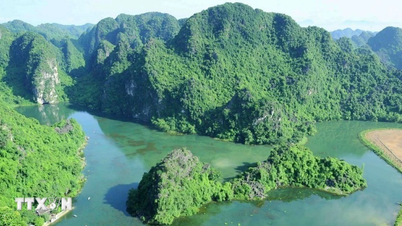
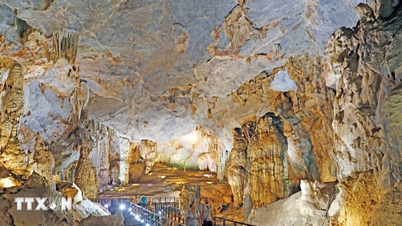
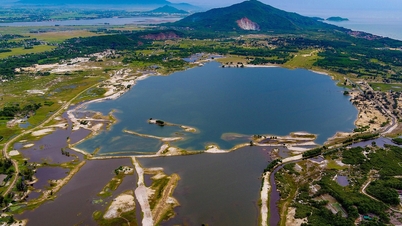
The Ngo Dong River is a small river flowing through the cave system in Tam Coc, Ninh Hai commune (Hoa Lu district). It possesses a unique beauty, making it an attractive destination for tourists. Currently, the protection of the ecological and landscape value of the Ngo Dong River is receiving attention from all levels and sectors, contributing to the enhancement of the value of the Trang An Scenic Landscape Complex, a World Cultural and Natural Heritage site.
Along both banks of the Ngo Dong River, lush green rice fields stretch out like a silken ribbon. Furthermore, the Ngo Dong River is a favorite destination for many migratory birds. The image of the gentle river winding through the mountains, the abundant vegetation, and flocks of birds diligently foraging in the majestic mountain landscape, gives visitors the feeling of stepping into a fairytale with its pristine, natural beauty.
Ms. Nguyen Thi Phuong Hoa, a tourist from Hanoi, said: "This is my first time visiting Tam Coc. I was very surprised by its pristine beauty, with majestic mountains and a river flowing through a system of caves, which gave me a wonderful feeling. You have preserved the environment very well, developing tourism while always respecting the natural conditions. The scenery is so poetic; I will definitely come back." Over the years, the unit managing and exploiting tourism in the Tam Coc-Bich Dong tourist area has always focused on protecting the ecological environment of the Ngo Dong River.
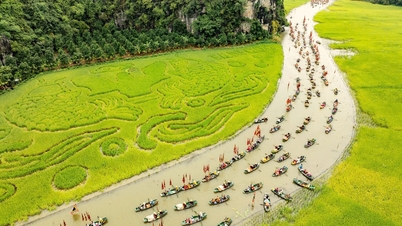
Since 2018, the Tam Coc rice field has been built on the Ngo Dong River as a highlight of Ninh Binh Tourism Week, aiming to promote and introduce the unique and attractive features of Ninh Binh, affirming its brand and position as a safe, friendly, high-quality, and attractive destination for domestic and international tourists.
Mr. Dang Ngoc Thien, a tour guide at the Tam Coc-Bich Dong tourist area, said: "I have worked here for over a year now, and I find this place very beautiful and peaceful, creating excitement for both the staff and tourists visiting Tam Coc-Bich Dong. Therefore, I actively promote the unique values of the Ngo Dong River in the Tam Coc-Bich Dong tourist area so that visitors can have an enjoyable experience."
Ms. Pham Thi Que, head of the sanitation and environmental team at Tam Coc Bich Dong Tourist Area, said: "Our team has 7 people, and every day we carry out the task of collecting trash and algae in the Tam Coc boat dock area and on the Ngo Dong River, maintaining the river's ecosystem to protect the landscape and create a beautiful environment for tourists visiting Tam Coc-Bich Dong."
According to research, the Ngo Dong River was formed entirely naturally due to the geological processes of the Trang An Heritage area. Therefore, harmonizing the interests of tourism development with the preservation of the landscape, environment, and natural conditions within the heritage area is crucial. Preserving the landscape and natural conditions of the Ngo Dong River in conjunction with tourism development will further enhance the value of the Trang An World Cultural and Natural Heritage site.
According to Mr. Nguyen Cao Tan, Deputy Director of the Department of Tourism: The Ngo Dong River, along with the Sao Khe River and the Den Voi River, are three rivers flowing through the Trang An Scenic Landscape Complex, a World Cultural and Natural Heritage site. Flowing through this heritage site on a limestone bedrock, besides the currently visible river, millions of years ago there were also rivers flowing at an altitude of 60-100 meters above the current water level. These were caves xuyên through the mountains, such as the Trong Cave and To Vo Cave, visible along these river routes. Gradually, the river deepened, now flowing through three caves (Cave Ca, Cave Hai, and Cave Ba), with rice fields on both sides of the river reflecting ancient agricultural practices, creating a beautiful and fascinating landscape. Furthermore, there are many historical traces of humanity, from caves containing traces of prehistoric people to traces of the Northern Domination period, the Dinh Dynasty, and especially the culture of the Tran Dynasty. Recently, through archaeological research and excavations, we have discovered very distinctive architectural structures from the Tran Dynasty, reflecting legends and historical events that are indeed true, from the establishment of gardens and ponds, to the old royal court, to the Thai Vi Temple—all hallmarks of Tran Dynasty culture associated with the Vu Lam Royal Palace and the formation of the Truc Lam Zen sect.
All those cultural values, combined with the landscape and the traditional rice-growing culture of the community in the S-shaped rice fields along the Ngo Dong River, have become the unique brand and identity of Tam Coc tourism. The Ninh Binh Tourism Department is developing a project to restore relics related to the Vu Lam Royal Palace, related to Emperor Tran Nhan Tong's renunciation of worldly life, and to reconstruct architectural works based on excavated structures. Along with light projection technologies and interpretations of heritage values, this will become a tourist destination. At the same time, the protection of the Ngo Dong River landscape needs to be further strengthened in the future through restoration, a plan to relocate scattered households in the area; improving the environmental landscape to ensure the natural ecosystem; and creating unique agricultural products with distinct characteristics and value to attract tourists to Tam Coc and develop sustainable tourism.
Tien Minh
Source
![[Photo] General Secretary and President To Lam presides over the meeting to approve the draft report on the results of the second inspection by the Politburo of the Standing Committee of the Hanoi City Party Committee.](https://vphoto.vietnam.vn/thumb/1200x675/vietnam/resource/IMAGE/2026/05/26/1779789811432_a2-bnd-4430-9620-jpg.webp)


































































Comment (0)