

(NLĐO) - One of the most gruesome mummies ever found by humanity in ancient Egyptian tombs has just undergone a special examination.
A research team led by archaeologist Lidija McKnight from the University of Manchester (UK) conducted an examination of a gruesome mummy using modern techniques, allowing them to explore its interior without damaging the mummy itself.
It was a monstrous mummy, larger than a human mummy, representing a period when the mummification techniques of the ancient Egyptians reached their peak.
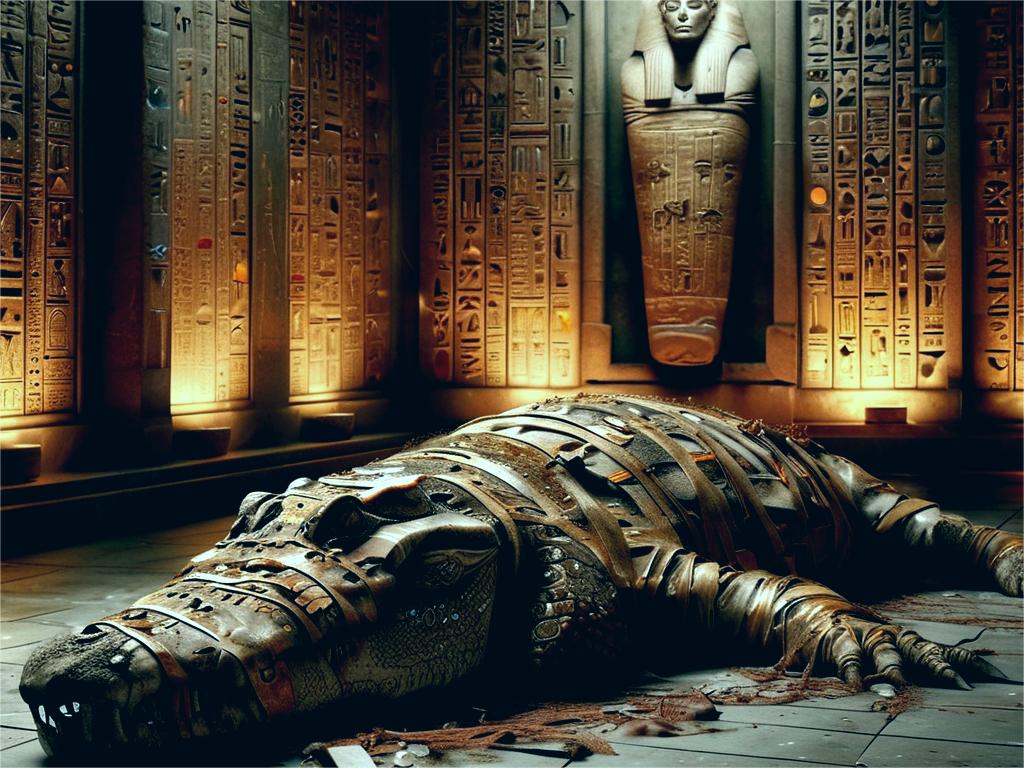
2005.335 is one of the most terrifying artifacts left behind by the ancient Egyptians in their ruins: a mummified crocodile - Photo AI: Anh Thu
The mysterious mummy, catalog number 2005.335, is currently housed in the Birmingham Museum and Art Gallery (England) and was once identified as a 2.2-meter-long crocodile.
Researchers found no documents explaining where this fearsome crocodile came from or how it ended up in the museum, only that it could be up to 3,000 years old.
In this study, Dr. McKnight and colleagues used state-of-the-art 3D imaging technology to examine the crocodile in order to shed light on the final hours of its life and the circumstances of its death.
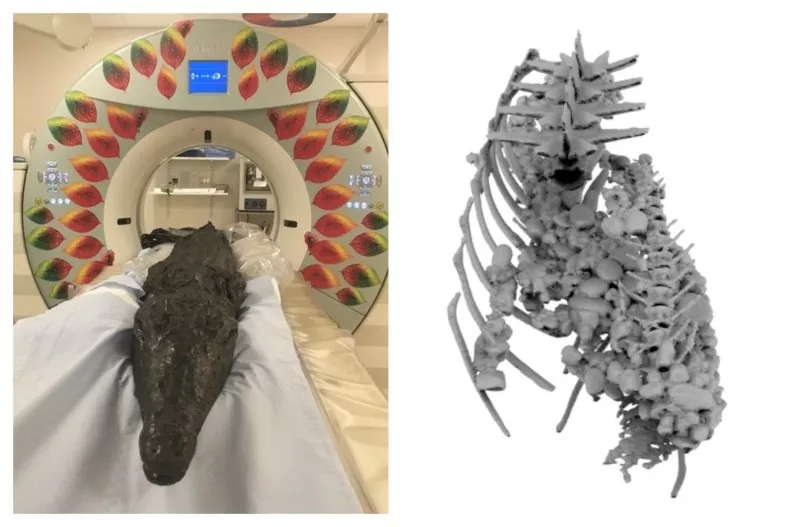
Mummy 2005.335 during examination and a 3D image showing part of the digestive tract - Photo: BRIMINGHAM MUSEUM
"The research has revealed surprising details about the life and post-mortem treatment of this animal," Dr. McKnight told Newsweek.
The scans revealed the presence of a fish, attached to a brass hook, which the crocodile appeared to have swallowed whole, with its skeleton almost completely intact.
According to researchers, swallowing the hook may have caused the crocodile's death.
Other details inside the digestive tract—for example, a large number of small stones called gastroliths concentrated in the upper part of the digestive tract—suggest that the animal died before the fish reached its stomach.
Crocodiles often swallow small stones like these to aid their digestion.
The brief time between the fish being swallowed and the crocodile's death suggests that the ancient Egyptians may have used baited hooks to catch the reptile with the intention of mummifying it from the start, rather than mummifying it only after it died.
In that situation, the crocodile was mummified to be used as an offering in some kind of ritual.
It's also possible that the crocodile's death was an accidental incident while these ancient Egyptians were fishing. According to this theory, it was mummified because it was revered.
In fact, the ancient Egyptians worshipped this large reptile as a representation of Sobek, the lord of the Nile.
As top predators, crocodiles were respected for the threat they posed, and their symbolism was believed by the Egyptians to ward off danger and protect sacred places from negative influences.
Regardless of the reason for its embalming, 2005.335 remains a symbol of ancient beliefs as well as incredible embalming techniques. The crocodile was remarkably well-preserved even after the white ice was removed, despite having survived 3,000 years.
Mummified remains of several other crocodiles and animals such as cats and eagles have been found in Egyptian ruins, but 2005.335 remains a particularly remarkable specimen due to its excellent preservation.
But where it came from remains a mystery.
Source: https://nld.com.vn/bi-an-ben-trong-xac-uop-quai-vat-ai-cap-3000-tuoi-196240718114520517.htm


![[Photo] Prime Minister Pham Minh Chinh attends the Conference on the Implementation of Tasks for 2026 of the Industry and Trade Sector](/_next/image?url=https%3A%2F%2Fvphoto.vietnam.vn%2Fthumb%2F1200x675%2Fvietnam%2Fresource%2FIMAGE%2F2025%2F12%2F19%2F1766159500458_ndo_br_shared31-jpg.webp&w=3840&q=75)



































































































Comment (0)