

A 60-year-old female patient from Ho Chi Minh City had been experiencing loss of appetite and lower abdominal pain for a year. Doctors discovered dozens of polyps in her gallbladder, resembling stalactites.
Ultrasound results from Tam Anh General Hospital in Ho Chi Minh City showed multiple polyps on the gallbladder wall, the largest of which measured approximately 1 cm.
 |
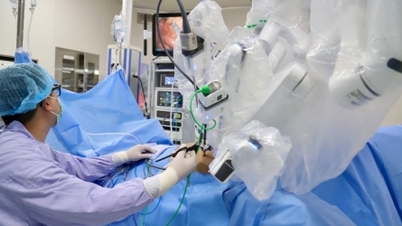
| Illustrative image. |
Dr. Pham Cong Khanh, Head of the Hepatobiliary and Pancreatic Department at the Center for Endoscopy and Endoscopic Surgery of the Digestive System, said the female patient had multiple gallbladder polyps.
Gallbladder polyps come in many types, such as cholesterol polyps, adenomyomatous polyps, inflammatory polyps, and hypertrophic adenomyomatous polyps, with approximately 95% being benign. Of these, cholesterol polyps account for the majority, about 40-70%, and are formed by the deposition of cholesterol adhering to the gallbladder lining.
Multiple, widespread polyps accompanied by gallstones, as in this patient, carry a high risk of developing malignancy. The patient needs early surgery to prevent dangerous complications such as bile stasis, digestive disorders, cholecystitis, cholangitis, and gallbladder cancer. This type of cancer has a poor prognosis due to a low 5-year survival rate.
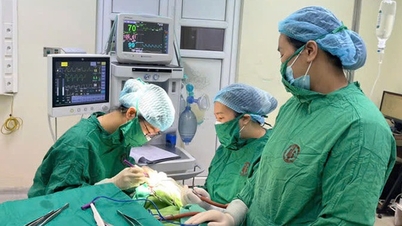
The patient underwent laparoscopic cholecystectomy. After endotracheal intubation under general anesthesia, the surgeon inserted a laparoscope through three small incisions into the abdomen and removed the gallbladder. The removed gallbladder had thin walls and its lumen contained numerous polyps of varying sizes. Post-operatively, the patient experienced no pain, was able to walk and eat well, and was discharged after one day. The pathology report revealed benign cholesterol polyps.
The exact causes of gallbladder polyps are still unknown. Several factors increase the risk, including being over 50 years old, having diabetes, abnormally large polyps, and having gallstones.
Most gallbladder polyps are asymptomatic and are only discovered incidentally during routine health checkups, ultrasounds, MRI scans, or abdominal CT scans. Of these, ultrasound is a non-invasive technique that is quick, painless, safe, and has good sensitivity and specificity for detecting gallbladder polyps.
Typically, gallbladder polyps smaller than 1 cm will not change over many years, and patients only need regular follow-up examinations. Surgical removal of polyps is indicated in cases where the polyp is 1 cm or larger, or a sessile polyp is 0.6 cm or larger, or a polyp of 0.6 cm or larger in individuals over 50 years of age.
The exact causes of gallbladder polyps are still unknown. The gallbladder is a pear-sized organ located beneath the liver, responsible for storing and concentrating bile (bile salts, cholesterol, fats, and bile pigments).
The body then uses bile to break down and absorb the fat. Polyps may form more easily if the fat breakdown process is not functioning properly.
Malignant gallbladder polyps are rare. However, several factors can increase the risk of formation, including being over 50 years old; having diabetes; abnormally large polyp size; having gallstones; and having symptoms of gallbladder polyps.
Symptoms of gallbladder polyps are often nonspecific and unclear, with many cases showing no signs at all. Therefore, this lesion is often discovered incidentally during a medical examination. Some patients with polyps may occasionally experience the following symptoms: vomiting and nausea.
Occasionally, lower abdominal pain may occur due to cholesterol fragments breaking off from the lining, indigestion, and jaundice. Polyps are sometimes identified via abdominal ultrasound, performed when the patient experiences pain in the upper right quadrant. In the absence of other abnormalities, gallbladder polyps are considered the source of biliary colic.
Furthermore, there were no differences in symptoms between patients with benign and malignant polyps. A large retrospective analysis found gallbladder polyps on abdominal ultrasound.
The results were as follows: 64% were diagnosed during treatment for an unrelated illness. 23% had abnormal abdominal symptoms. 13% had elevated liver function test results.
Cholesterol polyps can detach and manifest clinically as gallstones, causing biliary colic, bile duct obstruction, and even pancreatitis. In fact, there have been many reports of polyps causing non-gastr cholecystitis, and even massive bleeding.
Symptoms may be related to polyps such as cholesterol polyps, inflammatory polyps, or hyperplasia, including indigestion, right lower abdominal pain, discomfort, etc.
To prevent gallbladder polyps, health experts advise that people need to change their lifestyle and diet, which can help minimize the formation of gallbladder polyps. This includes avoiding fried or fatty foods; and avoiding foods high in cholesterol and processed foods.
Avoid high-fat milk and sugary drinks. Eat plenty of fruits and vegetables. Increase your intake of Omega-3 fatty acids. Add ginger and turmeric to your daily diet.
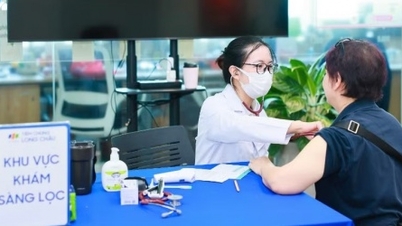
In addition, people should have a regular health check-up once a year or when they experience unusual symptoms. Early detection of gallbladder polyps helps in monitoring and appropriate treatment, preventing dangerous complications.
Source: https://baodautu.vn/bien-phap-nao-phong-chong-polyp-tui-mat-d222361.html

![[Photo] General Secretary and President To Lam presides over a meeting with the Central Organizing Committee.](https://vphoto.vietnam.vn/thumb/1200x675/vietnam/resource/IMAGE/2026/06/03/1780482764658_a1-bnd-4741-3342-jpg.webp)
![[Photo] Secretary of the National Assembly Party Committee, Chairman of the National Assembly presides over the meeting of the Standing Committee and Executive Committee of the National Assembly Party Committee.](https://vphoto.vietnam.vn/thumb/1200x675/vietnam/resource/IMAGE/2026/06/03/1780480353201_ndo_br_bnd-2585-jpg.webp)
![[Photo] First session of the 14th Congress of the Vietnam Trade Union](https://vphoto.vietnam.vn/thumb/1200x675/vietnam/resource/IMAGE/2026/06/03/1780465947883_ndo_br_img-3852-jpg.webp)









































![[Video] Sunset at Lap An Lagoon – Where the sun sets over the fishing nets](https://vphoto.vietnam.vn/thumb/1200x675/vietnam/resource/IMAGE/2026/05/31/1780192137701_beach-landscape-sea-water-nature-grass-745871-pxhere-com.jpeg)






































Comment (0)