


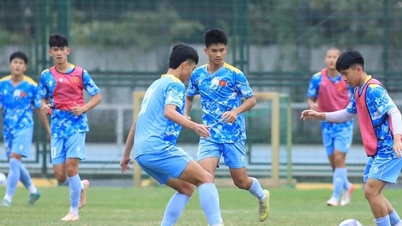
The current U23 team is the first step in the transformation of Chinese football - Photo: AFC
And that is the result of a continuous "learning from experience" journey for Chinese football after a series of painful lessons.
Having a lot of money doesn't necessarily mean it's a good thing.
Just days before their defeat to China, the Vietnam U23 team earned the admiration of the entire football world with an impressive victory against the UAE – a leading football nation in Asia with considerable financial resources. Similar to their national team, the UAE brought a young squad to the U23 Asian Championship, featuring many naturalized players from Africa.
This is the result of a large-scale naturalization strategy that UAE football has been implementing for 10 years. Unable to naturalize players through the use of overseas Vietnamese (like Indonesia, with stars born and raised in the Netherlands), the UAE was forced to choose the policy of naturalizing foreign players who have played in their league for at least 5 years.
The UAE even implemented this policy on an extremely large scale: searching for and recruiting stars under the age of 18. The goal was that when these players became eligible for citizenship, they would still be at the peak of their careers, or even just beginning to enter their peak.
That's why the UAE was able to bring a number of naturalized players to the U23 Asian Championship. But UAE football once again disappointed. They suffered a heavy defeat against Japan in the group stage, couldn't beat the "poor" Syrian football team, and were then eliminated by Vietnam.
Before the UAE, two other wealthy footballing nations, Qatar and Saudi Arabia, were even more disappointing. Compared to Qatar or the UAE, Saudi Arabia has never implemented a naturalization policy. Yet, they are the footballing nation that spends the most on foreign players in the world in their national league.
Every year, superstars like Ronaldo, Benzema, Kante, Mane... cost Saudi Arabian football billions of USD in salaries, plus another billion USD in transfer fees. Yet, the professional level of the Saudi Arabian national teams continues to decline.
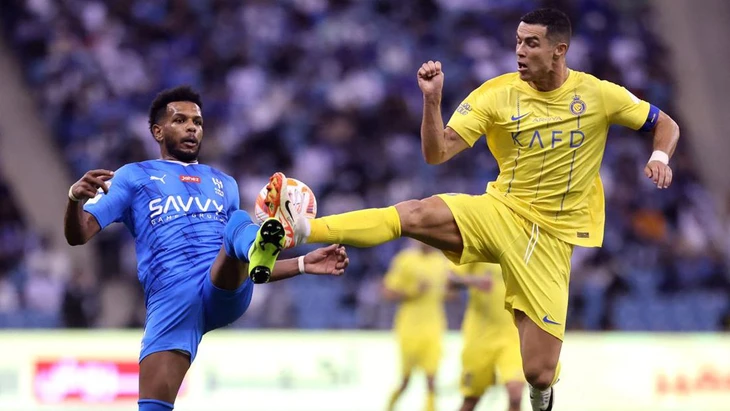
Ronaldo's arrival may not necessarily bring about a resurgence for Saudi Arabian football - Photo: REUTERS
China has learned its lesson from five years ago.
All the pain that football in the UAE, Qatar, or Saudi Arabia is currently experiencing has been felt by the Chinese for five years now. Between 2012 and 2015, Chinese football began investing heavily in foreign players, and then gradually implemented a naturalization policy.
A prime example is Elkeson, the Brazilian striker who rose to stardom in the early 2010s. Shining at Botafogo in Brazil, he was called up to the national team (but never played), and had a great opportunity to play in Europe. But Elkeson followed the lure of money and moved to Guangzhou Evergrande.
Over the next decade, Elkeson thrived in China, scoring over 150 goals in Asian competitions. From 2018, he completed the process of obtaining Chinese citizenship, promising to help Chinese football rise to prominence. However, upon starting to play for China, Elkeson's form declined at the age of 30. In 19 appearances for the Chinese national team, Elkeson scored only 4 goals and has not been called up to the national team for the past two years.
Chinese football has a host of players like Elkeson. This reflects the dark side of using money to buy foreign players and then naturalizing them with the goal of "taking shortcuts." According to statistics, between 2013 and 2020, China spent approximately $10 billion on foreign stars.
But since the 2020s, China has decided to change. Salary regulations have been tightened, making the China Super League no longer a "paradise" for foreign stars. Naturalization policies have also almost completely stopped. And now, the Chinese are returning to their own domestic resources.
The 2026 AFC U23 Championship marks the beginning of a new generation of players, trained since China launched its "2050 World Cup winning project." In this mega-project, the Chinese Football Association aims to become the strongest team in Asia by around 2030 and win the World Cup by 2050.
This project could be considered a failure, but the "foundation" remains. That is the modern football academies, focused on training local talent. China no longer wants to take shortcuts. And that's when a sporting superpower awakens in the football game.
Source: https://tuoitre.vn/bong-da-trung-quoc-dung-len-tu-that-bai-2026012123565588.htm

![[Photo] Standing Committee member of the Party Central Committee Tran Cam Tu working with the Central Inspection Committee](https://vphoto.vietnam.vn/thumb/1200x675/vietnam/resource/IMAGE/2026/05/28/1779969579668_ndo_br_bnd-2495-jpg.webp)




![[Photo] The heat at the fireworks display site on the opening night of the Da Nang International Fireworks Festival 2026](https://vphoto.vietnam.vn/thumb/402x226/vietnam/resource/IMAGE/2026/05/27/1779889741485_ndo_br_z7872039145157-fecaba5112f39e8352544099d7ef4738-5140-jpg.webp)


































































Comment (0)